Storytelling and "Documentation"

One of the things we do to track outcomes at Starfire is to document the day in and day out. Just like a lot of places that serve people with disabilities do (and are required to do), we complete these logs as part of our job description. We are paid to do it. I’ve had to consider many aspects of documentation, as my role has been to report on effective outcomes. I’ve tried to design documentation forms that take into consideration staff time, how it aligns with our work, and perhaps most importantly: the value of these logs to the person they are being written about.

Documentation historically tells very little of the actual story, due to these considerations of convenience for staff and the need to just get it done. Typically, the most amount of writing you’ll see in logs is when something goes wrong. That’s when the full story comes into play. But on “good” days it might look as simple as this: “5pm: John sat on couch watching TV. 6pm: John got up to microwave dinner and took medication. 7pm: John sat on couch watching TV. 8pm: John took a bath. 9pm: John prepared for bed. He had a good day!”

I have to say that after months of reading logs like this at a previous job I had as a caregiver, nothing I read made me proud to work at the agency. Things began to feel flat, the exact opposite of why I got into this work to begin with. People’s lives aren’t supposed to be flat, and we work with people! Another unsettling part was how the person being written about never read their own logs, or contributed to the narrative in any way. For some people, staff were even instructed to wait until they were in bed or out of the room to write the logs (as it would upset them to see staff writing about them).

Harkening back to our March newsletter post, I’d like to share some of Starfire’s documentation. This was written as Megan’s journey to a life she imagined (the first story in the newsletter) began to unfold. Michelle, a staff person at Starfire wrote these (MR), and you can see her enthusiasm and support for Megan as she and Brenda (Megan’s “connector” or bridge in the community) work to find a food pantry near her home where she could volunteer, to find work with the elderly, and continue making friends at the Rec Center near her house where she takes Zumba classes.

Megan’s goals for November: Sort out Connector arrangements

  • Dec 9 Brenda has decided to be Megan’s connector! – MR

Megan’s December goals: Explore volunteer opportunities with Brenda

  • Dec 11 Spoke with Megan’s mom about her opportunity volunteering @ the community rec. center –MR

  • Dec 12 Megan showed me around her neighborhood. I saw her house & where the rec center is. She will be able to walk there once the weather warms up! – MR

January goals: Set up time and day for Megan to volunteer at the rec center. Make driving arrangements

  • Jan 8 ** New Connection: Judy at the neighborhood food pantry. ** Brenda, Megan, Becky & Matt explored Megan’s neighborhood and came across a small food pantry. The lady there showed much interest in Megan, saying she’d like to “pick her brain” on her experience working at CAIN! Megan is on board for working there every week if it can be worked out with her mother & her service facilitator. I see GREAT things coming her way. –MR

  • Jan 14 Megan will be volunteering at the community rec. center every other Tuesday assisting with chair Volleyball. Today was her first day. It went really well! Between the food pantry & the rec center, Megan has the opportunity to make some WONDERFUL connections, right in her own neighborhood. Excited to see everything unravel! – M

  • Jan 30 – It’s been arranged for Megan to do a three week trial of volunteer work @ the food pantry. A woman will be picking her up & dropping her off each week. If she enjoys it enough, she will no longer be in program at Starfire that day each week & will take on the volunteer position there! – MR

I love this part: “I see GREAT things coming her way,” and all the little steps taken as they do come her way. She is “getting out” of the day program Starfire has, and finding her place in community beyond her label of disability. Megan dreamt up this life. She told us the narrative, and we supported her in living it out. Things don’t always happen this fast, or go quite as smoothly, but the important piece is still there: we are supporting people in a story that is of value to them. There are lessons along the way, roadblocks, wrong turns. But it is valuable.

I should mention here too that around the same time as all of this was happening, Megan got engaged to her long time boyfriend. We can’t take any credit for that though. Congratulations, Megan!!

timothyvogt
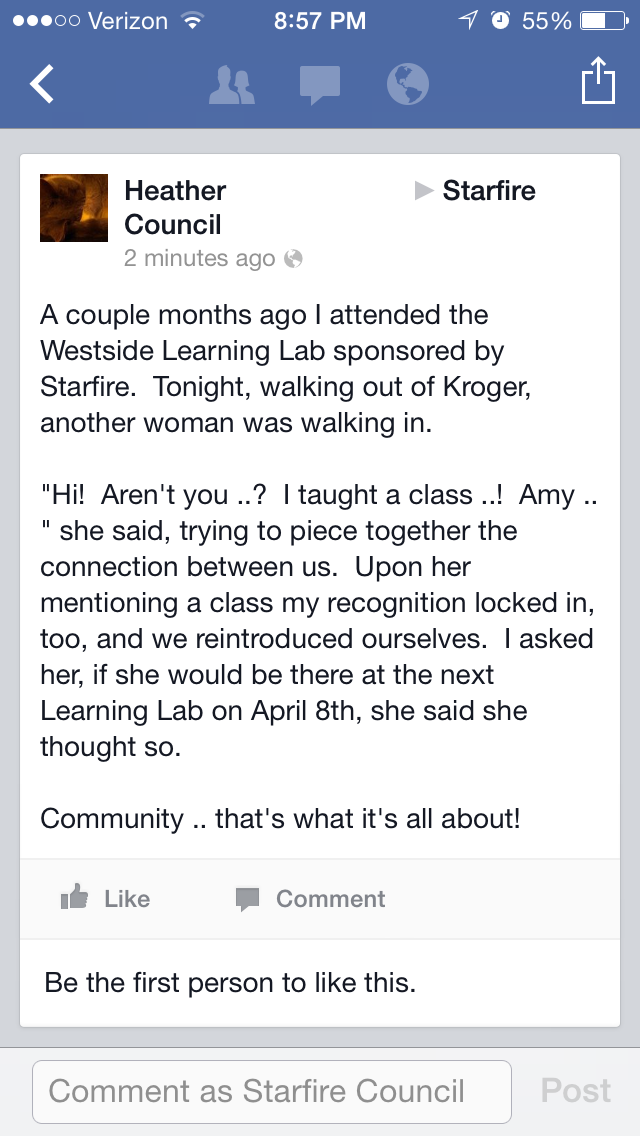
“Community…that’s what it’s all about!”

Heather recently posted to Starfire’s Facebook wall this wonderful reflection about community after attending a Learning Lab in Price Hill and recognizing a neighbor at a local grocery store.

Learning Labs are monthly meet-ups to learn from local citizens. Always FREE and always open to the public!  They’ve been designed for you to learn something of interest to you, or just to meet your neighbors.  Thanks Heather for sharing your neighbor-run in story with us.  We like hearing good stuff going on in Cincinnati!

“Community! that’s what it’s all about!”

If you’ve attending a Learning Lab in Price Hill, Silverton, Northside or the newly formed Bellevue, what has been your experience?  What do you want to learn in the next couple of months?  Who do you know that would make an excellent teacher in your community?

Interested in starting a Learning Lab in your neighborhood?
Drop a line to Candice@starfirecouncil.org

timothyvogt
Building a life one person, one family at a time!

Each month a few of us from Starfire put together a newsletter to send out to about 2,500 subscribers. We try to make it worth the read, and we think we’re getting better at portraying our stories and our message. So we want to start sharing the stories from our newsletter on Cincibility every month, and keep you in the loop about what’s going on at Starfire. Below is our March addition, abbreviated from the original newsletter format for easy digestion! Periodically, I will also post some of our archived newsletters that you may have missed. Enjoy!

Starfire’s march update

One question we’ve been asked lately is:

We think the stories in below can help people understand the “why.” It boils down to people’s value in their community. When people can be known by others while being shown in the best possible light of their gifts and passions, instead of their labels like disability, they can start to be seen as respected and valued citizens, able to contribute.

Here are a few of the reasons why one person, one family at a time is the way to go:

  • More flexibility to strive for each person’s unique goals

  • People become known as people in their communities, and are safer for it

  • Families can get stronger and feel more supported

  • Serving the person, rather than the organization’s needs, is what matters.

Start reading more here and here to learn more about Starfire’s values.

“It means getting off Starfire’s page, and onto the person’s page.”
-Starfire Board Member, Kathleen Cail

building a life

Megan and Linda volunteering together at SEM

Megan has chosen to start coming to StarfireU two days a week instead of four. This choice wasn’t easy, because as she will tell you, she loves Starfire. But Megan also loves volunteering, particularly with the elderly and at food pantries, and told us she doesn’t want her only options at the end of her four years with StarfireU to be attending another day program for people with disabilities. So, with the help of Brenda, a Starfire staff who lives in her neighborhood, Megan has found other opportunities.

First, Megan spoke to the women at SEM, a food pantry in Mt. Washington right down the road from where she lives. She told them about how she volunteered at CAIN, a food pantry in Northside as a StarfireU member. Excited to hear all about CAIN’s model of success, Judy and Linda asked Megan to join as a valuable part of their team. With her prior experience, Megan could jump right in and do the same tasks that all the other volunteers do.

She also sought out a position at the Recreation and Senior Center down the road, where she and Brenda had been attending Zumba classes together. Through her connections, she found a spot volunteering with the elderly, and even carpools to and from with the friends she has made.

As she transitions out of StarfireU’s day program to take on these opportunities in her community, Megan is still being supported by Starfire, and Brenda. The two continue to work together, finding more ways to get deeper ties in her community with the support from her family and neighbors. This is when we know leaving the StarfireU program is the best option for someone like Megan: when our work together leads to a newfound sense of belonging in her community and she is “springing” out of the world of disability day programs, into a good life.

singing, just for the sake of it

Arlene (mom), Jordan, and Brandy (sister) at Sing! Cincinnati night

Jordan loves singing, but until lately, his experiences were limited to watching other people sing on TV at home. Now as a fourth year StarfireU member, he is working on a project called Sing! Cincinnati, based off of the Canadian group Choir! Choir! Choir!. This pop-up community choir brings together anyone who loves to sing to perform a pop song each month, even if you’re not a great singer.

All sort of singers have come out of the woodwork to join Sing! Cincinnati alongside Jordan. Many admit they never had the chance to be part of a choir before. While their regular lives are spent at day jobs at Proctor and Gamble, hospitals, and schools, joining Sing! Cincinnati has linked them into a community of people who love to sing.  As one attendee, Leah Hoechstetter, commented on Facebook after their first event, “That was Total Fun!”

The next Sing! Cincinnati choir event is March 19th at 6pm at the Northside Tavern. If you go:

What should I expect? 
A relaxed, playful choir lesson lasting around 2.5 – 3 hours. A song director will teach you the three part harmonies to a pop song previously selected by the group. You’ll get a song sheet with a breakdown of each harmony to help you. By the end of the night, you will perform the song together for a video that gets posted on YouTube!

How much does it cost?
The entry fee is $5 per person.

Who will be there?
Every month new people join, and some people will become regulars. If you’re new, don’t worry, it’s an open group so you’re not the only one!

What if I can’t sing?
That’s the point! This is a group less concerned with the technical aspects, and more focused on the enjoyment of singing together. And trust us, when everyone’s voices come together, you’ll sound great!

and lastly, don’t miss our Final Four FlyAway this month!

2014_flyaway_banner.jpg

If you’d like to subscribe to our newsletter, follow this link.

timothyvogt
Swimming Upstream

guest post contributed by Kathleen Cail

The other day I called my sister and told her that most of the time, I feel like I am swimming upstream trying to build a truly inclusive community for my daughter.  I told my sister that it is exhausting and it really is. I share my desires with teachers, staff, and other moms.  I send information to teachers and staff about opportunities to learn more about Grace, the person, or about meaningful inclusion. These attempts often seem to fall on deaf ears.  You know what I mean—the emails or messages go unacknowledged, as if maybe I’ll go away, or perhaps it’s the ostrich approach to “burying one’s head in the sand.” Occasionally though, the road less traveled is worth it and there are those golden moments, those amazing people who just like Grace for Grace.

I could have just had Grace spend most of her day in the resource room, with only special education students, but that is not what Grace has experienced throughout her school life, nor is it how she views the world.  Instead, Grace is in the resource room for one subject and all other subjects she is in regular classrooms, with significant modifications.  Grace is probably not learning some of the basic skills she needs, but there is no guarantee that by staying in the resource room, she would be learning some of the important things she is learning in the regular classrooms.  Grace is learning to work in groups, studying subjects that interest her in a way that interests her, and more. Grace is learning social skills in the real world (for good and bad, just like her brother does). She has joined clubs like Yearbook and Key Club.  Has Grace been fully embraced? No. Does Grace have girlfriends who invite her to do things on the weekends or accept her invitations?  Just one and that is inconsistent.  However, Grace has met a young man, with whom she went to homecoming, has seen the movies Frozen and Philomena, and has visited the Newport Aquarium.  Grace and her friend are doing many of the things that high school students do. Most importantly, this young man just likes Grace and thinks she is fun.  Recently, a student stopped me and told me that he sees Grace around the school and is hoping to catch her for lunch in the cafeteria some time.  Neither of these young men would likely even know Grace, were she in the resource room all day.

Last week, Grace introduced a photographer at a talk.  I invited every teacher and administrator in Grace’s school, and even at the district level, to come see Grace in a valued role and to hear this photographer speak about our shared humanity and seeing beauty in people who experience disability.  One teacher acknowledged the invite, but couldn’t make it, one teacher showed up, and most importantly, the superintendent of schools came with his wife and daughter.

It would be great if there were one or two girls who would get to know Grace. It would be great if teachers and staff even acknowledged my attempts to inform them about Grace, or real inclusion. It would have been great if a few more teachers showed up to witness Grace introduce this photographer to over 160 adults and to hear the photographer’s important message.  However, sometimes there are glimmers of hope – two young men who like Grace, because they think she is beautiful and funny, a teacher and a superintendent who show up.  These “glimmers of hope” will sustain me for a while.

timothyvogt
On collaboration, passion and projects

Collaboration

The stories below are what’s coming out of this year’s Collaboration Projects (follow the link and you’ll find a wonderful “How T0” on beginning your own project written by Candice). But, what exactly is a Collaboration Project? It sounds a little non-profit jargony, right? Here’s the gist:

  1. All of our projects begin with a singular person’s passion.

  2. They wind-up as a group of passionate people creating together.

  3. The result, we hope, is that everyone involved feels less socially isolated, more connected, and valued for their (often simple, but unique) contribution.

And in case you’re wondering where we got the term Collaboration from, here’s a little history. The first year we launched these projects at Starfire, we called them “Capstone Projects.” It made sense because it was the member’s last year at StarfireU, our day program, and a Capstone is what many college students do before they graduate. But that sounded too final, like an “end,” when really we see these projects as a beginning to many things: friendship, creation, and imagination. And it takes the work of many. So, we re-named them Collaboration Projects, to signify the ongoing togetherness we are trying to build!

Passion

There’s another term for these projects, maybe you’ve heard of “Passion Projects.” It’s the closest definition we’ve found to our own projects that really makes sense (I’ll be quoting this article a couple more times in this post) :

passion project (or, a collaboration project) doesn’t mean a side business, although it could grow into one. A (collaboration project) is often an indulgence of your deep inner desire to create. A drive to bring your ideas to life, whatever form they may take.”

So, a collaboration project could be a local story slam going on at a coffee shop (Margot’s story), or a pop-up choir group happening at a bar once a month (Jordan’s story), or simply spending time with other sports fans watching games. It could be working with neighbors to start a community garden (Bridget’s story), or starting a walking club (Rachel’s story, to be continued). The point is to embrace that inner part of all of us that wants to create, and to connect:

“Create. Not for the money. Not for the fame. Not for the recognition. But for the pure joy of creating something and sharing it.”

Projects

Margot’s Story

The Cinci Story Slam project is an effort to gather local people with ordinary lives to share their experiences in front of an intimate audience. Unlike the Moth Project, a popular story slam in NYC, the Cinci Story Slam is free, and open to a wide range of storytellers who may or may not have previous experience on the mic. It was through Margot’s love for the stories found in cinema that the story slam project began, and since she and a committee of passionate storytellers have gathered to plan these events. Here are a few of the stories told at the first Cinci Story Slam, themed #itscomplicated, that took place at a local coffee shop in January.

Jordan’s Story

I can often hear songs from the Toronto vocal group, Choir! Choir! Choir!, streaming from Youtube out of Tim’s office in the afternoons. When Tim’s obsession (fair to say, right Tim?) with this group collided with Jordan’s passion for song and choir, the idea to form Sing! Cincinnati was born. This is a group of people who come together once a month to learn a song and its harmonies, and perform it in the span of a few hours. The first choir lesson is February 19th, if you’re in the area, you don’t want to miss it. Even if you’re not a singer, but you love to sing, this is the place for you! Check out the videos to learn more about what Sing! Cincinnati is, and watch their debut performance Christmas Caroling on Fountain Square.

To follow these stories, and the others coming out of this year’s projects, subscribe to our Youtube channel! And, if you’re wondering what all of our projects are this year, check out Candice’s posts 1 23, & 4.

timothyvogt
Leadership and social inclusion – it’s not simple stuff.

“If ‘being loved’ is the most important thing in our lives, then the most important thing is something we cannot do by ourselves or on our own…we can only receive as a gift.”

— H.S. Reinders

If you want to know, today in 2014, true social inclusion hardly exists. If it did, no one would have to point it out to you, or show it in their outcomes, or write it in their mission statement. Small pockets of it do exist. Our friends in Georgia could tell you stories, and in CaliforniaOntarioBritish Columbia, and even at Starfire we’re making some breakthroughs, but in reality all of us are struggling with getting it right. The fact is social inclusion requires a tremendous paradigm shift, one that must be fueled by a dedicated leadership. When it happens, you’ll be able to see at your grocery store, your neighborhood, your workplace. It will be undeniable.

Even just beginning the groundwork for social inclusion has many stopped in their tracks. Think of how many friends you have with disabilities. Or how many of your friends have friends with disabilities. It’s hard work, often as ambiguous and mind wrenching as a blind date. Try unraveling the intricacies that come with social inclusion, all in a days work sometime. It’s not simple stuff. It takes guts. Without leaders lighting a path for what is to be, most people try, and end up sticking with the status quo. That’s why at Starfire we rely so heavily on our leaders in this

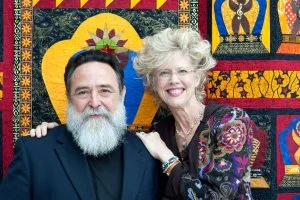
Tom Kohler and Beth Mount, two leaders in social inclusion

work. People like Jo KrippenstapelJohn O’BrienTom KohlerHeather SimmonsJohn McKnightConnie Lyle O’BrienJack PealerBeth MountJudith SnowJack Pearpoint, and Linda Kahn, (the list goes on). It’s why I look up to my own torch bearer, Tim Vogt. These guys are modern day badasses, stopping at no county waiver cost to advocate that “a good life” is filled with friendship and love, and it’s what people with disabilities deserve.

We all have our own moments we look back on and sort of cringe, “what was I thinking?” and then we feel a wash of gratitude for the leader who helped guide the way we eventually acted. Long-time social inclusion leader, Angela Amado, tells a story about the time she told (basically the grandfather of social inclusion) Wolf Wolfensberger, that she wanted to be the director of an institution for the mentally retarded after college. It was this moment in time for her, when this leader started a new conversation about her career goals, that her course in life shifted toward moving people out of institutions, and into community life.

But the truth is, there simply aren’t enough leaders asking the tough questions and mentoring the young go-getters. So it makes sense that status quo is so rampant. Day programs are “working” just fine, people “like” getting a paycheck from their jobs at sheltered workshops,* and “they will have no where else to go” if we try and fail at designing better services. As a responsible leader who serves some of the most vulnerable people in our society, I cannot imagine the type of will and fortitude it would take to stuff away such fears and doubts, and forge ahead toward the unknown. *(Labor law exemptions for employers of people with disabilities have created jobs that pay as little as 10% of the minimum wage…) There are also those who say in their own defense, “we are doing social inclusion,” referring to activities like outings where a group of people with disabilities go out to a restaurant or movie together. We have trouble taking things a step further, and seeing the damaging effects that congregating people with disabilities in this way can have. Rarely are people asking, “How can we build this into a richer vision of social inclusion, one that involves loving, respectful relationships in the community?”

And while words like “choice,” “self determination,” “rights,” and “person-centered planning” are par for the course at many disability organizations, to put it fairly: these terms are widely misused. Typical organizations lean toward a system-centered, bureaucratic approach, which means these words have come to represent mere cogs in the wheel of cost-driven processes. A person can choose to sit in front of the TV in the basement every weekend, and staff can argue that they are defenders of their choice — even if it results in no community friendships, no visible contribution, no real sense of social belonging. Perhaps staff feel they are not trained on duties of building a person’s social network, or see it as the responsibility of the higher-ups. And building relationships for ourselves, let alone others, can border on terrifying. It takes a pretty thick skin. So, instead of tackling the task head-on, we “come to use rights and choice to plug the hole that the lack of friendship has left behind,” (H.S. Reinders). This substitute for a good life is not going to stand. 

Then there are staff who feel the opposite and try their best to carve out a good life for the people they serve, even without supportive leadership. Often, these staff come to be known as the “troublemakers.” Their viewpoints make them outcasts, they are seen as nags and instigators, rather than as the thoughtful, dedicated workers they are. This type of dissatisfaction felt by staff who do not settle for less than a good life, as is evident in Allie’s post last week, should be grappled with openly as a sign of their fidelity to the work. We need to keep having conversations, practicing through trial and error, and struggling to bring things into focus if we ever are to succeed.

As you can imagine, it all takes a lot of patience. I’ve had my own moments asking, “Why can’t everyone just do their part?! It would make things a lot easier!! People’s lives are at stake here!!” One of our biggest hurdles might be that most people in mainstream society do not have any grasp or idea of what goes on in a person with a disability’s life. Tell the person sitting next to you on an airplane that you work with people with disabilities, and they will relate your work to the one disability service they’re familiar with, not knowing much about it besides maybe its location and perhaps outside appearance. They’ll say, “they do great work over there.” That’s because people generally think there’s good work being done at disability organizations. They readily feed into the co-opted stories of social inclusion all over the front page of newsletters and brochures, with glossy photos that smooth over the more common reality of isolation and segregation being experienced and reinforced in group homes, day programs, and sheltered workshops. Through these co-opted stories, the community is kept off-the-hook, led to believe that these organizations have people’s lives and well-being “under control,” and that those places are where people with disabilities “belong.” As well, organizations wind-up stagnating, and in keeping with their false narrative the true effects of their work go unexamined. Leaving people with disabilities, of course, to be the most negatively impacted of all as the consumers, yet often the least likely to organize together and demand better.

I’ll admit, maintaining this false narrative of inclusion in the disability world comes with its own merits. Generally speaking, people’s lives are probably better off going to a day program that professes to teach life skills, or art, or music, than sitting at home, alone. Everyone can feel better about that. But the reality is that these programs usually start off with a bang, “We’ll teach people to make art/music/eye contact, and the public will see they are just like everybody else!” and then will plateau into decades of the same ushering in and out of a segregated building without imagination and no ties to community life.* And as it goes, people at the top will applaud, parents will be grateful, and people will keep coming back, because they’ve found it’s the best thing out there that seems to “work.” (*Just last year I witnessed an elderly woman at a day program coloring in a cartoon toothbrush from a coloring book with other participants of various ages during a “Proper Teeth Brushing” seminar. When she smiled and held up the picture, I realized she had absolutely no teeth).

Harsh? Let me take it back a notch. These organizations are not “bad” and should not be blacklisted by society. I would be calling Starfire out if that’s what I was saying. I would be pointing the finger at myself. So many of us get caught up in the work deemed by society to be “good” at some point in our careers, and believe what we are doing is right. All I am trying to get across is that it’s complicated, and maybe more people should know that not every disability organization out there is saving lives, on the contrary. Many lives, many gifts and capacities, are being wasted. So community, you’re not off the hook. We need you to take responsibility too for the inclusion of our neighbors and family members. Most of all, we need more leadership in order to sift through this complicated story, veiled by many truths. Leaders who will help rediscover the true purpose in it all, to validate the reason we all got in this mess to begin with, and bravely start a social inclusion movement.

Which brings this thought full-circle. If Angela Amado never stepped into Wolf Wolfensberger’s office that day, and her career path was never challenged, she might have followed the track toward institutional work, never contributing to the effort of social inclusion. Without leaders who possess the courage, vision and willingness to question the status quo, people like myself, like Angela, and any number of us at Starfire will not be empowered. People with disabilities’ lives will not change. We will continue to isolate, segregate, and congregate people into programs with the best intentions. We will keep designing “new institutions,” as my co-worker Sarah would say. We will keep missing the point.

That’s why Angela will say that in her experience, the best staff come from organizations with leaders who are highly dedicated to this work. Watching our own leaders at Starfire, I’ve noticed a fine balance between maintaining an organization’s security, and innovating. You have to learn to be okay with lack of structure for a time. Accept a state of liminality, of constantly “letting go.” Free fall. Until the vision is realized. It requires a lot of support. But I have to think, if corporations expect and thrive on the fact that criticism is part of success, if their customer’s wants are as important to the design of a product as the bottom line, then why are we so afraid to adopt the same model in social service world? Any customer of Proctor & Gamble would ask as much. So when we hear time after time people with disabilities and their parents telling us that what their son or daughter wants most of all is friendship, why aren’t we bending over backward to make that happen? Maybe it’s because we think, well we can’t make people be friends with someone. Like any friendship situation, social inclusion makes us vulnerable to how other people choose to act. People we have no control over. But design thinking would ask us to frame it a new way: How might we set the stage for new friendships to start happening? And then begin the journey of discovery through trial and error and – free fall.

Sure, it’s not always easy. And it doesn’t come with the kind of perks that other innovative corporations might have. But it’s purpose-driven work. And we’ve got hope. And courage. And stories. Lots of ’em. Stories of friendship and love and affinity that make a true paradigm-shift seem that much less impossible, “We cannot do any of the more abstract work, the paradigm-shifting work, if we drift away from the stories,” says Al Etmanski, a cofounder of PLAN. “It’s like cutting off our blood supply. It’s that clear to all of us.” (quote borrowed from this article).  With these stories and leadership to drive the message forward, social inclusion can exist. “It’s going to be a ride and a half,” as Tim will say. I, for one, couldn’t be more grateful to be along for it.

timothyvogt
Hard Battles

“Be kind, for everyone you meet is fighting a hard battle, (including you).”

Friday, February 7th marked the twelve year anniversary of the death my father.  That Thursday in 2002 he was here preparing for outpatient surgery, and just as suddenly and inexplicably, he was not.  While I usually stray away from the emotional shout-outs on Facebook other than birthdays and weddings, I felt compelled to tag my mom in a status and let her know how grateful I was for the strength and love she’s shown and has shown over the past twelve years—the going at it alone in the aftermath of his death, continuing on as the mom of three children age 16, 10, and 3.  As I have a few short months before I become a mother myself, I think back to that February, the days and months that followed, the years now that have passed, and have no idea how she managed.  Keeping it together while seeing everything fall apart, what a hard battle indeed.

I write about this because I think there are a lot of loud public battles that are being fought and need to be talked about more– Katie wrote about the battle of leadership and inclusion how it’s not for sissy stuff, and then there are the private, quiet battles being fought, the personal ones that people don’t talk about, and keep to themselves.  I’ve never written about my father publicly on Cincibility—it never seemed appropriate, or necessary, or anyone’s business, until today.

This is a post more about personal battles, and the need for all of us to be kinder to each other than we’d prefer, or kinder to each other than necessary.

Phillip Seymour Hoffman’s death has been making the news since he was found dead of a drug overdose this past week and the blogsphere, media outlets, Facebook feeds and other talking heads have been commenting with their two cents incessantly.  Questions range from, How did people not see he had a problem? to Is addiction really a disease? And of course the Who cares that another celebrity is dead? rhetoric that pops up each time.

I read one poignant editorial by no less than Russell Brand (who knew he was an intelligent, well-written man?) detailing his own personal addiction with drugs and alcohol and his day to day battle to stay sober.  (If you haven’t read it, I highly recommend you taking the time to regardless of your thoughts about addiction.)

The same day I read a Facebook status from someone I know that said something to the effect that addiction isn’t the same as cancer, and if you wanted to see a real battle look for someone who didn’t bring it on themselves.  The status has since been deleted after a colorful commentary that ranged from the “I know!  I’ve never had the urge to try heroin… WTF?” to the “Perhaps you don’t understand that addiction is a disease.” to the “We can’t save everyone, seems like he brought this on himself though…”  It was a curious status, one that gathered controversy immediately, and I’ve been thinking about the qualifiers of “real battles” ever since.  What constitutes a “real battle”?  Who is worthy of our empathy?  Should we the ones to judge someone else’s pain?  Is it fair to use our experiences (or lack of experience) as a measuring stick for the amount of empathy another person deserves?  Who makes these rules?

wrote about my friend Phil about a year ago, and out of respect, left the details of his passing ambiguous.  At the time it didn’t seem to matter.  When I wrote the blog post it was a random Monday night, months after his death with no significance to the date, no current event reminiscent of his death.  It was just a post about the reminder of a friendship that had ended, how we come to collect people “like rare coins or trading cards” and how and if people are remembered after they’ve gone.  It was a sad unfortunate occurrence, the death of an otherwise promising man, husband, father, and friend.

Given the status questioning if addiction is worthy of the same sort of empathy as cancer, I’ll say it—Phil had an addiction, one that was hard battled, privately, and deeply personal.  He died because of this.

I woke up Thursday morning to a status on Facebook from a friend stating that her mother had died after a multi-year battle with cancer.  It wasn’t unexpected, and she had been updating her friends over the past week or so with statuses about her mother’s progress and the like.  Her mother had been in hospice and she knew that time with her was dwindling.  On Thursday morning, a hard battle fought over many years, now over.

It is hard for me to see one battle as worthy of empathy, and another battle deserving of a response of shoulders-shrugged you-brought-this-on-yourself.  Both battles have ended lives, leave families behind, both leave lots of questions, both leave a hole in the lives of people who loved them.

Hard battles.

“Soon I could no longer see where I ended and the pain began” Brand wrote about his addiction, narrating one particular day.  Reading the line again, I’m reminded that of course it’s not always cancer, or addiction, or death that everyone is battling, but the simple nuances of navigating the day to day—not being able to see where YOU end and where PAIN begins.  The blurriness of self and battle; the isolating difficulty that is just being, sometimes.  Phil’s sister reposted the Russell Brand article commenting perhaps it could help just one person seek help, or “at the very least, people can step down off the judgment throne for a moment of clarity” about what other people are struggling with.

Three weeks ago I got a series of texts from a friend asking me to check in with someone we both know about my supposed treatment of them.  There were hurt feelings over a situation I wasn’t aware of, things taken personally, supposed slights I hadn’t noticed I had done.  All this lead to some bad feelings and growing resentment.

I sent a long email, explaining my hard battle over the past fifteen months and hoped that this gave some context that might explain the perceived slighting.  My avoidance of her, l wrote, wasn’t imagined.  I had been avoiding her (and other people, too) and my distancing was one way to keep my sanity.  My lack of conversation was definitely personal – but not about her, but entirely about me and the fifteen frustrating months I’d had with doctors, medications, constant appointments, and disappointment.  During that time, I could not see “where I ended and the pain began” and the pain became all-consuming.

I have been having some resistance to our latest series as a staff at Starfire.  You’ll recall we’ve done Mindfulness, Asset Based Community Development, Appreciative Inquiry, Facilitation, Design Thinking, and Empathy over the past year to continue learning together and learn new depths to our work.  Now, we’re working through the Six Conversations of Peter Block.  During one such conversation the question, “what is a crossroad that you are at?”  The vagueness of the question was obnoxious to me and I felt myself wanting to immediately reply to whomever was in my “small group of people I know the least” that it was none of their business, and their crossroads were certainly none of mine, especially to people we didn’t know well.  What business is it of theirs to know “my crossroad” and how presumptuous, Mr. Block, to assume someone should want to share by design with strangers?

And, unapologetically, I do still feel that way.  But that’s part of the problem of why some battles get empathy, and others get written off.  People we know the least don’t know our battles, unless they are obviously messy or public and visible, and we keep it that way on purpose, our own protective fortress of pride.  A durable coat slipped on for social occasions, taken off only in the privacy and comfort of our own homes.  Unfortunately, people who know us best also don’t always see these battles either.

“The pain accumulated and I began to tell myself the old, old story” Brand writes of one particularly difficult afternoon resisting the urge to pick up.  And while there may be some people reading without personal experience who are struggling to see addiction as a disease, we can all nod to a particularly difficult battle we’ve raged within ourselves and relate.  How often have we sunk ourselves into the pit of our “old story”?  How hard it is to claw your way up with dirty fingernails out of that pit once you’ve fallen there?

Addiction. Adulthood. Cancer. Community. Depression. Disability. Divorce. Family. Finances. Foreclosure. Growing Up. Health. Identity.  Infertility. Jobs. Kids. Life. Love. Neighbors. Parents. Today.  Tomorrow. Siblings. Work. Yesterday.

Within us all is a battle we’re fighting, either the memory of one twelve years ago that still triggers us unexpectedly with painful reminders today, or a newly sworn battle we’re raging through.

Why do I resist small groups with people I know the least when the questions are personal and open-ended?  Because my story is long, and difficult and has split ends, and so is yours, and so does yours.  And we’re not always kind to each other as strangers, as “people we know the least”, and we’re not even always kind to those we know (and love) the most.  Am I worthy of your empathy?  Are you worthy of mine?  Will we judge each others’ pain?  Is it fair for me to use my experiences (or lack of experience) as a measuring stick for the amount of empathy you person deserves?  Are you going to measure my pain against yours?  Will you scoff at my experience, point out a “real battle” from which I can learn?

In small groups, I think to myself– I don’t need to “know what I think after I’ve heard what I’ve said.”  I know what I’m thinking without saying it.  I am an expert of my own thoughts, lived them, and I don’t need to say them to you, if I don’t want to.  And you know what you’re thinking, you’ve lived with those thoughts, and maybe you don’t need to say it to me, either, if you’d rather not.  But I remind myself of what I wrote last year:

“For so long I’ve carried the story that it wasn’t my place to ask.  That our story was one of nondisclosure.  But not of nondisclosure to each other, but to ourselves.  It was none of my business; laughter, jokes, and ignoring whatever was going on what was exactly we needed from each other.  I guess in hindsight, we were probably wrong about that.”

What we need from each other is to be kinder than necessary, for everyone, (yes, everyone) is fighting a hard battle, including you.

Especially you.

timothyvogt
The How To...

While in Savannah, one of the questions those we met with had was the “how” behind getting started with collaboration projects.  People have seen videos and read posts about projects, but a step-by-step how to was asked for.  To keep things simple, we narrowed it down to four steps:

Of course, with anything, there are lots of additional steps and missteps along the way, but at the basis of every project these four steps are followed.

1. Get to know someone and what they like to do or what they’re interested in — what does a person enjoy doing?  Where do they like to spend their time?  What roles or activities are enjoyable?  What things are of interest them?  This can be vague: “I like movies.”  Or this can be specific: “I like participating in my church community.”  We then tease out the why and the what behind these interests.  Why do you like movies?  “I like the stories they tell.”  What do you like about participating in your church community?  “I like that I am included in the choir.”

2. Find some people who also like those things too — where do other people who like those things (sports, music, poetry, beer) gather?  Who are the people in nearby neighborhoods who are already involved in these things?  What places host events related to this interest?  Meet these people.  Who else likes storytelling?  What places support storytelling?  Who else enjoys being active in that church?  What do people do in the church?  Find these people.  Find these places.  Ask more questions and get to know them.

3. Do something.  Create something. –once you’ve found a few people and perhaps a place that shares the common interest, hobby, or activity, brainstorm together about something new that can be created, or something interesting than can be done together.  Ask “what if we…” and “why not…” often.  Give people permission to do the things they’ve dreamed of.

4. Celebrate. –this is a simple step.  Appreciate the work and the planning.  Celebrate the event, the meet up, the collaboration project.  Go out to dinner.  Attend an event together.  Buy a round of drinks for the crew.  Have a good time and mean it.

timothyvogt
Making it sustainable

It’s a question that I hear over and over, and it used to stop me in my tracks every time. I’ve heard it from people who think we’re crazy, and parents who believe that their sons and daughters are capable of anything, and from almost everyone, because it’s a questions we all grapple with: “How is any of this friendship business sustainable?”

Part of the reason this question is hard for me is because I’ve struggled with that myself.  Like lots of people in their 20s, I can track my friends electronically, and there is evidence that I have a full social life.  I have just over 600 friends on Facebook, I have just over 200 phone numbers in my phone, and yet, there have still been long swaths of time where I felt like I didn’t actually have any friends. Even though I’ve made plenty of friends in my life, they’re not all around me right now. They moved away or I moved away, some had kids, some just kind of fell off my radar. They got lost after a friends divisive break up, they got busy with school or work, or they weren’t who I thought they were, or vice versa.  We’re all familiar with what causes friends and acquaintances to become social relics of a time in our life. We all know that it hurts, or is awkward, or just kind of sucks when people who drift away from us.  But most of us are fortunate to not have to stress over how to stop our current friends from joining the ghostly crew of former friends that live in our past.

When I think about my former friends, no single loss hurt too bad.  I’ve been sad to see friends go, and I’ve struggled to rebuild my social circle from time to time, but even through my most friendless hours, I was never really alone.  There was always someone to call or talk to.  Even when I didn’t have really close friends, I had people at work I could joke with over breaks, or who would ask what I did over the weekend.  They may not have been deep, intimate, soul sustaining friendships, but they helped me feel less alone.  And lots of us can think of a time in our life when our social landscape looked like this.

One story I hear variations of from parents goes like this: “Suzanne had a few girls in high school who were really nice and would take her out to dinner sometimes, but they went to college.” Or, “Tyler knew a guy in the neighborhood he would play basketball with, but he got a job and moved to Oregon.” Or, “Natalie used to go shopping with a woman at work, but she had kids and is just so busy now.”  Most families of children with disabilities can recall a time when their son or daughter had a friend or few, but most have not experienced their children having the deep and diverse social circles many of us have.  When only one person leaves, they don’t just create a little hole for others to fill in, they tear apart the whole network. So, when I would hear these stories and parents would ask me “How is this sustainable?” I knew the real question behind it.  It was “Friends are great, but she’s made friends and they leave, so how can you promise me these people you’re bringing into our lives aren’t going to be gone in a few years like all these other people were?” And I couldn’t.  And in me, that questions became a feeling that was not great.

For a while, day after day, I’d drive home and think of the fear of people leaving, and of temporary friendships. I’d let the fear limit me and I’d try to forecast where people were in their lives. If they seemed too “in transitiony,” I had some reservations about introducing them as a possible connection for someone. I’d think of the pain of loss, how well some families knew it and how badly I wanted to protect them from ever experiencing it again. I’d reflect on my own former friends, and how much more it would hurt if each friend moving on left me alone and building a circle from the ground up.  And then I realized that was the difference. While my individual friendships weren’t extra-sustainable, the circle they made up was.  And that was the closest answer I could figure out to the fear of being the friend left behind.

None of us can make people promise they’ll always be there. That turns friendships into assignments and commitments, and that isn’t good for either person.  We can’t make people sign loyalty contracts, we can’t meet someone new and ask what their 5 year plan is, and we can’t roll our eyes when our friends tell us they’re taking a new job, or having a baby, or moving to the other side of the city.  What we can do is make sure while people are around, they’re acting as connectors, bringing more and more people into a person’s life so there are always new friends on the horizon.  That way, if and when they leave, there are a few people they’re leaving behind to keep expanding that circle.  And if everything is perfect and they never leave, their presence is exponential.

I can list off dozens of people who I swore would be my friend forever and who aren’t around anymore.  But I can also list off the people I’ve met through them.  I can tell you how Bob introduced me to Sherri, who is one of the most caring loyal friends I’ve ever had.  I can tell you how I met Hannah through some people whose names I don’t even remember, and now she’s the person who I think has the most faith in me of anyone I know.  I can tell  you how Emma introduced me to Jason, and they introduced me to Jen, who is in D.C. now, but she introduced me to D’Vaughn, who was one of my best roommates ever. I can’t say that any of these people will still be around in five or ten years. Of course I would love it if they were, but I would also love it if they did what made them happy and helped them grow, no matter what it meant for me. I’m not worried about if or when our trajectories will split, because they are great connectors, and I know every time I’m out with them I’m likely to meet someone who could become my next BFF.

I can’t promise anyone that I’m introducing them to someone who will be around forever.  But I can suggest that they look at people not as the finish lines of friendship, but as the support to help you keep moving forward. I can help someone work through the fear behind “when will they leave?” and ask the more hopeful “Is there anyone you know you could invite to join you guys?” I still don’t know how to make individual friendships sustainable, but I do know how to make them exponential, and I know that growing and building is better than sustaining any day.

Jan Goings
When I Was New

I arrived twenty five minutes early, though they suggested fifteen on their website, and I turned the knob to the yoga studio. Locked, lights out, I sat on a plastic chair outside the room. Holding my gift certificate for the five-class pass, I considered leaving, knowing no one had seen me yet, and no one was there anyway.  I wandered the halls a bit, looking too interested in flyers for Royal Travel, for a packaging company, for a chiropractor, walking the steps to kill the extra time I had built in so as not to be late.

Finally, a petite, muscular woman arrived, unlocked the door and said “You can come in whenever.” “Thanks” I said, not wanting to be that woman who was still 15 minutes early to a class, I continued to sit and look very busy checking email on my phone.

Finally, I mustered up the courage to be the first one to arrive at the class (other than the instructor) and walked in. The instructor was polite enough, sign here, here and here, mats are there, grab two blankets, a yoga block, bathroom is there, water is here, take your shoes off, hang your coat there, line your mat here, we’ll start facing each other, then it’ll be lined this way. It was a lot of information for a first timer, even someone who earns a salary helping people do new things and meet new people. “Okay” I said, trying to be confident. I’d been to yoga studios before, but I’d never been to this one.

I filled out the paperwork, grabbed a mat, the blankets, hung up my coat, and began to set up. “We’re in a shoe-free zone.” Muscular instructor said without looking up from her computer. Right. She had said that, along with the list of other things I was supposed to remember. Why was I so nervous? Who doesn’t know to take off their shoes for a yoga class?

Beth, a fellow 20-week pregnant lady arrived, also early, and I overheard she and muscular instructor talk—she slowed down on the instructions this time, perhaps due to my inability to follow all of her list correctly. Beth took off her shoes, hung up her coat, filled out her paperwork, grabbed a mat, two blankets, a block, and sat next to me. We smiled politely. I wasn’t sure if talking before a yoga class was permitted, it wasn’t on the list of things to do, so the silence hung in the air.

Next, super fit pregnant lady arrived. She and muscular instructor must have known each other because the silence was immediately broken with chatter. Super fit pregnant lady just found out she was going to have a girl and muscular instructor exclaimed that she had a feeling this time was a girl for her. They’ve clearly taken other pregnant classes together, and were happy to reconnect over the good news.

Beth and I sat, with our legs crossed awkwardly on the floor next to each other. I wondered if she was also thinking about feigning some illness or important phone call.  She fidgeted with her socked feet, and I stared out the window.  There was still time to escape, but neither of us were brave enough to leave.

As others arrived more confidently that Beth and myself, the room relaxed a bit.  I took mental notes comparing their stylish yoga wear to my lacking outfit.  Apparently neon is the new black, and fitted yoga tops are the rage for pregnant fitness gurus.  Small talk was made by some regulars, silence by others.

Eventually, the class began with a round of say your name, expected due date, and things you wanted to get out of the class.  Having facilitated groups, I recognized the technique of getting people talking, and having done it myself to others, was a little annoyed it was happening to me.  (I thought this was just an exercise class!)  Nonetheless, when it was my turn, I obliged.  Jo taught us in our own facilitation series at Starfire that rarely will someone be the person that says “pass” when it’s not that hard of question.  She was right.

Muscular instructor led us through some stretches, positions, and breathing for about 20 minutes.  “Next” she said “grab a partner.”  Beth and I quickly shot glances at each other, eyebrows raised.  Though not clairvoyant, I could tell her she was thinking what I was thinking and was as put off by the idea of “partnering up” as I was.  We smiled and chose each other, having found some sort of unspoken comfort in each others discomfort.  (It reminded me of “choose a person you know the least” and I immediately had sympathy for anyone who ever attended a strategic planning session in 2010.)  Muscular instructor informed us that we would be grasping each others hands, supporting each others weight, and lowering our bodies to the ground through squats, repeatedly…and go.

Pretty much this, multiple times, with a pregnant, sweaty-hand, stranger:

We grasped hands awkwardly.  And did as we were told.  As two of the only apparent newbies in the class we weren’t very good, and muscular instructor made note of it, aloud.  “You’re not really leaning back, Beth & Candice.”  (She’d remembered our names and was comfortable using them in front of the class.)  “You need to support each other more.”

As 7:00PM rolled around, I was grateful for it being a one hour class and for the laying down positions, the ones where you’re supposed to be in some sort of deep reflection at peace with the world.  I was more concerned with how quickly I could leave, and that at these position were eyes closed positions.  As we ohmed and namaste’d each other, I was happy to be excused.

Being new was hard.  It was difficult to go alone to a place I’d never been and learn all the rules and norms.  I felt out of place when everyone else already knew the routine.  Relying on a stranger to support  you was uncomfortable.  Neither of us really let the other hold our weight– we were too unsure of each other to trust that we wouldn’t collapse our pregnant bodies to the floor.  We barely knew each other.

Each day we ask people, their families, coworkers to have conversations, forge new relationships, get involved, create new projects, and change the world!  In stories on Cincibility, it often seems so lovely, groups of strangers coming together to create beer tastingsmusicals, unique works of art together, and more.  It looks easy even in the photos.  Having been new, I know that it’s not that easy and the class was a great reminder at the time it takes to get comfortable doing something you’re uncomfortable with.  But, getting started is always the hardest part.

Wednesday is another class and I’m hoping a little bit that Beth returns.  I’m hoping that Beth will recognize me, and that we’ll be partners again.  I hope we won’t be the new people this time around.

And I really hope we don’t have to do partner squats again.

timothyvogt
Perspective

As we think about a new year, resolutions, and new perspectives, I thought I would share this folk tale about worlds.

Indian Hill Bridge – December 2012

A Folk Tale About Worlds —reposted from Momastery.com

A traveler came upon an old farmer hoeing in his field beside the road. Eager to rest his feet, the wanderer hailed the countryman, who seemed happy enough to straighten his back and talk for a moment.

“What sort of people live in the next town?” asked the stranger.

“What were the people like where you’ve come from?” replied the farmer, answering the question with another question.

“They were a bad lot. Troublemakers all, and lazy too. The most selfish people in the world, and not a one of them to be trusted. I’m happy to be leaving the scoundrels.”

“Is that so?” replied the old farmer. “Well, I’m afraid that you’ll find the same sort in the next town.”

Disappointed, the traveler trudged on his way, and the farmer returned to his work. Some time later another stranger, coming from the same direction, hailed the farmer, and they stopped to talk.

“What sort of people live in the next town?” he asked. “What were the people like where you’ve come from?” replied the farmer once again.

“They were the best people in the world. Hard working, honest, and friendly. I’m sorry to be leaving them.”

“Fear not,” said the farmer. “You’ll find the same sort in the next town.”

—-
How does your perspective affect the way you react to situations?
What are you hoping to think differently about this year?
What negative feelings are you leaving behind in 2013?

timothyvogt
Giving thanks for giving back

Americorps volunteers and Sisters of Notre Dame have dedicated years (and for some, their entire lives) to the service of others. Over the years Starfire has had our own fair share of support and love from Americorps and Public Allies, and many of our staff are alumni.

1392063_10151697268653302_942009524_n.jpg

This year, Tabitha and Emily are leading an effort to record the many experiences of these volunteers, and should have a beautiful collection when it’s all said and done.

Here’s a snippet from one of their interviews with an Americorps volunteer who moved away from his home to work at an elementary school in a tiny coal mining town, population: 406.

If you’d like to share your story with Tabitha and Emily, get in touch by emailing – emily@starfirecouncil.org

timothyvogt
A Good Staff Pt 1

He arrived with greasy hair, an otherwise nice looking man usually in clean clothes now showing up in dirty t-shirts, falling asleep in his chair, nodding off.  Apologetic, he’d right himself quickly, mumble an “I’m sorry,” and then drift back asleep, again, slouched.

We asked what was up, what was going on, talked about needing to go to bed at an earlier hour, offered suggestions for ways to get a good night’s sleep.

We called home and asked if anything had changed.  Mom, Dad, had no suggestions.  “Maybe he’s still adjusting to living on his own?” they wondered aloud.

Weeks later, he said what it was: “Gary.”  His staff watched TV all night in a small group home apartment where the bed faced the TV with only a thin wall to block out noise.  But the thin wall didn’t block out noise.  The TV was loud, always on, and he couldn’t fall asleep with Gary on the couch, the flickering glow of late night shows, the constant noise.

And because Gary was busy watching TV late into the night, Gary sometimes didn’t help him in the shower.  Without Gary’s help, a shower couldn’t be had.

But why didn’t you say anything? we asked.  Why didn’t you tell us what was happening?  Why didn’t you tell Gary to turn off the TV and to do what he was there to help you with?

“Because he was a good staff” he replied.

….

At a recent event, “Samantha” attended with her staff from her apartment.  The staff didn’t put on a name tag like everyone else did, didn’t sit with the group, didn’t say much of anything.  The staff sat on the side of the room in a chair like a sullen teenager, her weight shifted to one side, her face down in her phone.  Samantha enjoyed herself anyway, talking to others, enjoying the potluck, happy to have been invited, and happy to have actually been able to attend.

A sign up sheet was passed around towards the end of the night so that everyone could be invited to the next event.  Samantha signed her name but didn’t have an email address, not one that she could remember or spell anyway.  Standing next to her was her staff, keys in hand, ready to leave. “Will you write down your email address so Samantha can get the next invitation?” the staff was asked. “Naw, I’m good” she replied, eyes never raising from her phone.

….

I sat in a meeting once where no less than 4 paid staff members debated which day “Jim” should be doing his laundry.  He’d been “non-compliant” through out his “span date” and was being “defiant” regarding his “daily living skills.” (For those of you reading that aren’t literate in service speak, meetings about someone’s life often sound like this.)

The laundry wasn’t being done according to the day of the week set forth in last year’smeeting.  The plan needed to be amended, since staff couldn’t document that the laundry skill had been reinforced; that goal had not been met, and the skill was not completed 80% of the time.

“Why don’t you do your laundry on Mondays, Jim?” someone finally asked.  Jim said quietly because WWE RAW was on, and he didn’t want to miss it every week just to do laundry.

“Could he do his laundry on Tuesdays instead?  Or Sunday, or any other day of the week then?” I offered.  Yes, Jim’s home staff team decided after some debate.  Jim could do laundry a different day, but if it was changed in the plan, then it would definitely have to happen this year, did Jim understand this?

….

Katie wrote about getting manicures with Abby, and the process not being as “typical” as any other woman going to the salon.  For Abby, it includes weeks of negotiation with various staff and supervisors who manage Abby’s life.  This process is true of Jim, and Samantha, and of the man with Gary for a staff.

The problem here isn’t whether or not people are “good staff” or “bad staff.”  In any given week a staff can be both.  And as a “staff” I have been both in the same week, and both a good staff and a bad staff in the same day.  The problem is the way this system has been designed to micromanage lives, in a way that prevents life (in the ordinary and mundane and in the extraordinary and beautiful ways we know it to happen) in general from happening.  The micromanaged life of a person with a disability by a staff is often an impenetrable fortress built to protect and keep people safe (and sometimes, just keep people busy and scheduled).  The byproduct of the fortress is often a world of isolation and anonymity.

Katie’s example of manicures is a prime one.  Who among us would work for weeks to plan a one hour manicure with a friend if it included numerous emails, phone calls, negotiations with multiple other people, and then making sure that friend came back with a signed receipt and correct change?  We’d just as soon say that a friendship with that person is too difficult, too high maintenance, not worth our time.

Peter Leidy, of Wisconsin posted this link a few weeks back and it tells of the service world making day to day life about as clinical as it can.  The author, a father, writes about the difference between his life, and the way his son’s life is talked about.  “A person’s entire life, everything they do, is jargonized.”  I’d add, in addition to jargonized, a person’s entire life, everything they do, is often overscheduled by services, micromanaged, and clientized, and endlessly documented.  It seems that sometimes, common sense as Jack wrote about and common speak go out the window, once we start thinking about the lives of people with a disabilities.

There’s a lack of creativity in the work that a lot of us do with and for people who experience developmental disabilities.  Certainly it wasn’t too difficult — and it wasn’t in the least bit creative, to think that Jim could do his laundry another day of the week.  But isn’t it also strange to think that he has to have one day a week dedicated to a mundane chore that any of us might put off in exchange for a little entertainment?  It’s not at all creative to think that Samantha’s staff could have written down an email address so that she could be invited.  It’s not that creative to think of ways to make manicures for Abby a little easier with a friend.

It’s as if what is natural, day-to-day and ordinary for me, a person without a disability, has been re-engineered to be complex and difficult for a person with a disability.  Making plans becomes more difficult, getting to and from places more difficult, making choices more difficult, having relationships difficult.

Such is a life according to a rigid plan, one supervised by “good staff.”

In training with connectors, we’re required to do the same training as any other staff would do.  Topics include An Overview of Disabilities, Bill of Rights, Basic Principles of Home & Community Based Services, Confidentiality, Incidents Adversely Affecting Health & Safety of Individuals, Universal Precautions/Bloodborne Pathogens, Emergency Response Procedures, Interactions & Interventions with Individuals.  Also required, a background check, CPR & First Aid training all before any time is even spent with the person a connector will be working with.

The message is confusing.  If you’re training on policy and procedures, safety and precaution, your job is then policy and procedures, safety and precaution.  The job of a staff becomes a series of trainings that depersonalize the very person they will be working with in a very personal way.  This is not to discount safety.  Staff need to know what to do in just in case situations.  And I think everyone should be CPR certified (not just staff of people with disabilities).  But required training doesn’t necessarily include how to do a good job at helping someone live a life we’d like for ourselves.

In the examples of Samantha, and Jim, and with Abby, the staff were “doing their job.”  “Gary” we all want to say was a bad staff.  But that staff wasn’t hitting him, wasn’t stealing money, wasn’t being verbally abusive.  (He was reported nonetheless and a new staff was hired.)  But, it makes your wonder what other kinds of staff people that person had had for him to say that Gary, the one that wouldn’t help him with his showers and watched tv loudly all night was “a good staff”.  “Gary” was a staff worth keeping around in this man’s opinion, despite his obvious flaws.

Samantha’s staff’s job description likely did not include “be personable; look for connections when out; share your email address to get invitation to more events.”  It more likely said “transport individual to and from community outings.  Ensure safety.  Document…”  Or something even more generic like “assist client to become more independent in daily living skills.”

Jim’s staff were also “doing their job” trying to follow the goals in his MyPlan.  Laundry had to be done.  Jim needed to have clean clothes.  However, the plan, in it’s rigidity, didn’t allow for anyone to say, “wait a second, is there a better way we could be doing this?”

How might a staff person support Abby’s friend in making plans with her?  How could they make life a little easier with getting manicures and going out to dinner?  How could they help Abby look like a typical woman, with a purse and a wallet instead of an envelope labeled spending money in marker?

How could staff help Jim get his laundry done and keep watching WWE?  How could staff work to make sure Jim isn’t watching tv alone– are there WWE meet up groups?  Could Jim join one?  Could Jim host WWE viewing parties at his house?

How could Samantha’s staff be curious about others at the potluck, get to know them in an effort to have them get to know Samantha?  Could she share her email and make sure Samantha keeps getting invites?  Could she put away her cell phone for a bit and talk to people with Samantha?

How could “Gary” the staff understand his job was not babysitting, but providing thoughtful care to someone deserving of respect?

However, in all the above examples, the hypothetical questions are just that.  In reality, it’s not a “staff’s job” to help make friends, help life be a little more typical, nor is it their job to write their email address down if the person they support doesn’t have one.  None of this is explicitly said training when you begin– to go beyond safety and precautions and really work towards what matters: a good, full life.

The message staff first receive is a lengthy training not in how to get to know a person better, make time together make sense and be productive towards supporting someone in having good life, but rather to document, ensure safety, and check off a list of services provided towards daily living skills.

We’re doing a huge disservice to Samantha, Abby, and Jim.  And to staff people whose jobs have become disrespected, and demonized.

We can do better.
___________________________________________
Part 2 will include stories of “good staff” who work beyond the safety and precautions and required training to work with a person towards a good life and how they’ve come to understand their roles as part of something bigger.

timothyvogt
the roll and the ranch

We arrived 10 minutes early, not sure if anyone would remember that Douglas’ first day was coming up on Saturday, and not really sure if the all staff message was meant to include him.  It was sent to everyone but being an electronic scheduling system we weren’t sure if Douglas was expected at the meeting.  Nevertheless, we made a point to attend, telling ourselves at least it would be an opportunity to pick up a few names and faces before Saturday, make a good impression.

A few people gathered around the outdoor picnic tables talking about last weekend’s unexpected rush that lined the sidewalk, and the impeccable taste of the pork and coleslaw that day.

“Is the meeting here at 3?”  I asked.

A woman said “Yep.  a staff meeting” and she went back to reviewing her notes scrawled in a composition notebook, preparing for the meeting.

“Sup Douglas?  Thanks for the card you sent me”  Elias said.

Douglas nodded and shyly smiled.  He was nervous on the drive over and the attention of someone knowing his name caught him by surprise.

A few weeks back Douglas was hired at Eli’s BBQ through an acquaintance that Katie had.  There was a message on Facebook a while back that said they were looking for help, and we knew that Douglas’ resume included experience in the restaurant industry.  Being a foodie himself with a taste for good food, we pursued the opportunity.

Douglas was hired, and with his mom, Paula’s assistance, they were sure to send a thank you card for the opportunity.  We were now getting close to the big first day after a few weeks of back and forth paperwork, schedule negotiation and all the detail grit work that goes into starting a new job.

The staff meeting began as any other, people walking in late, people scattered about the tables in their cliques of co-worker friends, a few with visible tattoos, and a varied collection of people wearing cool t-shirts and aprons smeared with BBQ sauce and smudges from the grill.

Douglas wore a black polo and cargo khaki shorts.  He and his gym shoes fit in with everyone else.  Casual.  Relaxed.  Ready to work.

“People hug me after literally every catering event” one man said during the meeting, laughing.

Elias, the owner, and namesake for Eli’s BBQ, chimed in.  “That’s because catering food usually sucks.  You get the ranch and the roll and you try to make them last between the crap meal in between.  That’s not what we give people though.  This is good food.”

“You’re right.  People absolutely love us.  We should be proud.  You should be proud of  your work.”  Another man said, with a prominent pork tattoo featured on his forearm.  A man obviously proud of his craft.

Douglas gets to be a part of the roll and the ranch and the good (and bad) stuff in between starting Saturday as an employee of Eli’s BBQ.  The work of how to include people isn’t a tricky business, but it does take creative asks and an honest conversation.

“What do you need from us?  Anything special we need to do?” the manager, Eric, asked me over the phone a few weeks prior.

“Not really.”  I assured him and we talked about treating Douglas the same as any other employee but with a little grace and some gentle reminders.  (I bluntly reminded him that while Douglas does have a disability, he shouldn’t have special rules when it comes to doing the job he was hired to do.  It also meant that he might need some directions repeated and some assistance to learn all the tasks that will be new to him.  Eric, the manager, needed to know that Douglas doesn’t drive and has to rely on family or county funded transportation to get to and from work.  And while we would do our best to make sure he was never late, how frustrating would it be to not be able to drive to make sure you got somewhere on time?)  The manager understood and was happy to have an honest conversation about what was needed and expected to make sure everyone was successful.  These are things people don’t know about the lives of people with disabilities, but these are the important things that are okay to say.

50West has a list for Michael.  It includes such rules as “high-fives are just fine” and “no yelling in the bar”  and “memorize all table numbers.”  Things Michael needs to know and needs to be reminded about.  These things that are okay to say to him to make sure he’s doing his job, and make sure people get a good impression of the brewery (and of him.)

Eli’s BBQ will figure out their pace and way to be inclusive, too.  So far, the nonchalance, the-welcome-aboard-new-guy-attitude seemed seamlessly inclusive with a good dose of ambivalence.  People said hey but didn’t fawn over the new guy.  Douglas, a naturally shy guy, appreciated the “sup” and the lack of commotion over him starting.  (No new guy wants to draw unnecessary attention to himself at an all staff meeting.)  But, he will be apart of a team– the roll, the ranch, and the sweet meal in between.

______________________________________

If you’ve not yet tried Eli’s BBQ:
Open 7 Days a Week 11AM – 9PM
3313 Riverside Drive, Cincinnati, OH 45226
Cash only. (and you don’t need too much of it!)

Eli’s BBQ

elis.jpg
timothyvogt
The Hill is Alive--What An Organist Will Do to Hear the Beautiful Sound of an Allen Organ

Go ahead, hit play and listen while you read:

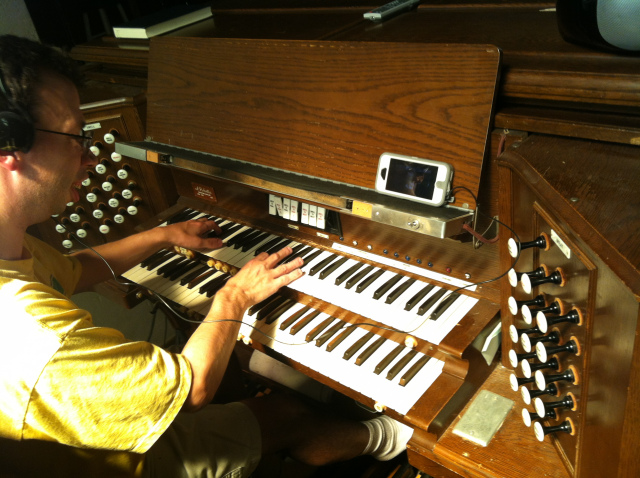
Scott’s a pianist, and a member of the ATOS (American Theatre Organ Society) and the AGO (American Guild of Organists). Never having taken a music lesson, he learned from his mom and began to play by ear at a young age. He would practice on the Emery Theatre’s Wurlizter organ, before the theatre closed down in 1999. Scott’s passion for the organ is only matched by his year-round love of Christmas.

“Music directors don’t usually let just anyone play their organs,” his friend John told me. “It was kinda like pulling teeth trying to find one in the city that Scott could play.”

We pull up to the Christ’s Community Church in Price Hill and wait for Amy and Chris, a couple of Westsiders who offered to let us into the church midday. The church was built in 1886, and stands today a mammoth, brick structure, with tall, tall windows of stained glass. It dons an impenetrable holiness over the neighborhood.

“The music director here has been trying to find someone to play this organ for over a year,” Chris tells us as he walks up the steps to unlock the church.

We walk past the words: “THE HILL IS ALIVE”, painted in rainbow fashion on the blacktop beside the church. It feels like a covert operation, getting let into a vacant church – for the sake of music.

“What kind of organ is it?” Scott asks, anticipating the moment he can sit down and put his hands on the keys, his feet on the pedals.

“I’m not sure!”

“It’s an old one!” the couple chime.

He’ll need to find a brass ensemble and choir soon, if he is to turn this old organ into the star of a Christmas show, as he plans. But for now, he’ll get the organ back in shape and worry about finding sopranos, altos, baritones, flutists, trombone and tuba players, later.

Outside, the neighborhood has come to a quiet, still halt. The blacktop radiates under the unrelenting, midwestern sun, and pedestrians move like molasses on the sidewalks. Inside, we creak our way up the stairs to arrive at the entrance to the sanctuary.

“One generation will commend your works to another… Psalm 145:4,” reads a quote, framed beside the church’s double doors.

Our eyes capture the glory of the architecture, the hanging medieval style lanterns, the raised altar, the choir loft, scanning every corner to locate the organ. There it is, we point, and like a pack of tourists, we move toward it.

Closed in its wooden case, a beast in hibernation, it is a somber, dusty mass of polished wood. The air grows thick as Scott settles in, slipping off his shoes to play the pedals.

The necessary nobs get a twist and buttons a punch, and slowly the organ pipes emerge from behind their wooden shutters. The keys and stops fan around Scott like a generous embrace from a sophisticated and distant relative.

I blink and my eyes stare off, looking deeply into the carpet below, watching as the sound of worship, celebration, rebirth surrounds us, the chords bellowing into my chest.

Aside from our motley crew, it seems a pity that no one else is there to bear witness. The pews try their best to look more like a potential audience than empty row upon empty row. The dust and sunlight pouring in from the warmth of the colored glass dance about, attempting to be part of this unique spectacle. The statue of Mary whispers to Cecilia, the patron saint of music, “Hear it!? Do you hear that? Stand tall, the organ is being reborn! O Bethlehem! O Faithful! Hark, angels sing!”

“An inspirational day,” the couple tells us before they head a few blocks away, back to their home. A bit of hope in a neighborhood where rainbows painted on pavement represent the site of a homicide, where the hot sun bakes on crumbling roofs, on half burnt houses.

So we took pause, for the sake of Scott’s passion and nothing else, and perhaps, if we let the music move us so, we left feeling a little more alive.

Scott is looking for a brass ensemble, choir, and other organizers (musically inclined or not!) in the Price Hill area willing to work together to put on a Christmas show this year during the annual “Holiday on the Hill.” Please contact John for more information: john@starfirecouncil.org

join Scott for a Christmas concert!

timothyvogt
In Defense of the Queen City

If you’ve missed the onslaught of posts about Cincinnati being burdensome on new people to make new friends, and a response about our “inbred smugness” count yourself among the lucky ones who didn’t have to read the asinine back and forth online commentary of “no we’re not” and “yes we are” bouncing back and forth totaling over 190 individual comments like children pushing responsibility on to someone else.  This recent post was an actually interesting Citybeat follow up but all of these articles point to the issue of friendship, neighborliness, and the human desire to not be alone.

In a frustrating email to fellow co-workers about these nonstop Cincinnati identity articles that keep popping up, articles like those mentioned above, and articles like 31 Ways You Can Tell You’re From Cincinnati and this and this I threatened to write my own version of how to tell you’re from the city you’re from (and I might!)

Allie responded that a post that did need to be written was one about relationships, a defense of Cincinnati, and in defense of personal responsibility in making friends.  I had to share her wisdom here:

I was thinking this could also be a good time for a post about the idea of personal responsibility in making friends.  Like, how many of us have thought “why won’t anyone talk to me,” then when we started doing this work, realized that’s what everyone is thinking and we’re all just walking around alone, wanting friends, and wondering why nobody will talk to us.

We get so focused on waiting for someone else to initiate a conversation that our brains miss the fact that we could be that someone.

Maybe we’re not a smug city; maybe we’re just a city of waiters, because humans are waiters.  These articles aren’t about people who are or are not included, they’re articles about a bunch of people who are waiting for someone to step up and be ‘the Nice Expert.’  They just need people like us to tell them the only difference between someone who feels isolated and someone who is a Nice Expert is the bravery and what-the-hell mentality to start a conversation or toss out an invitation.

So, to follow up Allie’s words — friendship and connectedness is not a secret science.  There is no mysterious formula that natives in the city of Cincinnati are keeping from outsiders.  It’s not a matter of family legacies in the Queen City, which high school you went to, or unfriendly churches, exclusive mom clubs/book clubs/running groups/PTAs.  Sure, all of those things exist, and all of those things exist in every city.

I think a lot of us at Starfire have learned that many people are just waiting to be invited.  Friendship comes with a certain dose of chance and spontaneity, and a big commitment to saying yes.

The next time you’re wondering why you don’t have plans, didn’t get invited, weren’t asked to coffee, didn’t get cookies on your doorstep from neighbors perhaps take a step forward to make the plans yourselfmake the invitation to others, ask someone to coffee, and bake some damn cookies to share.

timothyvogt
10 Ordinary People Making a Big Difference in Cincinnati

We heard from so many brilliant Cincinnatians tonight – genuine changemakers, working to make a difference in their own big and small ways. Here’s a glimpse at 10 (okay, 10 plus their team – no one does this stuff alone!) of the many great people who we will be hearing from over the next two days. Hope you can make it!

1. John Orr

John will speak to his journey with mindfulness practice. Mindfulness, he reminds us, is both a simple and ancient practice that can have a strong impact on our sense of connectedness, happiness, and overall well-being. John will be giving a crash-course on how to integrate this into your own life.

“Mindfulness can move you closer to the beauty of life.  It can give you the power to choose how you respond to fear and cynicism when it does arise.”

Mindfulness guru

2. Judi Winall

Laughter yoga was developed by a medical doctor in Mumbai in 1995, and is now a world-wide movement. Judi will instruct on how to laugh as an exercise, not as an emotion, so you can do it anytime, anywhere, with anybody.

“Laughter is one of the most powerful way you can counteract the stress in our lives — it makes us happier, healthier, and wise. And plus it’s free.”

laughter yoga guide

3. Aaron Kent

Owner and operator of DIY Printing, a silk screening coop for artists and the community.  Aaron will be hosting a screen printing class at his shop in Essex Studios, where people will be able to design, print, and bring home a 3Day t-shirt! People are invited to bring their own t-shirts, and DIY will be donating a box of their own.

“DIYs doors are open to artists and community-oriented businesses and people.”

screenpring.jpg

artist, screen printer

4. Kathy Wenning

Hear from a powerful mother who has been on a journey that began down the service-centered road, and has recently turned a new corner toward gifts and potentials. Now, what disability once meant to her son’s identity and their family’s life has changed, and she’ll share what it’s been like to be on that ride.

“No matter who you are, you can contribute and help someone that you already know, have a better life.”

parent.jpg

parent and community builder

5. Denny Burger, Daniel Kilcoyne, and Jess Linz

Telling stories about the good people they have met this past year as community interviewers, this group will discuss what it’s like to seek out the gifts of your neighbors, and “find the sweet spots” that exist in our neighborhoods. You can find them and other interviewers each month at Starfire’s gatherings where they share the stories that they’ve collected.

“We’ll impart to you secret knowledge about how to network, how to connect in our greater community.”

Starfire’s community interviewers

6. Vonceil Brown and Jori Cotton

Vonceil and Jori will be talking about their work together as spoken artists at the organization Elementz Hip Hop Youth Center. The two collaborated with Public Allies Cincinnati last year to create a spoken word showcase in the city, and hope to continue the event forward in future years.
“I think of it as revolutionary, because a lot of spoken word artists talk about things that are going on in the world.  It’s a great way to speak up for the underdog.”

spoken word artist

7. Roanne Lee

Leader at the Awesome Foundation — an organization helping to fund awesome ideas. Roanne will be hosting a session to help people brainstorm awesome ideas together. ‘Nuff said.

“The crazier it is, the weirder it is, the better it is. We can all think of really awesome ideas, really there’s infinite possibility.”

foundation.jpg

awesome person from the awesome foundation

8. Kristen Barker

Working to create “family-sustaining jobs” in Cincinnati. She is involved with supporting a range of community efforts, from a farm in College Hill providing food to families and the neighborhood, to a healthy bakery initiative called “Yucky Cookies.” A model passed on from the Mondragon Corporation, Kristen is helping Cincinnati be a leader in the worker-owned cooperative movement.

“It’s about putting people above profit.”

leader of Cincinnati Union Coop Initiative (C.U.C.I)

9. Kim Popa

Building community through movement and dance, Pones Inc. dancer will be inviting people to – well, dance! Headphones will be offered that playing really simple dance instructions. May take place at Starfire- or out in public for more of an adventure!

“If you’re nervous, and you feel like, ‘I’m not a dancer, I’m not gonna do it,’ then I invite you to definitely come.”

Dancer, mover, shaker enthusiast

10.  Dustin Lee

Dustin is helping to lead the urban garden movement in Avondale. Community and home vegetable gardening discussion – that will be starting at Starfire, then move on to Gabrielle’s Garden to “get our hands dirty!”

urban gardener

YOUR STORY GOES HERE.

your story.

 Join us tomorrow and Thursday – there is still plenty of space and time on our calendar for you to fill it with your own story of hope, community, and love!

OPEN SOURCE SCHEDULE (so far)…

Wednesday, Aug 28th from 3p-8:30p

3:00-4:00
Vinyl Listening Party & Record Swap
Valued Social Roles

4:15-5:15
Cincinnati Naturalist Society
Positive Thinking
Listening Partnerships
Valued Social Roles (continued)
Art & Painting
How to Start a Neighborhood Bike Ride

5:15-6:15
Free Dinner!

6:15-7:15
Faith Inclusion
Awesome Ideas by Awesome Foundation
Cincibility Podcasting
Pones Inc. Dance Community
Fantasy Football
Values in Action

7:30-8:30
Mindfulness
Intentional Family Building
Laughter Yoga

8:30-9:00
Open!

Check back in for Thursday’s schedule: Aug 29th from 3p-8:30p

Where5030 Oaklawn Drive, Cincinnati, OH 45227

Find out more on Facebook

timothyvogt
The Utility of Common Sense by Jack Pealer

The narrative in this video was prompted by a study done in the 90s by one of our great thinkers, Jack Pealer. So, to honor Jack, and in preparation for our 3Day community gathering kicking-off tonight, I thought it good timing to share one of his posts written on this very topic around community and isolation. Thanks Jack. Hope to see some of our Cincibility followers at the 3Day!

——————————————-

The Utility of Common Sense

“We’ll have to keep working to avoid the general judgment that some people should be gathered up and put somewhere else to get help.”  -Jack Pealer

Is “common sense” useful to those who want to support richer lives for people with disabilities?  Seems like it should be.  After all, much of the richness that we’re trying to enable people to experience is found, we say, in the varied patterns and textures of that locus of our existence we call “community.”  Communities, by definition, work better when they are governed by commonly agreed upon ideas—common expectations and experiences.  Shouldn’t that mean that this “common sense” that supports community life will also support those members who have disabilities?

Sometimes yes and sometimes no.

Let’s look at the yes-examples first.  Over the years I’ve often found myself facilitating meetings where a person with disability, her/his family, friends, and other supporters were trying to describe a bright future and to figure out the best ways for that future to happen.  A remarkable thing about those meetings is that the people who come to them really listen—sometimes for the first time—to the person who is the meeting’s focus.  Participants really work to understand the interests, the wants of that person, and they try to develop a vision that captures those interests.  Most often the visions and plans that issue from these gatherings are rooted in common sense.  That is, the ideas that develop are usually self-evidently rational for this person at this time in his/her life.

Common sense is the process at work when people understand, for example, that this person a) can’t stand living in a big group any longer or b) won’t be helped by coming to a workshop or day program every day or c) needs a personal relationship that lasts with one (or more) others.  In this context, common sense is what leads planners toward the sort of plain inferences that have sometimes resulted in big changes in the lives of some people.  So, at least one kind of common sense—the kind the Oxford English Dictionary (OED) defines as “… the plain wisdom which is every man’s inheritance”—does offer support to people with disabilities.

But there are other meanings of common sense, and those offer less comfort.  For example, the OED also defines common sense as “… the general sense, feeling, or judgment of a community.”  The idea is that communities tend to hold some ideas in common, including ideas about themselves—who “we” are—and about other people—who is “not us.”  This version of common sense can attack the potential membership of people with disabilities.  Wolf Wolfensberger (author of social role valorization) described the common sense of communities about people who are judged to be “not us;” this description took the form of a catalog of “common negative social roles imposed on societally devalued people” (see A Brief Introduction to Social Role Valorization).

Among the roles listed in this catalog are those that describe some people as “sub-human/animal” and “burden of charity.”  Common sense—as unconscious but real community judgment—is what led me and other officials of a community where I once lived to decide that the right place where children with disabilities (only) should go to school was a location seven miles from town next to the county poor farm and animal shelter.  Wolfensberger’s list of devalued social roles also includes that of “menace or object of dread.”  Common sense—the general feeling of a community—is what led countless citizens of neighborhoods across North America to abandon civility and oppose, sometimes with violence, the presence of people with disabilities as their neighbors.

Some years ago, I sat working in an office of a school that was open only to children with disabilities.  A car pulled up outside.  A man got out, lifted from the back seat a cardboard box, and carried the box into the school.  Coming into the office, he explained that he was from the local (community) Elks or VFW or American Legion Post.  I forget which.  His group had sponsored an Easter party a week before—a party for the children of group members.  They had candy left over.  Would “these” children like to have it?  The candy was accepted; he returned to his car and drove away.  I thought then that it was possible that he drove past several other schools on his mission to deliver left over candy.  There are other schools in our town.  But, something that we might call his common sense (the general judgment of our community) about difference and the exclusion that communities say must accompany it led him to this school and “these” children.

We need to think carefully about the extent to which common sense—our own and that of our fellow citizens—can be trusted as a guide for helping and supporting people with disabilities toward richer lives.  On one hand, if I’m trying to assist one person whom I’ve come to know—and if I’m doing so together with others who also know and care about the person—I think I’d be trustworthy, most of the time.  Common sense is a useful guide when it’s informed by relationship and affection.

On the other hand, if I’m considering how to support a group of people with disabilities (or a “batch,” as sociologist Erving Goffman named the unconscious view often held of such collectivities), the general community judgment about those people may not be of use—may actually turn my attempts to help in quite harmful directions.  Given the history of organized services, we should view with suspicion what seems to a community to be “common sense” about how it assists groups of people whom community members have learned to understand as “not us”.

But, for as far ahead as I can see, communities will use organized services as their main tools to try to help groups of people.  And that means that those who want to support people with disabilities toward richer lives have to stay alert about appeals to common sense.  We’ll have to keep working to avoid the general judgment that some people should be gathered up and put somewhere else to get help.  We need a preference for the plain wisdom that grows from meeting each person where she/he is and connecting that person with other citizens who share her/his interests and who will become devoted to her/his participation and membership with all the rest of us.

timothyvogt
Meet Joe

Meet Joe. Living with the label of disability, his social network looks significantly different than most.

Joe has his family. Just like most of us, at the end of the day, there’s never enough family.

Teachers, barbers, dentists, accountants, make up part of the people paid to be in Joe’s life, but the majority are direct support staff, who he spends a lot of time with. He can rely on them for services, but they are often in his life temporarily,

But out of everyone in Joe’s life, close friends and acquaintances, people he runs into occasionally like neighbors or the clerk at his local movie store, are the smallest number by far.

Finding friends is an unpredictable road that can be tricky for anybody. It takes the perfect combination of common interests, shared places, mutual respect, and a touch of serendipity. Put all the pieces together, and sometimes there’s a spark, one that none of us can predict.

From the time he was first labeled with a disability, Joe’s life has been planned out for him. It often led to him being placed in separate programs, away from everyday life. While this was planned by a well-meaning society, it has meant that Joe has to work a little harder to build his social than others.

Now Joe and his family are on the road to turning this picture around by drawing on Joe’s passion for history to build natural relationships. Joe and his mom spend time in conversation with people, visiting with people who love history too, hoping to make connections over time that will lead to doing stuff together, or collaborating on a community project, so that maybe they will find that spark of serendipity that can lead to more people in Joe’s life.

Based on Jack Pealer’s 1990 study on 51 people with disabilities’ social network, and the similar reality that many people with disabilities still face today. Art and narrative by Brandon Black, Jennifer Bradley, and Jon Gray.

timothyvogt
Dreading and Doing

It’s all about connections.

This past month I made it to one of our community gatherings at Beans and Grapes. We started the conversation off with a great list of what’s happening in our lives that’s new and good.  On that list were things like:

“I started a new job!”

“I found a home for my iguana!”

“We met my brother’s girlfriend!”

the new and good stuff happening (left), and why community is important (right)

It was all such ordinary, and in its simplicity, beautiful stuff. Then we made another list about why community is important to each of us.  That list about blew me away, it was so full of authenticity and wisdom, and it came straight from the mouths of the plain citizens sitting in our tiny semi-circle.  The list read something like:

Community is important to me because…

“it’s about being intentional, getting along with others, understanding my neighborhood’s history, potential friendships, makes room for playfulness, anyone can join, when you know your neighbors there are less frustrations, it’s powerful, asks us to be authentic, gets us doing things together, promotes safety, can be unexpected, other people helps us navigate through new things in life…..”

our semi-circle of community builders

After that, we turned to a new page and made one final list. It was the list of “do’s”. We answered the question, “What can we do now to help our neighbors and communities become more tightly woven, or what have we already started doing?” Again, simple stuff, but powerful actions when the alternative for many is sticking to our comfort zone.

Do’s:

“Joined a book/bike club!”

“Will finally meet the neighbors across the street!”

“This month is dinner at my place with the new neighbors.”

the “do” list

photo-51.jpg

By the end of our time together, one woman looked back on our three lists and reflected, “It really is all about making connections.”

She then admitted, “I had a hard time coming here tonight, I just felt like I had so much other stuff to do at home, I get like that with these gatherings. But by the end, I’m always glad I came.”

Candice chimed in, “Yeah, I have a similar feeling, sometimes I’ll dread having to facilitate, but as soon as I get here I feel glad I came, it gives me energy to be with all of you.”

In my mind I thought, “yep, I can totally relate.” Feeling somewhat ashamed to admit it, I realized how this is such a universal feeling that we all experience before doing something new, or that requires us to step outside of the box.

Which reminded me, of the time I became an English teacher overnight in a city tucked away in the beautiful former Yugoslavia….. I was living in a hotel room above a gas station when I found I’d be teaching a university level class in less than a month, having no prior experience or a clue about teaching. Here’s that story.

– part two –

First comes dread.

It gripped me right before class. Utter, complete, total dread. I would pace around my apartment, shoving random pens and notebooks into my teacher bag, all the while talking myself into going. I would see the 4 dozen eyeballs staring at me in my mind. I was to stand in front of 25 students and perform, poised, calm, informative – the way a teacher does.

“Perform what!?” I would huff to myself, exasperated, still packing random pieces of chalk and extra tissues into my increasingly heavy teacher bag. “I’m not a teacher! What do they expect!?”

I was there on a ten month scholarship, one I applied for (admittedly) so that I could travel back to the Balkans – a place I fell in love with as a study abroad student in college.  Winning the scholarship meant an all expenses paid adventure, in exchange for my assistance at a local University in Štip, Macedonia.  How hard could that be? Reading the oral exams, helping grade essays, lending a hand here and there while the teacher made the lesson plans and did the lecturing.  I would simply – assist. The rest of the time would be me traipsing around a new place with a map and some bus tickets, with not a care in the world.

As soon as I realized that being a teaching “assistant” meant something quite different, the dread began to sink in. My first interaction with the teachers I was there to assist felt like a bless and release.  They told me I’d be working in 5 classes, with 20-30 students per class. I’d was to hold the students attention for 2 hours with lessons on writing and speaking. Each teacher was generous with their advice, they gave me papers, workbooks, and various materials to work from, but in the end I was completely unprepared for what was to come.

Starting somewhere.

I had a month to prepare before classes actually started. I started by pouring over the worksheets and scribbled notes I took during our crash course on teaching all the grantees got in D.C. during our orientation. Then I used Skype to call my sister, who was a teacher at the time in Korea, and rambled, vented, and generally dribbled on about how I am totally not a teacher, am never going to make it through the school year, and pleaded with her to impart on me everything she had learned about teaching during her first 5 years in the profession.

She tried her best to listen and calm my nerves.  In the end, the best teacher advice she gave me was to have a sense of humor about the whole thing. She recommended I read Frank McCourt’s Teacher Man – so I downloaded it that night on audio and began listening. The book didn’t help me gain any better grasp on what the hell to do in the classroom, but it did make me lighten up a bit. I listened intently to his funny anecdotes on all the times he screwed up as a new teacher. Like medicine, the stories came to me like doses of bittersweet anticipation for my own mistakes to come.

Dread usually had the last laugh though. My gratitude to Frank McCourt, but I think he’d understand I needed more than just a lighthearted perspective to get through my fear of the unknown. So I crossed off the days before the school year began, and figured that once I knew how bad it really was, I could stop being so afraid and at least know what to expect.

What happens if you just show up?

On my first day of class, I took a picture of myself in the mirror. I guess kids these days (wink) call it this a selfie. I guess I thought of it as a mark in time.

first day of teaching

“I look like a teacher!” I said to myself.  Then I heard it, crawling out of the reflection of myself and into my bones, loud and clear: twisting my stomach into knots, attempting to feed me a better solution than walking out my door, “Why not stay home? Write an email, you’re sick. Stay, rest. Plan your escape.”

I ignored it. I walked outside my hotel room above the gas station, and made my way to teach. Like anything I’d done before that was new and scary, I knew if I just showed up, if I just made it to class and started teaching, the dread would subside for a bit.  It was my mantra: Just show up. Get there. Get out of bed, get out of your door. Just show up.

Eventually, the chalk prints on my pants, the looks I got when I showed up with different colored socks, the hurried walk down the steep cobblestone streets to arrive just on time for class a sweaty, flustered mess, all of that became routine, expected, normal. And despite this, being slightly lost and disheveled, in the midst of it I found myself doing what I thought I could never do. I was teaching.

Doing is a beautiful, beautiful thing.

Out of the impossible rubble that was dread, I emerged a teacher. And from that came camaraderie with the students in the room. I came to know their stories. I learned about their dreams. I heard their opinions on the education system, on Hollywood actors, on the protests happening in Tunisia as the Arab spring grew eminent, and I told them what it was like growing up in the midwest.  I taught writing – not by the books, or based on some course material – but what I knew about it.

Transitions, thesis statements, 5 paragraph essays, I knew the basics well enough to begin introducing these concepts to them. Living in a country with a 31% unemployment rate, many felt discouraged, despondent. I wanted to give them something useful. As I got to know their hopes and dreams, I realized how becoming better writers could mean their ticket into grad school, or a job abroad, or maybe more confidence when they became teachers themselves. There was no time to waste, they had their lives ahead of them. My grandiose optimism was met by many unimpressed faces, but in it I had found my drive, and I had found purpose in my teaching that would take me to the end of the year.

Out of my comfort zone, away from the norm, as messy as it may have felt at the time, in the middle of the chaos I found myself focused on what was tangible. Then, the unexpected bonus happened – and that was watching the true writers in the class coming out of the cracks in the chaos.

Dread never tells you about the unanticipated goodness to come.

One guy I remember, his hair gelled, his jacket a crisp leather, his attention in class that of a cactus. The first time I read his essay I had to check the name twice. It was written in such a voice, authentic, captivating, I found myself chuckling at certain passages and leaning in to read more closely others.  Just like his personal style, his presentation on the page said, “I don’t give a fuck.” He’d turn it in late, without excuse, in hardly legible handwriting, and ignore me the rest of the class unless he had something snarky to say.

I decided I’d read his essay out loud one day. I prefaced with, “Darko has a secret, and he doesn’t want anyone to know this.  He is a writer.” I watched as his classmates look at him, then back at me as I read, and some began to see him differently. They laughed. They scratched their heads. I shed some light his way, though he winced at the spotlight.

Another student, who spoke English in a smooth and steady British accent, was absent nearly every class. At first this offended me, and made me feel taken advantage of.  But she was a puzzle. When she was present, she challenged the status quo with her comments, she was the most engaged person in the room. Her first essay assignment brought more to the table than I’d expected. She wrote about driving her mom to and from the big city, holding her hand in the waiting room, fighting with the doctors for better answers, while she received chemotherapy.  Then, driving back in silence, her mom sick the whole way home, she would make it to class when she could. I realized how life goes on outside of the classroom, and how very important it is to set aside the rules sometimes and just listen to people. Eva has recently started a fantastic blog — you can read here.

Sometimes dreading precludes doing, and that’s okay. In fact, maybe that’s how it often should be.

Would I go back to teaching? I give that question an affirmative: NO. Not because I’d dread it, but because (and teachers, I salute you) I realized I am not cut out for that work, it’s damn hard!  But people like Darko and Eva and the 100 other college students I met gave me another piece of myself to discover, through the reflection I saw in their eyes. I did something that scared the crap out of me, and it gave me confidence. I try to make sure now that doing things I dread a whole bunch are on my list of “things to do” at least regularly – if not always. Dread is tricky, it maybe gets a bad rap, because so often it turns into excitement, drive, and motivation. If you think about it, perhaps they are the same thing anyway. Dread – and excitement.

timothyvogt