riding the white horse – part one of a two-sides to every story tale.

This post is in response to a writing prompt given during a Social Role ValorizationTraining in West Virginia this May. The prompt was: “write about someone else’s life from his or her perspective.”  Below is my own personal account of a friend’s life who I met in 2009.  Part two will delve deeper into the metaphor of the white horse, and my first experience meeting my friend.

My name is Abigail, and I want to tell you the story of my life.

a white horse enters the scene.
what automatically comes to mind?

I was born the youngest of 8 kids. My father remarried after his first wife died. My 7 older siblings are my “half” siblings. He married a much younger woman than he. Together they had

me.

Since I was born when my dad was in his 60s, my older siblings are all much older than me, and had moved out of the house, so it was like I was an only child growing up. The times when it was most apparent that I in fact had a rather large family was during holidays, like during the Jewish holiday of Shavuot, when the house would fill up with the sweet smell of cheese blintzes and butter crackling, and my half-siblings and their kids were all in from out of town.

Apart from holidays, childhood was spent a lot with mom. It was because of her that I discovered how much I LOVE musicals. My ma and I could sit inside on a Saturday, she with her pack of cigarettes and me with a plate of snacks, and we would watch Singin’ in the Rain, My Fair Lady, and Mary Poppins back to back. I loved the dancing, the merriment, it made me feel like I could almost escape into that other world where everything was art.

Fred Astaire and Ginger Rogers.
“Life is an art, and you are the artist.”

After graduating from high school, I moved out on my own. I didn’t have many friends from high school. To be honest, not many kids in my class ever talked to me. I went to a large public school, but took often classes in a separate part of the school apart from most of my classmates. During lunch I usually sat with ten other students who also had class in the separate classroom. One of my classmates and I would talk about our favorite Yiddish plays, and come time for Christmas when all the green and red would spring up everywhere, we’d give each other the knowing eye. With this exception, the most I truly shared in common with people in that separate classroom was how much time we had to spend together, so I kept mostly to myself or talked to the teacher.

Now in my later twenties, I still watch musicals from time to time. They are sort of like old friends, who I’ve known since way back. I laugh when they laugh, I know their secrets, I can finish their sentences. Still, it hasn’t been the same watching them since my mom passed on. When I got the call from my dad, even though I was expecting the call for some time, the shock took me over. I was shaking, and as I begged him for more details, hoping to find out something different, some other truth, I could hear my voice getting louder. My chest tightened. Tears bloomed in my eyes.

I was alone.   (Well, I am never really alone, one Staff person is always with me in my tiny one bedroom apartment).

When I hung up the phone, and my gut felt punched out, I told the Staff person on duty that night I lost my mom and she gave me a hug. I cried. I didn’t call my siblings. I didn’t call any friends. It was right around 8pm, the time when I always take a bath, so I got undressed and grabbed a towel, and cried some more in the bathtub until the water got cold. When I got out I called the Boss of my Staff so I could take off work the next day. I was told I better go, that it wasn’t going to do me any good to take off, and going to work in the morning was better than sitting at home and feeling bad. Plus, who was going to be my Staff all day tomorrow, on that short of notice?

If you ask me, I like a routine. I like to know what I’ll be doing for the month ahead of time. That’s one of my characteristics. When you have Staff people coming in and out of your life, and each new staff has a different way of doing things, or a different idea for the way I should do things, you’d probably start to understand where I’m coming from. This way, even if you think I’m uber schedule-oriented, I have to keep somewhat of a routine in my life just to feel sane. It helps me be sure that the Staff people, who take me grocery shopping, help me do my laundry, and cook my meals, are getting everything done in a timely manner.

You see, I can’t just run out to the store if Staff forget to pick up my groceries or take me to the Laundromat, I don’t have a car, and it would be unheard of for me to walk there by myself. So even if a Staff thinks all this scheduling of mine is too much, I’ve found they don’t stick around for too long either way, and sometimes having a schedule makes for less arguing in the long run. It’s sort of like married couples, I guess, only they call me Consumer, and I call them Staff.

Recently I decided to quit my job. The place I have been working at for 9 years. I know what you must be thinking. In this economy, you might think I’ve gone off the deep end to give up possibility for stability, for reaching the 10 year mark, maybe getting a raise. But you see, I was earning a sub-minimum wage for doing the same tasks over and over for 9 years. I learned a few things, but to be honest the work never did much for me. I didn’t make any friends while I was there, and at times I got really frustrated with the people.

Although for a good while, even though the money was minimal, I still liked getting a paycheck. I liked having that extra cash to do with it what I’d like. Wednesdays and Sundays are my nights to eat out, so I needed my own money for that at least. At home I eat mostly frozen foods and hotdogs, partly because it’s the only thing I know just about anyone can cook and partly because my Staff and I have used the same grocery list for years. But a girl needs a little excitement in her life, and dinner nights are that for me.

Fortunately, times do change, for better or for worse. When my dad died a year after ma, I was torn apart.  But he did leave me a good stash of money. And just like that, voila, I didn’t need a shitty job anymore.  I could afford my dinner nights on my own.  I got a new apartment, with curtains and a clean carpet and a swimming pool. The new furniture didn’t need a plastic cover to protect from bed bugs any more. And my closet got filled with clothes that fit me (and fit into the 21st century).

“Life is full and overflowing with the new
But it is necessary to empty out the old
to make room for the new to enter.”

So I quit my job of 9 years.

And for what it’s worth, things are better. But it wasn’t super easy, all of this transition. A former teacher, my brother Jim, Staff and Bosses areall weighing in on what’s best for me, and they are helping make positive changes in my life.  But as far as my job, no one really thought it was best for me to quit.  Was my only way out to fight my way? Well, I did. I kicked and shouted my way out. Literally. I’m not proud of it, but I am happy it got me somewhere different on a schedule that seemed right for me.

So I say I quit. My Staff says I was asked to leave and “can never go back.” Good riddance. I think whatever I do instead of that will be more worth my time. Even if it’s sitting at home for a while until Staff figure out some other Program I can fit into. Which is what I’ve been doing lately, and I don’t miss that place one bit.
timothyvogt
More With, Less For

So, today was my first full-day “back in the program.”  I’ll be spending my Wednesdays networking, building capstone committees and working with two people on their senior capstone projects.  Since we’re early in the year (only into week 2) we’ve got some time to work with.  I needed to get a training tool prepared for a meeting happening tomorrow in Anderson, so we decided to do this together as opposed to me alone at my desk, later.

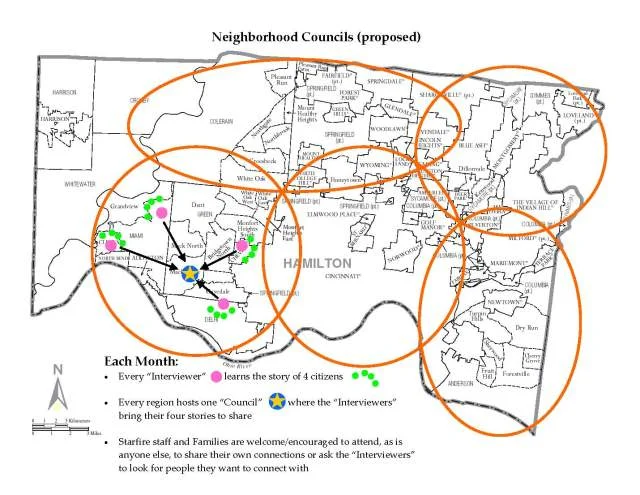
Here’s what we did today in preparation for a interviewer training.  As you know, Starfire’s working on some new goodness.  One of the things Sarah and I have been working on is hiring interviewers in the 5 regions of Cincinnati.  The picture below shows what we’ve been up to.  Tomorrow, we are training our Anderson/Eastside people and will bless and release them to start interviewing and being curious about their neighbors, and tying those connections back to Starfire. (To be potential committee members for capstones, to possible teach a class, to host us somewhere, to be someone potential friend, anchor, ally.)

Here’s what we spend our time on this morning.  Per an interviewers request, she asked for some go-to questions to help frame the conversation when she meets with people.  Together, Michael, Melissa, Ashley, and Kasey worked on this very training tool that will be used tomorrow, and from here on out.  When struggling to come up with questions, Melissa said, “why don’t we use the sharing places and relationships?” as a framework for our questions.  That’s exactly what we did.  In having her present to share her insight, we’ve created a pretty useful document!  It’s posted below.

Some recommendations for being curious & interviewing neighbors

Asking about gifts… Many people aren’t used to thinking of themselves and their communities as “gifted.”  Here is a way to think about what kinds of gifts people and communities might have (adapted from John McKnight).

Head is knowledge. Do you know about history, language, who lives where, where to get something or how to get something done, are you a mentor to others?
Heart is passion. Do you love of children, prayer, a love of the neighborhood, love of sports, passionate about locally grown food, passionate about community activities being free or affordable?
Hands is your skills of any kind. Carpentry, handyman, plumber, guitarist, gardener, seamstress, writer, cook, website designer, engineer, mechanic, bartender?  What things can you can do?
Teachable is what allows the neighborhood/community to grow because of a willingness to share and teach. I can teach kids to play soccer.  I can teach you how to knit.  I can teach computers to others.  I can teach about healthy eating.  I can teach about photography.  I can teach about hosting a party.  I can teach about making crafts. I can teach about childcare.  I can teach about sewing.  I can teach about how to get around the neighborhood/city.

Where to start?

Just the facts…

  • Name, age (optional), street they live on, how long they’ve been in the neighborhood

  • Married?  Single?

  • Children?  Grandchildren?  Other family members?

Sharing Places…

  • What are your favorite places in your neighborhood?

  • Where do you frequent?

  • Where are you a regular?

  • Where do people know your name?

  • Where did you grow up?

  • Where did you go to school? Grade school?  High school?  College?  Vocational? Continuing education classes?

  • Are you active in a church?  Which one?  How long?

  • Where do people meet in the neighborhood?

  • Where are the “third spaces?”  (Coffee shops, parks, community centers, libraries, etc.)

Making Contributions…

  • What community organizations are there in the neighborhood?  (YMCA, Red Cross, childcare centers, senior center, fitness center, local businesses)

  • Are you active in any community associations?

    • Which ones?  What do you do as a member of that organization?  How do people get involved in that?

    • In what ways do you think people could give back to the community?

    • What needs do you see? (don’t let this linger to complaining though)

    • What project would you love to be a part of?  (if you could wave your magic wand…)

    • What is the thing you wish was most celebrated about your community?

    • What do you want people to know about your neighborhood?

Experiencing Respect…

  • What company they might work for?

  • What do you do (for a living)?

  • How did you get there?  Ie: used to be a teacher, now I’m a….

  • What do you think your best trait is?

  • Where do you feel valued or respected in the neighborhood?

Making Choices…

  • What are your hobbies?

  • Where do you spend your free time?

  • Why did you choose to live where you live?

  • What’s coming up for you that you’re excited about?

  • Where might people be able to make choices about changes the neighborhood?  (Community council?  Committees?)

Growing in Relationships…

  • Who keeps the “pulse” of the neighborhood?

  • Who knows what’s going on?

  • Who plans events?

  • Do you have children?

    • What are they into?

    • Does your family live close by?

    • Where did you meet your most recent friend?

    • What do your friends do?

    • How do you spend time with friends/family?

    • Who else in the neighborhood do you think I should talk to? ** (ask this question every time to find your next person to interview)

If you’re stuckhere are some other questions to keep in mind during your conversation.  Try noticing…

  • I see you’re wearing a XU hat. Did you go there?
  • Is that a walk-a-thon shirt?  Do you do charity walks often?

  • That’s an awesome outfit… are you into fashion? Where did you get that scarf?

  • I see you brought a book with you.  What’s that book about?

  • You seem to know a lot of people here…Do you come here often?

Be curious…about something they already said.

  • You said you went to Mexico last week, do you travel a lot?

  • You’re into biking?  How would someone get involved in that?

  • You mentioned that event coming up.  Did you help plan it?  How long has that been happening?

  •  You said you were late because of a running group.  Have you always been a runner?  How many people are in it?  Where does it meet?

  • You said you needed to leave by 7 because of a women’s group.  What’s the group about?

Helpful Tips

  • Share personal information about yourself at the beginning. If you share your interests, family, work, how long you lived in the neighborhood and why this neighborhood matters to you, people are more willing to do the same and it puts them at ease.

  • Give them a brief intro of why you’re interviewing them and what you’ll do with the information.  “I am an interviewer with Starfire.  Starfire is a community building organization that believe that all people have interests, skills, talents, and gifts that should be celebrated and recognized.  I also live in the neighborhood and I think that by knowing our neighbors, we can create a more vibrant and inclusive community where people can grow in relationships, make contributions, experience respect, share common places, and make choices about how they want their lives and community to look. ”

  • Be honest that you are interviewing them to be curious about gifts and your shared neighborhood.  You are not there to collect complaints about the neighborhood or what hasn’t been done over the years.  This is not a time to complain about dislikes and deficits.  You are not to help fix community problems.

  • Use the questions to guide the conversation but let it flow naturally.  You don’t need them to answer every question and you don’t want it to feel like an interrogation.  If the conversation is going wonderfully and is natural, that’s great!  Keep it going and notice what they mention something that sparks your interests, curiosity, or tells you something more about the person and the neighborhood.  For example, they might casually mention the parish festival is coming up for them. This is a great opportunity to find out more about that!

  • While you listen, begin to make linkages in your mind to other neighbors you have already met.  What might this person be willing to share with others?  What might they be willing to teach to others?  What might they be willing to act upon?  Who have you met that this person should meet?  Or what have you heard from others, that this person would also be interested in?

  • Ask if it’s okay to share their information.  (Interest, talents, skills, hobbies, community associations with others who have the same interests.  Explain that all introductions to others would come through you with their permission.)


So this was a morning work with people, as opposed to at my desk alone for people.  We’ve got to keep doing more with, and less for.  Without Melissa, we wouldn’t have thought to frame questions with the five valued experiences!  I can’t wait to use this tomorrow…

timothyvogt
Things Change, And That's the Way It Is -- Part 2

Disclaimer!  This post is continued from here.  Probably makes sense to read that first before jumping into Part 2.

One of the first PATHs I remember was Kathleen’s.  You remember Kathleen’s story from here where she writes of her PATH with Katie.  Kathleen had a full room.  Admittedly now, it was of paid staff, and family members, and other people with disabilities.  We’ve gotten better over the past two years of understanding why the invitation to others too is so important.  But there was a shift immediately felt.  Overnight, Kathleen went from being someone defined by disability to someone with goals and plan of how to get her there.  Her parents saw her a little differently, she saw herself a little more realized.  I think of the staff that attended, we saw a clearer picture of what our time together could really be about.

Kathleen’s PATH. You can see how different (plain) the PATHs looked back then. Since we’re being honest, I also thought pastels and shading were hokey. I’m happy I changed my mind on that issue, too!

And we saw this, for the most part, again and again with people’s PATHs.  Seeing the power of Kathleen’s dreams for herself put down on paper made it very clear to those in the room, that yes, this is part of what can help us take people’s lives seriously, and there is a different story that can be told.

Our house, 2009.

I write this to be honest about how things change.  I did buy a house in October of 2009.  A little two bedroom in Madisonville with a big backyard.

Too many tomatoes!  Actual photo from 2010

That spring, Jordan and I started tilling up the ground and planted about 4 tomato plants.  We had more tomatoes that summer and fall than we could eat.  One such plastic bag full of pounds of tomatoes led us to share them with our neighbors.  “Please, take these. We can’t eat another tomato” we told them one day when they were talking on the sidewalk.  This is how we learned Cindy’s name (two doors down), and Amy’s name (across the street), and was advised not to worry about the guy that jogged up and down the street in the middle of the night with a flashlight.  He’d creeped me out for the past year that we’d live there and it felt good to have someone say he was harmless.

October 2011

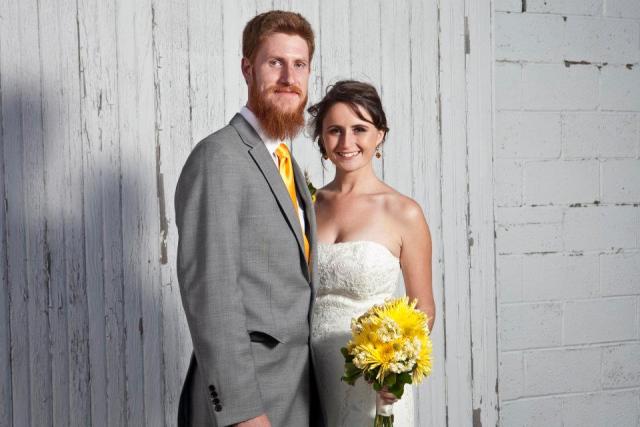
Jordan and I decided in 2010 that after 7 years of dating, owning a house together, and raising two dogs that we were ready to get married.  We got married last Fall, another positive and possible I said in my mini-PATH.

Bees.

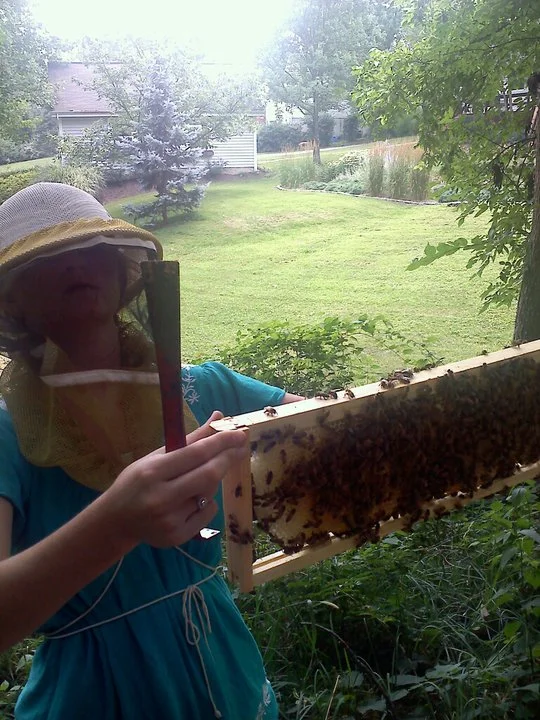
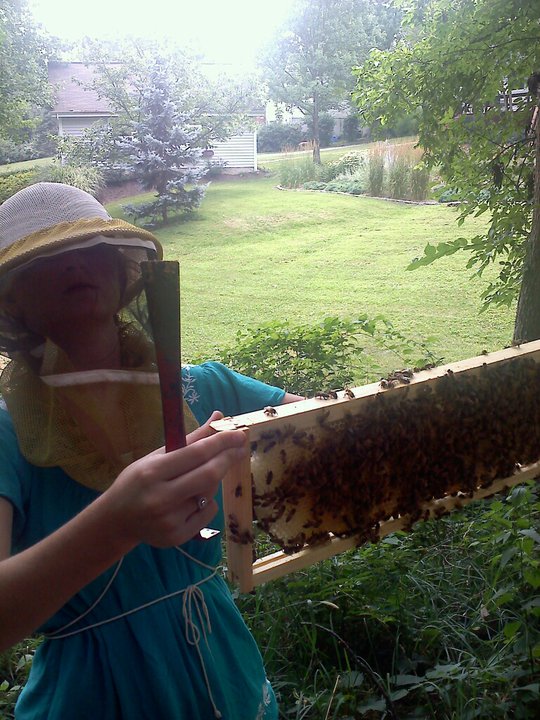
And, believe it or not, I also sought out a person to teach me about beekeeping.  And Liz did, gracefully.  And I learned, with her encouragement, completely gloveless.  As for writing, this marks my 24th blog post on Cincibility.

PATHs started, for me, the journey of understanding giftedness and how to talk about it.  We talk a lot at Starfire about rusty citizens.  I thought I was a good person, active, involved, aware of my community before I started in 2008.  I wasn’t even scratching the surface then.  I know that 2009 was the shift that was needed.  PATHs, person-centeredness, deeply thinking about what is positive and possible changed the journey for me.  It lead me to start working actively with people in their third year (2010-2011) to find volunteer positions based on their PATH goals.  Steven became a docent at the Holocaust and Humanity museum.  Nikki a hospital volunteer at Children’s.  Ronny, an radio intern at Media Bridges.  Kathleen a childcare assistant at a church.  Mike a volunteer at the Hamilton County Republican Party (there’s a great story of how we connected there that includes fawning over pictures of Michele Bachmann and Sarah Palin.  The things you do for people you care about!), an intern at the United Way, and to help him become employed at GBBN Architects.  Krista was a photographer for the University of Cincinnati’s documenting the ZooMates program.  Justin was an assistant baseball coach for a 3rd grade team for a few weeks.  Tim, an intern in the athletic and alumni departments at a highschool school.  Brian a volunteer at a preschool a mile from his house.  Jason as a caretaker of a horse with another person at a local farm.  Lauren as a respected volunteer at the Girl Scouts, leading troops during their school day who do not have the resources to do so as an afterschool activity.  Bridget helped JC connect as a maintenance man at a local megachurch.  As it turned out, Kirk, the head of maintenance realized at JC’s birthday party some months later that they had known each other from going to the same church when JC was was a child.  They reconnected because of Bridget’s ask if JC could share his skills there.

I quoted Wolfensberger in graduate school, but finally saw what he meant by valued social roles, and how it can change the way we see people, and the way we treat people.

What was the next step?  This was the third year of Starfire U.  The fourth year was fast approaching.  How could we build upon valued roles, the five valued experiences, and put some of this into action?  How could we invite others in to see what we’ve been talking about, and join us?  How could we roll all that we’ve learned into this?

What we are called to do with each other, is to let us be who we are together.  How could we do that in the fourth year?

timothyvogt
Things Change, And That's The Way It Is -- Part 1

“I’d like to go back to when we played as kids, but things change, and that’s the way it is.” –2PAC

I’ve not allowed myself much time to reflect on the past four years, and what it means now that those who started with me aren’t present in the day-to-day.  This week is a grace period for me.  I haven’t actually had a normal full week without Kathleen, Ronny, Joseph, and others.  Last week felt like any other time that we were closed for a week: staff worked on loose ends, organizing, planning.  Then, leaving for Toronto on Friday, again, there was a quickness of moving away from the commencement ceremony.  Tim posted the back of the program which I wrote, and he and Lauren edited.  Though it’s written by me, I attempted to use a voice that was universal about how (I think) we all felt about what we’ve experienced.  But everyone has a personal story of what 2008 through 2012 meant.  Here’s a bit more personal of a reflection of the past four years.  I hope to do this in a series of posts instead of one large lengthy reading.

In 2008, I was 22 years old.  I had already failed and grown to loathe one career, the path I’d thought I went to Xavier University for: high school teaching.  I wasn’t sure what I should be doing.  Most people don’t have a crisis of identity at 22, but I did, quite real with panic attacks, weeping, and feeling utterly immobile.  Most people don’t quit their first grown up job after 3 months, but I did that too.  It felt pretty miserable.

I had a small studio apartment in Walnut Hills, a dog, a boyfriend, and for once, no real direction or understanding of what I was working towards.  I have to mention, that it was because Jordan understood how unhappy I was, that we decided quitting my job was a better decision than being constantly miserable.  We lived off of his income alone for a couple of months while I did my best to take my time figuring out what I wanted to do, albeit, quickly.  His “income” being that of a 21 year old full-time college student who moonlighted as a 3rd shift UPS employee.  We ate a lot of chicken patties bought in frozen bulk from Sam’s Club.  Someone asked me last year right before we got married, how I knew I wanted to marry Jordan.  I think frozen chicken patties and working 3rd shift to allow me to find out what I’m supposed to be explains a lot of that.  It might also explain the reason behind elaborate meals that I cook and post photos of to Facebook.  A continual thank you to him for bearing through it with me.

jord-2007-2.jpg

Jordan and I, 2007.

After I quit teaching, I managed to find a temporary position through high school connections.  I became an instructional aide in the high school setting again (not teaching exactly) and was already disgusted in my short seven months in the special education world.  I was placed in the resource room and I was working at the same high school that I went to, but had had no idea that the resource room existed.  No, it wasn’t in the boiler room or hidden under the stairs, but it might as well have been.  The only people who really ever came in were the same kids day after day, and the intervention specialists.  Everyone in the resource room had an IEP and everyone in the resource room was lumped together because of some arbitrary commonality: something was “wrong.” Ranging from 10-20 students in any given bell, with any type of problem, developmental disability, learning disability, behavioral problem,  and including “bad kids” who were sent there too because they wouldn’t shut their mouths in class, sit down, and listen.  Since I wasn’t teaching curriculum, there was a lot of talking, tutoring, and listening.  I read tests out loud.  I locked up modified tests in a little red cabinet per regular education teacher’s request so that no one had “an unfair advantage” over the regular education kids. (That still makes me laugh thinking about the ridiculous notion that special education student could have an unfair advantage in education.)  I provided extra time on tests.  I witnessed the madness of OGT (Ohio Graduation Tests) prep and the rules for exceptions.  I don’t recall the exact details but something along the lines of, if you fail to score the minimum needed for passing after three attempts, and you have an active IEP, then you’re okay and are not required to pass them to graduate and receive a diploma.  I can’t imagine the feeling of needing to struggle through five sections of such a large standardized test, and then fail the tests three times in order to prove that yes, in fact, you’re not as smart as everyone else.

In March and April of 2008, I applied for over 50 positions at non-profits in Cincinnati.  I was (and still am) sincerely interested in everything that has to do with people in our city so there were a lot of scenarios I could easily imagine myself fitting into.  A homeless shelter needed a front desk person, could that be me?  Working in Neighborhoods needed people to counsel about predatory lending, could I do that?  Pregnancy Center East needed a director, maybe I could figure that out?  A case worker was needed at Santa Maria helping people experiencing poverty link to resources in Price Hill, sure, that sounded cool.  A non-profit in Madisonville is looking for people to work in a new program for people with disabilities, I applied for that, too.

In hindsight, I couldn’t have lucked out more.  I guarantee that those who interviewed with Krista and Tim for that same position were more “qualified” than I was.  22 at the time, and quitting 3 months into one job and working 7 months at another, my resume didn’t tell a very flattering story of who I was. I don’t recall all the details of the interview, but I remember Tim asking if I didn’t have experience how I could do the job well (or something like that.)  He seemed off-putting and the question was phrased in a way that threw me off guard.  I remember blushing (I do that easily as you’ll recall from this post) and I responded that I wasn’t a black teen with behavioral problems on an IEP, I wasn’t a homeless woman struggling with addiction (I had interned at the Drop Inn Center in 2003), I wasn’t a 14 year old girl with Down Syndrome and I wasn’t a teacher anymore, but I thought some experiences were universal and regardless of background, demographics or whatever else, people were people.

In June of 2008, 25 other 20-somethings started Starfire U that year with me.  They weredefined by their diagnoses, labels, and files from high school and other programs.  I was defined by a degree and a shoddy resume.

In that first year, we (I) didn’t know what we (I) were (was) doing.  Calendars were juvenile, staff planned only, and quite honestly, embarrassing to look at now.  Tim has shown a picture of himself dressed as Santa Claus at a big dance for people (adults) with disabilities and talks about how he thought that was okay then.  It’s shameful, but it’s part of his story and I’m grateful he’s willing to tell it honestly.  The calendars of 2008 are that for me.

Parking Lot Olympics, August 2008

Parking lot Olympics with a torch made out of an umbrella? Sure!  80’s Dance Party on a Thursday afternoon?  Yes!  Mystery clues placed around the office with construction paper footprints leading to a whodunit conclusion?  Of course!  Trying on and wearing Native American dresses while a woman from Imago presents the same presentation she does for grade schoolers?  Why not?  Ice-cream social 10AM on Monday!

I would explain my days to friends and they’d be jealous.  It became a sort of sport for them, I imagine.   “So… what did you do today?” I’d be asked.  “We made cookies for firefighters.”  Or, “we made a dream catcher.”  Other staff of Starfire U could respond, “We went to Coney Island” or “We went to Ride the Ducks on the river.”  “We played putt-putt.”  You see, at that point, certain staff lead the “field experiences” (how clinical, I know) and some did “seminars.”  I, given my extensive teaching experience I suppose, was delegated to seminars.

I can guess now what my friends were thinking then.  How could someone’s career be so trivial?  They were studying to change the world through social justice, computer science, nursing, and criminal justice.  Weighty topics of importance.  I, with all my education and training, was decorating dollar store wooden picture frames with disabled people using Crayola paint and magazine clippings.

Something shifted in the first year that only distance from those early months can reveal.  If I continued to tell a story of cookies, dance parties, Coney Island, and art projects, I would also continue to perpetuate the notion that our work was silly, and meaningless.  If our work was silly and meaningless, so were people’s lives.  I honestly knew then that this wasn’t the case, but I wasn’t sure what else it would be.

I enrolled in graduate school at the University of Cincinnati full-time in 2008 and began working on a Masters degree.  I thought this was important to my career moving forward and I know now it was more for ego than for anything else.  I enrolled in the educational studies program, cultural and social factors of education and what makes some people succeed and some people fail.  It was there that I started doing some deep intentional reading and found some clues to how this work could be more than silliness and entertainment.  I read dozens of articles about inclusion models in education.  I learned about self-efficacy, and self-determination.  I read about segregated workshops originally being intended to be a springboard into community-based employment.  An article called “The Myth of Transition” described how the opposite effect has happened.  The research showed that people do not learn skills, but in fact become less employable in community positions after working in segregated workshops.  I read and wrote about the history of segregated schooling, supreme court cases like Olmstead, local laws, what impact the Americans with Disability Act (ADA) really had.  I refreshed myself on Bandura’s social learning, Zimbardo’s experiments on control, abuse of power and obedience.  I realize now that I even quote Wolf Wolfensberger in one specific research paper but didn’t fully comprehend who he was, and how much that would radically change my work in the coming year.  I quoted him in a section exploring relationships: “Social roles dominate people’s lives, and people largely perceive themselves and each other in terms of their roles. The value people attribute to various social roles tends to decisively shape their behavior toward persons whom they see in valued or devalued roles. Those in valued roles tend to be treated well and those in devalued roles, ill.”

It was evident to me then that a wealth of knowledge, theory, debate and questions around disability existed.  None of it seemed silly, or trivial.  None of it had to do with fun activities.

Cover of Amusing Ourselves to Death

amusingoutselves.jpg

If entertainment was our purpose, it would also be our outcome.  I had read in high school with my then English teacher Jason Haap, Neil Postman’s “Amusing Ourselves to Death” alongside George Orwell’s 1984, and Aldous Huxley’s Brave New World.  I think back on Postman’s writings frequently, especially in the context of taking people’s lives seriously, and the role of entertainment in our life.  Was my role to entertain people, give them happy memories, pat myself on the back and call it a day?  Or was there really an opportunity that was bigger here to affect change in the story told about Down Syndrome, Cerebral Palsy, Autism, and all the other big box names we give to disabilities.

Postman writes in Amusing Ourselves “Everything in our background has prepared us to know and resist a prison when the gates begin to close around us . . . But what if there are no cries of anguish to be heard? Who is prepared to take arms against a sea of amusements? To whom do we complain, and when, and in what tone of voice, when serious discourse dissolves into giggles? What is the antidote to a culture’s being drained by laughter?”

Was my work drowning people in a sea of amusements?  Was it a distraction from real life?  The approaching second year was a game changer.  Bridget learned about PATHs, and lead a staff training on it to bring us along.  “we’re going to offer PATHs to all the members.”  I remember it well.  Jewell, John, Bridget and I were all in a group.  We did very small personal mini-PATH’s (the North Star conversation only on speed.)  I remember my North Star included buying a house, getting married, learning about bee keeping, starting a garden in my backyard, writing, and a few others that I can’t remember.  I was skeptical about the whole process, not buying into the hippie shit of drawing what you’re feeling and dreaming out loud, and all the other hokey stuff I thought I’d left behind from when I planned retreats.  At some point, I became embittered by it.  We gathered as a large group again, shared our North Stars and at the end of the afternoon, everyone rolled theirs up and took it to their desk.  “I’m going to keep this” someone said.  “I’d love to hang this above my desk as a reminder of what I could be.”

PATH

I’m embarrassed and ashamed now to say that I felt very differently.  I immediately crumpled it up and recycled it.  The idea of “writing something down and seeing it as an image makes it more probable to happen” was bullshit.  I was not an immediate believer in the process, and wasn’t buying that this was something that would really change people’s lives.  And who cares about drawing pictures?  Was I ever going to really learn to keep bees?  Buying a house?  When I’d just graduated in 2007 with large amount of student loan debt and was paying out of pocket for graduate school?  Whatever.   This was Winter of 2008/early 2009.

I had a lot more learning coming my way…

timothyvogt
With Gratitude

This is the back of the program from last night’s commencement for people finishing up their fourth and final year of Starfire U.  It was written by Candice, and is a beautiful way to sum up everything all of us are feeling and thinking about together.

with-gratitude-6-28-12.jpg
timothyvogt
Sticks & Stones

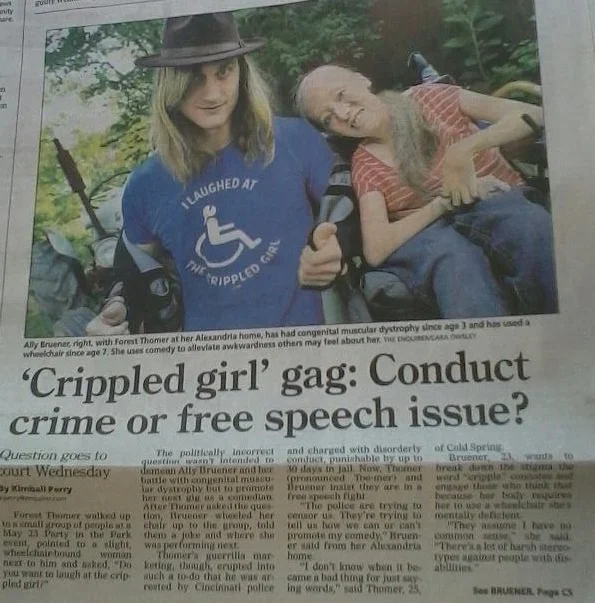
I got a phone call this morning from a reporter from one of the local news stations.  He wanted me to comment on the ongoing saga of Ally Bruener, a local comedian (and a fellow Campbell County High grad…Go Camels!) who has been promoting her comedy shows with some pretty provocative marketing:

crippled.jpg

The story is now on the Huffington Post and USA Today; and with her partner’s court case being this afternoon, the reporter wanted a quote.

He called and explained the story to me and asked for my opinion on whether or not it is ever OK to use the word “crippled” to talk about someone.

I asked him if he had quotes from Ms. Bruener herself, and he said that he did and he had quotes from her father as well.  I then declined to be quoted, as I told him I felt it better to defer to Ms. Bruener and her family as to how they want to talk about themselves.  He said that since he’s already got their point of view, he was looking for a quote to “balance” the story.

I pointed him to ADAPT as advocates that would probably be very supportive of Ms. Bruener’s “taking back the word,” whereas other advocates might not.

He then asked me if I would ever use the word “crippled” myself and I told him that I wouldn’t, just as I would also not use the word “retarded.”

I told him that my reasoning for that is this:

How we speak about people reflects on what we believe about them.  And what we believeabout them reflects on how we treat them.

In other words, our language drives our actions, and if we limit our description of someone to that of “crippled” or “retarded” or “handicapped,” then we are limiting our thinking about them to one very narrow aspect about who they are.  And if we let that narrow label define their life, we perpetuate a perception that permits the world to isolate them, take away their rights, and do all kinds of things that most of us would find intolerable.

I didn’t get into all of this with him, as he expressly asked for a soundbite.  Can you imagine fitting all I’m writing here into a 2 minute news update?  He told me how tough it had been for him to get anyone to speak on behalf of other people with disabilities on this issue.  I told him that it was impossible for me or anyone else to “speak on behalf” of the 8,000 people with disabilities in Hamilton County and that I thought it was for each of those people (and their families) to speak on their own behalf.  I apologized for not being very helpful and acknowledged that it was a nuanced issue.

If you read all the comments in the articles and by commenters, you’ll see the truth in the issue, at least for me:

–It is her right to use that word how she sees fit, however distasteful it may be to others.

–That word and others like it (retarded, handicapped, etc.) are not helpful words.  They create barriers between people with the label and those without.  Those barriers lead to most people with the label being treated pretty poorly.

–The marketing was extremely successful, and I imagine most comedians would kill for the free publicity she’s getting out of this.

–Arresting people who make us uncomfortable doesn’t seem to be the way to go about building a more just and caring society.

That doesn’t mean that I approve of using words like “crippled,” “retarded,” “nigger,” “faggot,” “chink,” or “kike.”  Marketing for shock value or advocating by “taking back the word” doesn’t let me or Ms. Bruener or you or anyone else off the hook for being respectful, thoughtful, and careful with our language.

That also means I run the risk of being branded as “politically correct.”

Can’t you just hear it?  “Here come the word police again!”

But here’s the deal:  until you (or people you love) are on the receiving end of one of those labels, you cannot imagine the hurt it brings.  And my guess is that even if you’re “taking the word back,” you’ve been hurt by it, as have millions of others both living today and in the past.

So why perpetuate it for a few cheap laughs?…unless you’re in the business of getting a few cheap laughs, I guess…

timothyvogt
Be Hopeful

Ronny sat behind my desk for months with a red drum between his legs.  A bungee cord wrapped around the drum and placed behind his back to keep it in place.  In the morning before a seminar, during lunch after he’d eaten, at the end of the day waiting for his ride, he’d sit there.  bum, bum, bee, bum.  Sitting behind my chair, I’d hear the thumping.  Responding to emails, working on credit card receipts, in the background of the mundane office tasks there would be the constant, bum, bum, bee, bum of Ronny and the red drum.

Ronny welcomes everyone to Be Hopeful

photo9.jpg

I’d answer the phone, be in the middle of a conversation and hear that persistent bum, bum, bee, bum.  Ronny, drumming.  At one point, I begged him to stop practicing behind me.  “Ronny, please…can you do that anywhere else?”  He smiled and in his voice, “Man, I gotta practice.”  He allowed me to move the drum to the Commons one day and he practiced with a small audience at lunch.  The next day the drum was behind my desk again.  Ronny came in in the morning, sat down, affixed the bungee cord around himself and the drum and bum, bum, bee, bumbum, bum, bee, bum, bum, bum, bee, bum, bum, bum, bee, bum, bum, bum, bee, bum, bum, bum, bee, bum.

It became a funny thing, and inside joke that constant drumming.  Ronny would laugh when he came back to practice and when Kathy or I responded to a particularly annoying email or got off phone call that was exceptionally frustrating, we’d walk past and bang on the drum ourselves.  Kathy would walk past and bum bum bum, bang on it.  I’d wrap up credit card receipts which always take longer than I hope and bum, bum, bum on the drum.  Ronny continued to practice.  In addition to the drumming, there was also a chant.  Hey, yay, yay, yay, yay.

“Ronny, please.  Can you sing something else?”  And he’d respond, “I have to practice….Heyyy, yay, yay, yay, yayhey, yay, yay, yay, yayhey, yay, yay, yay, yay.”

photo7.jpg

Ronny, center with the red drum. Baoku, right, Chelley, left of Ronny.

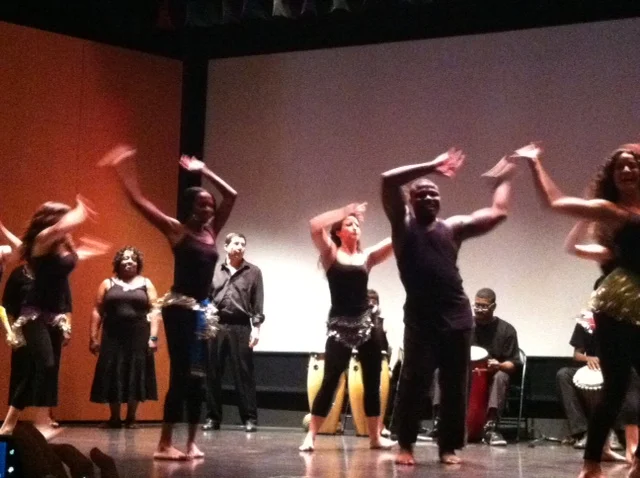
On Saturday, after months of hearing the repetitive drumming, the repeated bum, bum, bee, bum and Ronny’s deep voice singing hey, yay, yay, yay, yay on constant replay, Be Hopeful premiered at the Cincinnati Art Museum.  I’d been in the office late a week or so before the premiere and got to glimpse a rehearsal in action.  It looked as all rehearsals do a week or two before a performance: people holding scripts, asking questions, a director pointing to a place where a performer ought to be standing, but it was full of energy, people smiling, dancing, drumming, laughing, singing.

photo14.jpg

Katie Bachmeyer wrote an excellent article for Be Hopeful on Cincinnati.com.  It read, “Movement, beats, and powerful vocals collide next weekend during the live performance of ‘Be Hopeful.’ Audiences can expect a lively, soul-quenching hour of African drumming, Colombian dancing, and spoken word from an eclectic group of artists who want to share their story of hope and freedom… “It’s a story about who we really are,” said Ronny Edwards, Mt. Healthy resident who is co-creator of the event. “Not just who you see when you pass each other by on the street, but who we are as people.”… For the project, he teamed up with the head of The Image Afro-beat band, Baoku Moses. Together the two gathered a group of over 20 professional musicians, dancers, and spoken word performers to bring life to Moses’ choreography and words. “My people say that when we lose hope, we lose life. Hope represents life itself,” said Moses, Nigerian-born writer and director of Be Hopeful. “What has come out of this project is brilliant, with so many artists coming together from different backgrounds, it has ended up being magical.” Moses said the performance is for all people, genders, ages, and creeds, and especially those who have lost hope and are searching for something to believe. They chose the first showing to be held at the Cincinnati Art Museum on a day of free admission, as a way to draw families and a diverse, wider audience. “We always look for ways to represent all segments of our community,” said Emily Holtrip, director of learning and interpretation at the Cincinnati Art Museum. “Be Hopeful is right along with our mission to become even more inclusive and welcoming.” Along with Moses and Edwards, the cast includes professional dancers from Pris and Columbia Viva, along with artists from the socially conscious rap group T.R.U.  “

Katie told people to “expect a lively, soul-quenching hour.”  I had no idea how right Katie was.  You can watch a sample of the performance here.

Tim’s post of 51 People is the bleak reality of many peoples lives.  Sitting as an audience member on Saturday, I cried watching Ronny, the dancers, listening to Baoku sing, hearing the spoken word poetry, seeing Jai All Day be a presence as the emcee for the event.  Brandon, who had help Ronny with his capstone the past year, performed about the strength of people being together.  He held up a single sheet of paper and ripped it, easily down the middle, and talked about how by ourselves we are weak, easily broken, discarded.  He then held up a whole notebook, trying to rip it in half, it was evident.  If the paper equals people, together we are stronger.  And there is hopefulness in more pages coming together to tell new stories.

photo18.jpg

Brandon attempts to rip the notebook

Ronny’s voice by himself, the hey, yay, yay, yay, yay wasn’t bad.  But his singlular voice didn’t carry the message that Saturday’s performance did with many voices harmonizing, joining in, singing out, being hopeful.  The one beating drum bum, bum, bee, bum didn’t have the strength of three.  One dancer on stage doesn’t have the power of 10.

There is hopefulness in bringing people together.

If you missed last Saturday’s performance, there is another happening this Saturday, June 16th at 7:30PM at New Thought Unity Center. Suggested donation is $10.

If you were struck by Tim’s post and aren’t sure what to do about it, attend this performance for starters and see what it means when people come together and begin to recognized everyone as gifted, talented, and a part of a community of hopefulness.

timothyvogt
51 People

The other day, this article on the Huffington Post went viral, at least within my circle of friends.  Candice wrote about it as well here.  There were lots of mothers, especially, imploring people to read it.  And one friend sent it out along with the insightful and challenging question “What are you going to do about changing this reality?”

I thought it was a great question, as it acknowledged the reality of the fact that people with disabilities don’t have many friends, and then threw down that beautifully simple and sadly pathetic gauntlet:  What will you do about it?

I immediately thought of a tool that we’ve adopted to tell this story, the “51 People” research and graph (click this link for a full size version):

51-people.jpg

This is local research, done by Jack Pealer.  Jack has lived and worked in Ohio for a long time.  He learned about person-centered approaches and SRV in the 80’s and has been one of our most informed and thoughtful voices for inclusion ever since.  He has helped me personally a great deal in understanding what all of us are up against together in this effort.

Back in the early 90’s, Jack asked 51 people with the label of disability a simple question:  “Who is in your life?”  This is the result of that research.

To me, it prompts two more questions:

  • Does this look like my life or the life of most people without disabilities?

  • Has anything changed in the past 20 years to improve this picture?

To answer the first question, let’s break the graph down, and start with “Family.”

family-comparison.jpg

So in the research, Jack found that people had about eight family members in their lives.  That seems about right to me.  Many of us have lots more family, and we may have a lot of extended family that we can name, but may not see often.  And we can count in-laws, which double the numbers.  But overall, I think this seems in line with what I consider to be my “close family.”  If my prospects for marriage were as slim as those of us who have the label of disability, I would have around 8 family members in my life as well.  Since I’m married, I have twice as many.

In the next part of the graph, we see how many “Paid Human Service Professionals” are in the lives of the 51 people.  These would be people like group home support staff, staff from places like Starfire, day program staff, teachers and others who are paid to be in the lives of people with disabilities.

When I think of the people I pay to be in my life, I think of mechanics, carpenters, doctors, and the barber.  You could also think of hairdressers, landscapers, lawyers, accountants and bus drivers.  I have those kinds of people in my life, just as people with disabilities do.

But…

paid1.jpg

…there’s waaayyyyy more of them.

Kathy Wenning has helped me really understand the difference, though, between the people paid to be in my life, and the people paid to be in her son Joe’s life.  In my life, I have power over these people.  I can fire them if they don’t do a good job.  In Joe’s life, these people have power over him.  They build the programs, they make all the decisions, they fill the calendars and hold the purse strings.  They may say that Joe gets to choose, but in most cases, Joe is simply choosing from a menu that they have created for him.

I also get to pick who these people are…I hire them.  I decide if I want to pay a lot for quality, or if I want to go for the cheap option.  But Joe has these people hired by managers for him.  The quality of their training, attitude and the level of care is completely random, depending on the staff, their supervisor, and the agency.  Joe also can’t choose whether his favorite staff decides to take another job or gets promoted out of his life.

In my life, these people also play a very small role.  I may interact with them anywhere from one to four times per year.  Even if I had a therapist that I saw once per week, it would only be for an hour, and it would be limited to a set number of sessions.  So if they were promoted or moved away, it wouldn’t be a big loss to me.

For Joe, these people are a big part of his life.  When he moves out of his parents’ home, he’ll probably be in contact with a paid person every day for the majority of his waking hours.

So we may have paid people in our lives, but those of us with the label of disability have a lot more of them.  And if we have a disability, chances are the paid people exert more control in our life.  Big differences, huh?

The next section is the crux of the problem (but luckily something we can all do something about)

friends.jpg

The 51 people reported having an average of 2.41 friends without disabilities, and 2.75 “other citizens.”  We can assume that these “other citizens” might be neighbors or people from church, perhaps.

This is where my life and the lives of these 51 people starts to really look different.  I have over 700 “friends” on Facebook.  I would say that about 50 of them are actively involved in my life.  In addition, I have another 50  or so “other citizens” in my life:  co-workers, neighbors, people who go to my church.  Many of them are potential friends in waiting, right?  So for me (and most people without disabilities), this part of the graph is filled….packed!…with people!

There’s a stark contrast between those images, huh?

The final quadrant is also important.  It shows the results of a system that serves people with disabilities throughout their lives.  They go to separate classrooms and even separate schools.  They participate in Starfire outings and Special Olympics with other people with labels like theirs.  They work in workshops and enclaves with each other, and they live in group homes together:

others-like-me.jpg

We can personally think of this section of the graph in two ways:  Do we have any friends with disabilities in our lives?

In my graph, I chose to count five close friends that have the label of disability and put them in the “friends” section.  They have spent time at my house, and me theirs.  Our families know each other and we see each other in many different places and on some holidays.

Most people without disabilities do not have actual friends with disabilities (If they did, we wouldn’t be having this discussion!)  They may know someone from high school, or they may volunteer at Starfire or some other place, but they don’t call them up on a Friday night, or meet up for coffee.

There’s another way to look at this part of the graph.  We can also think of it in terms of the segregation that is evident in the picture:  We can ask how many friends we have who share our negatively perceived labels.

Most people also do not get forced to work with, live with, hang out with, and go to school with people who share their same problems, limitations or insecurities.  I chose to chart the number of people in my life who were, like myself, overweight.  Notice that those people are my family members, my friends and my “other citizens.”

What if we said that everyone who got speeding tickets could only hang out together?  Or what if everyone who takes Viagra had to live in the same house?  (OK, that would be really weird!)

Side by side, these graphs make it pretty clear what is happening to people with labels of disability:  they are leading an unnaturally segregated and unbalanced life:

life-comparison1 (1).jpg

Take a look at the bottom of the “51 People” graph.  There’s a note that reads “9 of the 51 people had only paid human service professionals and other people with disabilities in their circles.”

This is why this is so very important.

As parents pass away and brothers and sisters get busy with their own lives, if there’s no one else in their lives, then people with disabilities are at a serious risk of having no one else in their life who isn’t either another person with a disability or someone paid to be there.  If they have crappy and/or overworked staff, they are at their mercy.  If they want to do something with their lives that the paid staff don’t know about or don’t want to do, they’re pretty much out of luck.  If a terrific staff moves on, who knows who might take their place.  They don’t get to experience the respect of being loved for who they are.  Their chance to live a good life is pretty slim.

Remember how we had these two questions at the start?

  • Does this look like my life or the life of most people without disabilities?

  • Has anything changed in the past 20 years to improve this picture?

Well, we’ve answered the first definitively:  No, this does not look like my life or most other people’s lives who do not carry the label of disability.

And the tragedy is that in conversations with parents of people with disabilities, when I ask that second question today in 2012, they become quiet, shake their heads and say something like “Nothing has changed.  This is exactly what my son’s/daughter’s life looks like.”

And remember my friend’s insightful and challenging question about the article:

“What are you going to do about changing this reality?”

I said the challenge was beautifully simple and sadly pathetic:  Be a friend to someone with a label of disability.  Do what friends do…hang out, call each other, worry about each other, make a fuss over each other on birthdays, joke with each other, introduce each other to new friends.

Simple, huh?  So…..what will you do about this reality?

Feel free to offer up questions, thoughts or objections in the comments section if this is unsettling or confusing.  I can try to answer them in later posts.

timothyvogt

On Wednesday, I went to Raven’s, (my youngest sister) spring performance.  It was a typical K – 8th grade music concert.  A stage, a couple of bad microphones, adorable kids with missing teeth, tiny Kindergartners, awkward 6th graders,  pre-teens too cool to care their parents are taking pictures and tearing up at their songs.  I took this picture of Raven next to her art work (left) because our mom couldn’t make it to the evening.  I did the mom thing and embarrassed her.  I’ve posted it below to add to that effect.

rave.jpg

isn’t she adorable?

While I was there I was known as “Candi” not Candice.  I ran into my Kindergarten teacher, Mrs. Marois, my fifth grade teacher, Mr. Mohr, my 8th grade math teacher, Mrs. Hamm.  I saw my 7th grade teacher, Mr. Cameron, and a couple of moms of people I went to grade school with, who are now the grandmas of kids Raven goes to school with.  It was a nice enough evening and Raven and I wound up going to the reception in the cafeteria afterward.  It was there that I talked to other people who knew me whom I haven’t talked to much over the past 10 years.  They asked about my mom, our sister Jen, how Starfire was going, congratulated me on my recent wedding.  They knew what I’d been up to, kept track of me and my family since grade school.  They knew who I was, still cared, and were curious about what I was up to.

In my small group during Thursday’s meeting, we decided to talk about hard conversations and how much you push towards valued roles, experiences, and the like and when to just not push.  In hiring connectors for fourth year members, I’ve been frustrated with not getting names or help from families.  When asked “who do you know that…?” some people have come up blank.  “We don’t know anyone” I’ve heard said.

Thinking this couldn’t possibly be true, given my experience on Wednesday night of running into 10 or so people who know me that I haven’t talked to in years, I began to think about how my childhood and life was probably much different than anyone’s life that was labeled as a “member of Starfire.”  My small group, Courtney, Katie, and Bridget agreed, thinking about their lives, too.

Bridget told a story about her son Aaron’s primary grade awards that took place that day during lunch.  The teachers were honored during the assembly.  The special ed teachers were thanked first and moved quickly to the left, she recounted to us.  No one clapped, and they quickly moved out of the way for the next teachers to be honored.  Bridget noticed this and thought it was strange.  Next, the kindergarten teacher was a celebrity!  There was applause and the other teachers being honored formed a line next to her and smiled and clapped.  Bridget wondered out loud about the difference she saw.  We all guessed that the special ed teachers weren’t known to many in the school.  They weren’t seen by many, and no one clapped.  (Probably Bridget said, because most people didn’t even know they taught there and had no idea who they were).

Who were our friends in grade school and high school, we asked?  Bridget answered, the people who did the same activities as us.  I had softball friends because much of my time in the spring was spent playing softball.  I had Girl Scout friends because we had a Thursday night girl scout meeting in the parish center and had badge ceremonies.  Sold cookies after Masses, went on field trips.  We had songs and the Girl Scout Handbook.  We had secret handshakes and uniforms.

It’s no surprise that kids with disabilities often get left out of this stuff.  If you’re not on the softball team because you’re no good at it, then you miss out on months of practices, games, team parties, the bonding time being driven around by other people’s parents.  If you are on a softball team and you have a disability it’s probably a special team, with all kids with disabilities.  None of those opportunities, of course, are necessarily bad.  But they aren’t typical.  You miss out on awards night with everyone else in the school gym and maybe sleepovers and inside jokes with the rest of your classmates.  If you’re not in Girl Scouts because you couldn’t do all the things required of earning badges (which used to be the case), or couldn’t go to sleep-away camp because you needed help with some things at night or eating, or other personal stuff, then you’d miss out on all that too.  You can see where the narrative leads.

So when we get to PATHs and capstones, the question of “who do you know?” or “who knows your son/daughter?” often stumps people.  There often weren’t friends (or many of them) in grade school, high school.  Not a lot of ordinary citizens that spent time with their son or daughter because they wanted to.  Kathleen Cail posted a link to an article about friendship last week that a few of us shared on Facebook.  If you read it, you’ll see just how important it is to have people in someone’s life that choose to be there.  The author writes, upon learning of her son’s diagnosis, “At the time, we didn’t question that Ben would have friends. We didn’t know that being friendless was the norm for kids with physical and intellectual disabilities.”

In 2008, each member of the current senior class was offered a PATH.

path-049.jpg

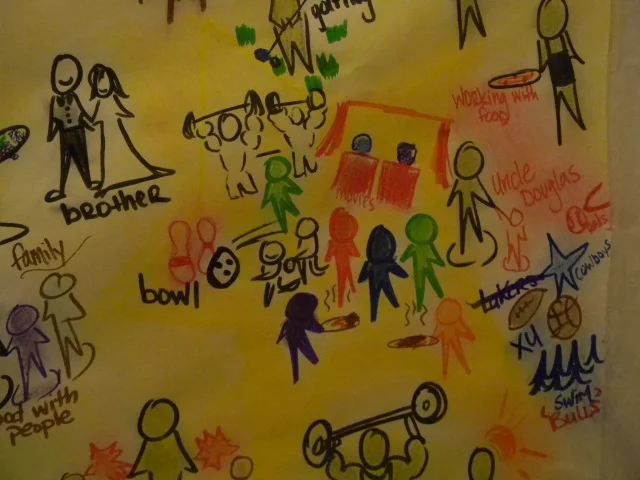
Douglas’ Northstar; as a brother, Douglas is walking his sister down the aisle this Fall at her wedding!

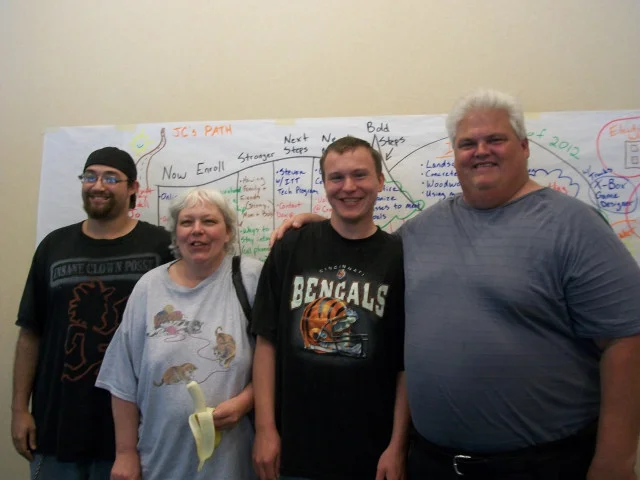
Of those 21 people, only one person had an ordinary citizen present in their planning circle.  Jeremy, a long-time friend of JC’s attended.  Jeremy was a friend from Norwood HS who had kept in contact with JC.  They watched wrestling together, listen to metal music (note Jeremy’s Insane Clown Posse t shirt), hung out.  They were, and are, still friends.

june-283.jpg

(from Left to Right) Jeremy, Jackie (JC’s mom), JC, and Uncle Bob

This year, we’ve been much better at asking and inviting.  This leads to a different story for people.  In a recent PATH, Douglas mentioned that he wanted to work out a gym with some guys in his positive and possible conversation.  A service facilitator recommended services and day array program where fitness was a focus.  But, in Douglas circle was a guy from Xavier, Adam, who had met Douglas a few months ago.  He spent a semester’s worth of Friday’s eating lunch and learning about Starfire, teaching classes about golf, participating in different experiences, exploring with us.  One of the people he ate lunch with that semester was Douglas.

Anne, a spirited co-worker of ours here, invited Adam to Douglas’ PATH (with Douglas’ permission, of course.)  When the circle became quiet about where and with whom Douglas would work out, Courtney (another thoughtful co-worker) asked Adam “I mean, do you go to the gym?”  Adam answered,”I go to O’Connor Sports Center.”  When asked if he knew anyone that would be willing to include Douglas in going to the gym with them, he replied, “I could do that.”

craig-10.jpg

Craig and his PATH circle

Adam probably doesn’t know that the invitation to work out with Douglas changes Douglas’ story in a powerful way.  It’s why in Craig’s PATH this year, a point was made to invite Mike, an IT professional who had taught classes here, runs our systems, invited Craig to help with software and glitch problems, and knew Craig as a capable, and legitimately certified computer guy.  Mike was the voice that was able to talk about real opportunities to share Craig’s gift of technology.  (It was recounted to me that most in Craig’s circle didn’t speak code, except for Mike and Craig and Jon  ) It’s also why Margot invited Jeanne.  Jeanne and Margot have gotten to know each other through volunteering at Interfaith Hospitality Network.  Margot, Jeanne said, “knows all the kids names before I do.”  Now Margot is working on her schedule so that she can volunteer on her own with Jeanne, outside of Starfire.  You can see how having ordinary people in a PATH circle helps change the story of what’s been told about a person in a real way.

Margot’s Northstar. Jeanne suggested the central image of a sports bracket with Margot being the champion of all the things she likes to do that compete for her time!

path-245.jpg

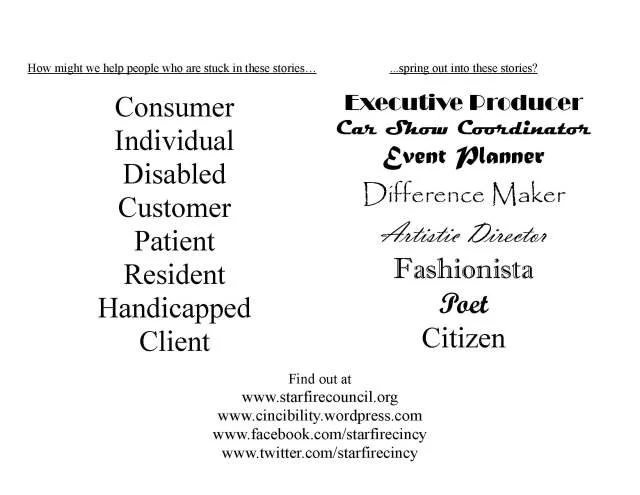
Our work must be about friendships, networks, community building, and people.  We must have parties, grill outs, celebrations, conversations over coffee, beer, and lunch.  We must make invitation and think of people we know and how to draw them in based on what they care about.  Going to the gym changes Douglas’ story.  Volunteering with Jeanne will change Margot’s identity.  Mike’s knowledge of computers and his belief in Craig’s capabilities make a difference in a practical way.  We give people a reason to meet one another, get to know one another because it’s important to someone’s life.  It can mean the difference between being known as a person, and being a consumer, a client.

timothyvogt
Knowing My Place

Take no offense, Westsiders, but you are not my people. There are deep reasons why I won’t live “over there” and I’d be willing to guess they are the same reasons why you don’t live “over here” on the Eastside.  It has nothing to do with supposed Eastside snobbery, honest. Nothing to do with your way of life, your neighbors, your festivals or your schools. It’s just not my place.

My identity is not tied to “West.”  I’m sure you’ll agree that “East” doesn’t make you nostalgic, full of that warm feeling just shy of pure joy, but more than just the feeling of comfort.  You see, Eastside is home.  I wasn’t brought home from the hospital to West 8th Street, but 33rd Street.  (You hear that newfangled Oakley residents? Yes, 33rd Street, before they changed them all to “avenue.”)  For a while one corner’s sign said 33rd Street and the other read 33rd Avenue.  They finally changed them both to Avenue.  We prefer street, and we still call it that.  (We fight the man where we can on the Eastside.)

Westsiders are lovely people, I’m sure, because I’ve met more than a handful.  I’ve drank heavily on multiple occasions at the Crows Nest listening to your Westside boys, The Tillers.  I’ve attending men’s volleyball games in Elder’s gym, in awe of how hard and fast high school boys play volleyball, of all things.  I’ve run your hills at Rapid Run Park, threw up before and cried after races.  This isn’t about politics, or accents, or cuisine.  It’s personal.

concrete-slide.jpg

See that concrete slide tucked on that hill? We used to buy wax paper, situate a square under our butts and fly down it.  Inertia already letting us stay in motion, the wax paper just added to the effect.  You’ll crash at the bottom unable to stop yourself and fall into sticks, rocks, and dirt.  You’ll climb the steps next to the slide and doing it again.  One of your friends will hurt themselves and it will be worth it.  This is what happens on the Eastside.  You’ve probably not frequented Alms Park, and gone down the slide, I imagine, because you’ve got Mt. Echo.  Lovely place (I went for my first time a month ago), but it’s not the place I found out I was allergic to holly while hiding in a vast thicket of the plants.  It’s not where I played in the grand castle, or the place where I wept at the overlook of the Lunken Airport when I realized my grandmother was really and truly going to die that month.  The police showed up that night, ran our IDs and warned us for being in the park after dark, thinking Jordan and I were necking or something.  I’m sure you have your Westside after dark park stories too.

It’s not on your side of town that I learned to drive my Hell Beast, the Jeep Cherokee that mysteriously shifted itself into reverse.  And let’s be honest, I’m grateful for that because I always get lost on your streets.  Suddenly Pedretti turns into Glenway, Glenway into Queen City, and before I know it I’m on my way towards Indiana driving down Route 50.  No, when gas was cheap enough to drive around with friends purposeless, it wasn’t down your streets that we laughed, and sang and felt so grown up and ridiculous.

blue-manatee.jpg

See that bookstore on Madison Road?  It used to be called the Blue Marble. That’s the store where I would walk to and dream of all the books being mine someday.  It’s probably where the obsession began: filling bookshelves, not dog-earing the pages, but collecting them like sacred artifacts.   It’s where Mr. Mohr took students with straight As for the year to buy a book in 4th grade.  I chose the Eleventh Hour: a Curious Mystery and gave it to my aunt as a gift.

aglamesis.jpg

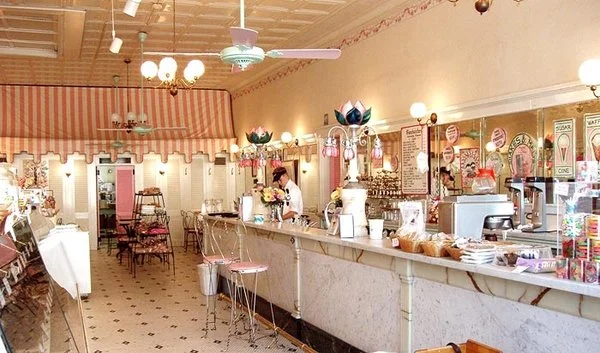
See that pink brick building a few doors down? That’s Aglamesis Brothers Icecream.  It’s always been there, I’m sure of that.  Mr Aglamesis has always been that old.  Mrs. Boberg, my first grade teacher took us there when we got 10 or 20 or 1000 gold stars on the star chart (details are fuzzy when you’re six).  It smells divine in there, and my family didn’t go there often or at all that I can remember for icecream because it was expensive, but on the rare occasion that I was able to sit at the marble counter in their pink and wire back bar chairs, I felt like a character out of some magnificent Blue Manatee book.  They served little finger cookies on top of whipped cream on top of shakes.  I didn’t like whipped cream then but it was so beautiful on top that I didn’t dare ask for the shake without it.

20th.jpg

Across the street there all lit up in red is the 20th Century Theater.  She sure is a beauty now, isn’t she?  I stood out there once with my grandma and what seemed like a thousand other people.  It closed in 1983 and sat there for about 10 years empty, not lighted and a tree growing out where it said 20th at the top.  We held little paper cups with candle in it, had a vigil to keep it from being torn down for a parking lot, probably.  I’m sure you have your theaters on the Westside, but I’ve never helped save them with my grandma and don’t even know where they are located.

The bowling alley up the road on Madison.  One time in grade school we got a behind the scenes tour there from someone’s dad who managed it at the time.  I had a birthday party there, and in later years, our sober driver would drive us there to bowl late into the night while we demanded snacks and food.  On Saturday mornings, the family would bowl before Troy died, and we’d make a morning of it.  When I was younger, Aunt Sandy would take me to her bowling league where men and women would chain smoke, and I’d beg for quarters to play an old bowling game, and demand snacks, and food.  I think you have bowling alleys on the Westside, but I think you know what I’m going to say.

cecilia.jpg

I was baptized there at that giant church, made my first communion there, confirmation.  Jordan and I chose not to get married there for reasons that aren’t nostalgic.  But my grandmother was married there, and my mother, and my two of my aunts.  I’ve given two eulogies there.

I nearly passed out in that choir loft once, standing behind that huge pipe organ, which is hard to believe given my current ability to sing.  I can tell you what the vestibule used to look like before they put in the accessible restroom.  I can also tell you that if you use the restroom in the under-croft as a child, you have to run up the red carpeted stairs as fast as possible because it’s just so frightening down there.  I can tell you the same selections from the Gather Book that they used to make: On Eagle’s Wings, Taste and See, City of God.  When I hear other friends who grew up Catholic and went to different parishes reminisce about their church songs, they sound strange, foreign.  Nice enough, but I don’t know the melody and the lyrics are unknown to me.  The Westside is like that to me, too.

Tom Kohler was in town this past weekend and he asked, “How long do you think it would take you to get to know your neighbors if you moved to the Westside?”  I answered not that long.  But how long would it take me to replicate 26 years of personal history to a place?  How long would it take me to reproduce a Meyer/Jones family history dating back to the late 1930s?  How could I say, that’s the house where my grandmother, mother, aunts, sisters, and I were raised?  I couldn’t.  I couldn’t point out the stump of a tree that was struck by lightning and nearly hit Jenny when she was a child.  She said afterwards that she tasted pennies, and we were all convinced she was probably struck too.  I couldn’t point to the hill we went sled riding down and Mom wound up doing back-flips when she lost control of her sled (and body).  I couldn’t walk past the routes I took on my Sea Princess banana seat bike around town.

And I don’t intend to try to want to build a new history across town.  I know my place and it is in the veins of neighborhoods like Oakley, Madisonville, Kennedy Heights, Pleasant Ridge.  It’s down Madison Road and Erie, Minot, Robertson and Isabella, Bramble and Whetsel and the side streets in between.  Westside, this love story is not for you.  And moving to your side of town would be the worst kind of infidelity.

timothyvogt
Cheeseburgers Part 1


Above, Jason mans the grill at one of his earliest Coke & Cheeseburger Parties, August 2011.  If you aren’t familiar with the story of Coke & Cheeseburger Parties — catch up here:
and here.  Last year, I wrote from Toronto:

“Jason is a man who loves Coke and loves cheeseburgers.  Instead of trying to “fix” this in Jason, we’ve helped him think about who else values Coke and cheeseburgers.  It didn’t take much time to realize that most Americans probably do.  Matt Groening has a wonderful quote (I’m assuming it’s from the Comic Book Guy, but please correct me if I’m wrong) from The Simpsons that fits the purpose of Jason’s project,

“Oh, loneliness and cheeseburgers are a dangerous mix.”

And that’s the point isn’t it?  Jason is connecting to businesses, nonprofits, schools, people, and helping create a community of people to talk, meet, and enjoy two things he loves: Coke and cheeseburgers.  In the meantime, Jason gets to meet new people, people see Jason as a valuable person (after all—he’s grilling and bringing this stuff for free!), and he gets to do these things in common spaces,  with common people and experience respect, and make a contribution—after all a Coke & Cheeseburger party is uniquely Cincinnati!”

A few weeks ago, Jason and I traveled a mere mile up the street from his house in Reading in search of a person who would appreciate his passion for the greatest of all American things: Coca-Cola and cheeseburgers.

We found ourselves sitting in my car outside a bygone factory, on a stretch of road in the heart of Lockland.  I was told in Lockland is a bar and a man and woman who own the bar.  Go ask for John and talk to him was the suggestion.  Across the street from where we were parked was a small neighborhood bar that a connection of mine suggested Jason and I check out.  Jason and I went over our game plan before we got out of the car.  “Jason, let’s just go in and order a cheeseburger and a coke.”  (That’s all the plan we had, and ofter all the planning you really need to get a conversation going with someone.)

Mike Moroski, a connection of mine through an internship another Starfire U member had, met up with Sarah Buffie and I a month or so ago for coffee.  “We need a cheeseburger guy!” we told him desperately.  I knew Mike knew a lot of people, and I already knew that Mike probably was not the guy to be Jason’s connector.  He was the connection– a big difference in this goodness.   Mike sits on of a couple of boards around town in addition to having been in English teacher at Moeller and is the current assistant principal at my high school, Purcell Marian.  He’s in a band, and co-ownes a restaurant in Indianapolis.  Mike has mutual friends in common with Sarah and I, and I’ve received emails from him as early as 4:30AM.  I don’t know where this man finds the time or energy to be so involved in this city, but I’m glad he’s out there.  He agreed to brainstorm with us who he knew and how to find our connector.

JC’s American Pub 101 Mill Street  Cincinnati, OH 45215

Mike’s the reason Jason and I found ourselves in a typical, ordinary, local bar in Lockland.  Jason and I walked in and one man sat at a stool at the bar in painter’s garb drinking a Budweiser at 6PM.  The bartender nodded at us.  There were a couple of tables he pointed at that we could sit.  We chose to sit at the bar to be close to the action, and make talking and being curious easier.

I explained that we were there to meet John to talk about cheeseburgers.  The bartender was John.  Jason and I ordered some drinks and chatted a bit about how we “found” him.  (He wanted to know how we knew who he was.)  I explained Mike told me that he was a guy that likes cheeseburgers too and had a bar.  After about a 1/2 hour of warm up banter, John began to smile and better understand why were where there.  He talked about himself, his family, his service in the military, and why he wanted to run a local bar.  We ordered some burgers and kept talking while periodically watching the baseball game that was on the TVs lining the bar.

While we ate, John explained that since there was only a bartender they had to deep fry everything, including the cheeseburgers since there wasn’t anyone to man a grill and make drinks at the same time.  He explained that JC’s American Pub was striving to be a friendly neighborhood place and change the reputation the previous bar owners had before he took over.  They re-branded it JC’s after John (himself) and his wife Christy.  JC’s American Pub wants to “make you feel like everyday is the 4th of July! Red White and Blue is what we are all about. Supporting our service members by offering happy hour prices to them anytime they come in!”  Surely, I thought, this is a man, and a place that cares about people feeling welcome, and appreciated for their contributions, both large and small.

There’s not a perfect way to connect people.  Jason and I connected with John over meat and drinks.  John offered that Jason could come on Sundays, grill outside the bar, bring in patrons.  While they waited for a grilled burger, they could come in and get a beer, a drink, play some darts, shoot some pool.  I left with a commitment to follow up, but Jason  left with a much different future than when he walked in. After I dropped Jason off at home and helped Jason tell his story to his parents, I drove home with tears in my eyes think of all the possibilities.  Could Jason be the burger guy at a local bar?  Could he promote his Sunday grill out during football season?  Could he be known locally as a griller, the burger guy, an entrepreneur, a patron, a part of the gang at JC’s?  Could he have a grilling contest in the winter?  Could Jason do this long term instead of “special” programs for people with disabilities?  Could we get other people to grill with him?  Could Jason meet friends there?  Could Jason be known for his gifts?

You can see how extraordinary is different from “special” in this story.  JC’s American Pub isn’t a special place for Jason.  It’s a regular Joe type of bar.  It’s pretty ordinary.  Nice enough, nothing fancy, the way a neighborhood bar should be.  But it happened to be exactly the place Jason needed, in an extraordinary way.  Keep you posted on how the Sunday grill outs pan out.  There’s much more to the story that’s yet to be written…

cheeseburger.jpg
coke1.jpg
jason.jpg
jc-pub.jpg
timothyvogt
When one door closes...

FYI:  Having a “PATH” done in this post refers to a graphically facilitated brainstorm session where a person hashes out plan for the future with friends and family in attendance.  The “North Star” refers to the positive and possible goals decided on during the PATH meeting. Every Starfire U member is offered a PATH in their second year.

Kathleen and I decided to write this blog together.  She is a fourth year member of Starfire U, and is in quotations.

Kathleen calls Starfire her second home, and the people here her other family.  As a new staff, her hospitality to me was abundant.  Locating her voice in the hallway calling out “Hi Miss Katie Katie!” and finding her warmly waving behind a smile, it makes my day every time.  This ability to make people feel instantly liked at a new place is a tremendous gift to others, and Kathleen is naturally good at giving it.

For the last year and a half, Kathleen has been a volunteer at a preschool.  She loves kids and is an aunt to four little ones, so naturally, the opportunity to gain work experience with preschoolers was thrilling.

“It all started with my North Star.  My hopes, my dreams my high expectations. That’s what got me thinking in terms of helping and giving and caring and having integrity. Having the guts to try new things. So it was there, as I was brainstorming through the blue print of my life, my PATH… Not to steal words out of Nikki Booker’s (a fellow fourth year member) mouth,” she laughs.

Always eloquent and able to speak her mind, Kathleen never fails to impress me with her composure.

“In the back of my mind, when we were doing my PATH I not only had kids on there, I had other things. Like leadership and doing things with my church like the Pregnancy East fundraiser.  We collected money and were greeters.  Also doing more with the Board of DDS. I do a lot with them. I see myself actually working there, I don’t know why, but I do. SO maybe that might be another alternative. And I see myself as an event planner, too…”

During Starfire’s Annual Meeting this year, Kathleen made a beautiful speech.  Leading the committee of event planners for the Annual Meeting was part of her final project for Starfire U.  She planned out everything from venue (they picked the 20th Century Theatre) to appetizers.  So seeing it come to fruition was a powerful moment for all of us.  Kathleen can now proudly affirm to everyone that she indeed is an Event Planner.  During that speech, she stood in front of over 200 people and exclaimed how it felt to finally be at that moment. She said it was like standing on a rock at the water’s edge, getting ready to jump.

Kathleen at the Annual Meeting

Kathleen is at a crossroads in her life. With the end of her Starfire U experience approaching, and many accomplishments to look back on over the past four years, she is heading in a direction that looks much different than she might have ever dreamed.

“At my PATH, we were just transforming my plans for the future into something bigger, dreaming big, and putting it all into different categories…And my PATH wasn’t just about kids.  It was about being a leader, working in various fields of interests, being active. What I’m saying is, I want to still be on my journey from where I first started with my PATH. I still want to find other jobs, instead of just being with kids.”

While I can see Kathleen in various roles, and would have loved to have her as part of my wedding planning committee had I known her a year ago, I still saw her work at the preschool as the most practical role for her.  It seemed like the most sensible fit for her future.

However, recently Kathleen had been making mistakes at the preschool, and she was beginning to overstay her welcome.  This news came to me as an alarm, as the next step I hoped for her would be working more full time with them after Starfire U.

“I don’t want to say that I was bored at the Church of Redeemer, I had to find things to keep busy. I always got a hug from my co-workers and the little ones.  I’ve had an experience- a great experience at the Church of the Redeemer.”

Much of what she did at the preschool was what she called “down time,” and her real wish was to have more responsibilities, like the teacher.

“I need more hands-on-actually doing things. I want a brand new position, somewhere that overlooks my old mistakes. There’s more to me than doing what I did at the church. Doing more with speaking, being more pro-active. That’s something I think people were missing, and I forgot to tell anyone. So I pushed it too far.”

It reminds me of the dozens of times I have grown tired of jobs, where not much is involved with the work.  The people are nice, the pay is steady, but there’s just something missing.  From bagging groceries to pulling pizzas out of the oven to canning fish in Alaska, after 30 + jobs I am not one to say: “stick it out, you’ll grow to like it, find a way to make it work.”

The difference between me and Kathleen’s experiences might be that no one ever expected me to stay at these minimum wage jobs doing repetitive tasks. When I quit, I did so on my own accord, and after leaving I always had the option to turn to people who supported me and start a dialogue about what my next options could be.  I always had the option to jump in somewhere else.

Next, Kathleen uses a reference here from My Best Friend’s wedding to describe how she feels about options in her own life.

“Let’s say for example I want pudding.  And let’s say there’s something else, an activity in my life that also love, and that’s jello.”

The way she describes everything is with her hands, placing one hand on my desk near me, and the other in the air in front of her.  Her tone is not frustrated, but passionate, and our eyes are locked.

“Since the jello is up here, and the pudding is down here, sometimes I am pinned and stuck with pudding when I really want to be up by jello…

“I’m lacking because the pudding is making me want even more opportunities, and even more activities. And even more things that eventually I get bored with. But I still want to be up by jello. If I’m up by jello, that makes me still the popular and typical adult that I am. But hun, I’m never going to get the jello. I got out of the phase of being on pudding. Now I’m losing the contact to where I was.”

When I first heard that Kathleen would have to leave her internship, initially my heart sank. What else will she do? Why miss out on an opportunity to do something you love? Being with kids is what she loves, right? My knee-jerk reaction was to think of the possibility of stability, security she would now be missing out on…

“I mean, yeah I blew my chance at the Church of the Redeemer,” she said. “I’m now ready to move on. I know it sounds stupid, and it sounds kind of dumb. But I don’t know, it’s just something that I think would be a good use of my time if I tried something else.”

Kathleen and I are both approaching thirty.  I would like to believe that just like any thirty year old, she’s at an exciting crossroads.  But my reality and hers are not the same, and it’s not the simple fact that she has Down Syndrome.  Kathleen’s opportunities to make life decisions look different than my own. They entail a whole web of dialogue about her, and what she should and can do.  Often, this dialogue occurs without her own voice being heard, or until she makes a mistake. Or several.  These are the circumstances that dictate her PATH in life.

Kathleen’s story here reminds me to be a better listener. It reminds me to recognize when someone has determination in life, and support that person when they make a mistake. And believe that when one door shuts, Kathleen, just like myself, can find an open window.

timothyvogt
What's Next?

As you may know, in 2010, a few of us here in Cincinnati huddled up and launched the “What’s Next?” series.  Over the past two years, we’ve heard from people all over the region, but mostly focused locally, who are leading the charge toward a more inclusive future for Cincinnati.  In addition to the people mentioned in the original post (linked above), we’ve since heard from Tim Reiley, Principal at St. Ignatius in Cincinnati, who is leading the way in developing a completely inclusive grade school experience.  We also heard from local advocate and historian Robert Harris, as well as Missy Jones, who is working on making NKU an accessible and welcoming campus for people with labels of disability.

The next presentation will be on Tuesday, March 13th at 3:30.  We’ll gather at Starfire, 5030 Oaklawn Drive, 45227.  (Here’s a link to the event page on Facebook!)  As always, the event is free and open to the public.

Our guests include two citizens who are using their talents in design to literally build a more inclusive city:

Chris Kubik will be talking about the work of May We Help?    There’s so much to love about this effort.  It’s a bunch of local engineers who volunteer their talents to work on customized equipment for people….for free!  It’s literally the definition of an inclusive community.

Make sure to check out the pictures on their website and you’ll get an idea of the creativity and dedication of this group of citizens. And the coolest part? Chris and his wife live around the corner from me in Bellevue!

We’ll also hear from Chip Williamson, who is an architect thinking about sustainable communities. He has been working over the past few years with the Cornerstone Corporation for Shared Equity in Over the Rhine. Now here’s the neat thing about Cornerstone and Chip’s work: It’s not only about designing a physically accessible space, but their model of shared equity helps people build up assets! So it acts as a wealth building opportunity as well. Renters who attend meetings, take care of the property and generally pitch in to make the communities great can build equity and develop assets and personal wealth.

These two efforts speak to the importance of the design process, which has been top of mind lately. While I was in Toronto this summer, I had the pleasure of taking a three-day module with John O’Brien on design thinking. I also go to hear from Norm Kunc and he said something about design that really stuck with me:

From the beginning of time to now and from now until forever, there will be people with disabilities. Since we know that’s true, then we can say that disability is a natural part of our world. And if disability is a natural part of our world, then anything that is designed without taking disability into account is flawed. So adaptations are simply fixing a flaw in design!

I had heard various versions of the “disability is natural” conversation before, but that was the first time I had heard it so simply and logically put.

I also heard another great example of the importance of design at the recent CoreChange Summit:

Imagine that you are on a big ship. There is an experienced and competent Captain, a talented and capable crew, and lots of smart technicians, operating state-of-the art equipment and instruments. You hit a storm the likes of which you’ve never seen, winds are blowing the ship everywhere and the waves are crashing and churning. Who is the most important person at that moment?

The answer, of course, is the designer, who isn’t even on the ship, but thought about that storm years before as he or she worked on the plans for building the ship. If they did a good job designing, the ship will survive. Nothing the captain, crew or technicians can do at that point, will help much.

At CoreChange, they were illustrating the fact that designing our future communities was a sacred and important task. Mr. Kunc was talking about the fact that leaving out accommodations for differences in people’s modes of communication or participation was a flawed design to begin with. Makes sense, huh?

So Chip and Chris will be sharing how they are using their design talents and networks to create a more accessible and equitable Cincinnati. Another step forward. Make sure to join us on 3/13 at 3:30!

timothyvogt
Go Big or Go Home
0311-sitwells21 (1).jpg

Sitwell’s Cafe, Ludlow Avenue

There are a few places in Cincinnati where you are sure to draw glances from regular patrons, likely peering out from behind their soft covered classic, sipping the same cup of coffee for hours, and for a moment feel taken to some dark corner in Europe far away from home.  Sitwell’s café in Clifton has that potential; it draws out the vagabond, the hippie, the dreamer, the beat poet, the mysterious innovator in us all.

mysteriousness in us all

So, what better place for Nikki BookerCatie O’Keefe, and Jeni Jenkins to have their first encounter together?

It’s July and a gorgeous, sunny day. Clouds cascade above, casting light shadows across Ludlow Avenue, while inside three women gathered around a table tucked out of view of the general public begin making plans. Nikki has called the meeting.

“I want to make this story come to life,” she says, running a hand over the wrinkled cover of her favorite book, Waddie Welcome and the Beloved Community. “And by come to life, I mean turn it into a play.”

Flipping through the pages, stopping to explain certain photos or read from it aloud, it’s as if she’s holding her very own scrapbook of Mr. Welcome’s life.  She knows the book from cover to cover.  She has seen the story play out on stage in her mind.  But now she has to convince Catie and Jeni, award-winning playwright and producer respectively, to join her in making this dream happen.

“This describes me. I feel it,” Nikki says before reading a passage.

At first glance Waddie Welcome looks anything but influential, beset with cerebral palsy and approaching nine full decades, he is mostly quiet and unassuming. But beneath the years, beneath the persona of disability, lies fierce determination, a determination that has influenced thousands across the state, the nation and the world…

With that, the silence of invention and creation settle across the round, wooden table. Nikki waits patiently for Catie and Jeni’s response.

“So… where are you thinking the play will be?” Catie breaks the silence.

“I already know the place,” Nikki responded reservedly. “If I’m going to do this, I might as well go big.”

What transpires next is the start of a great collaboration.

Since this day, Nikki has traveled to Savannah to meet the author, developed a strong production team with Catie and Jeni as avid supporters, and continues to inspire people in Cincinnati with the story by hosting readings throughout the city.

As for opening night, the picture in Nikki’s mind is growing clearer, and is just as big as she imagined it.

Imagining the Emery

The play will premier on stage at the historic Emery Theatre, “a 1,600-seat, acoustically pure symphony hall,” bequeathed by Mary Emery 100 years ago with the vision that, “high-quality art inspires individuals and communities to invest in themselves, and that inclusion and respect lead to a better society.”

“I am making history,” Nikki now says. “Not only for me but for this whole state, the world, for people with disabilities… Don’t just judge a book by it’s cover, you have to find the book and read its pages.”

Or in this case, watch the story come to life on the big stage.

To support the adaptation and theatrical performance of Waddie Welcome and the Beloved Community, go to Kickstarter and contribute today.

nancy.jpg
timothyvogt
You Just Can't Keep a Good Man Down!

My son, Joe, is a people person – just ask anyone who knows him.  What I really mean is:  he is a passionate people person – not like most of us.  Most of us like people well enough, especially family and friends.  And we engage with those people readily. But when it comes to mere acquaintances or strangers, we are a lot more guarded.  For some unexplained reason, we feel a need to keep the real ‘us’ hidden.  So we wrap ourselves in a protective veil of polite but detached anonymity.  We don’t try – or even care – to get to know the other person – just like Anne in Kathleen’s story.  We may not even realize that we are telling each other, “You are not important to me.”   We want to blend in, to be one of the crowd, to not stand out, to show that we have nothing to offer and want nothing in return. We don’t want to share anything personal about ourselves. Only when we slowly get to know someone, do we begin to trust enough to begin sharing little bits of ourselves.  So, in lines at grocery stores or at ticket booths or in any number of queuing opportunities, we ignore each other.  We stare into space or look at inanimate objects – anything to avoid eye contact or any type of interchange with others around us.  We put on the don’t-talk-to-me look.  In waiting rooms at doctor’s offices we grab a magazine or a cell phone to avoid human interactions.  In groups of people at gatherings we stand around engaged in meaningless small talk – polite and distant.  Some of us connect with others more readily than this.  But for a lot of us, we steel ourselves against some unknown threat.  We are uninterested in meaningful conversations as we rush thru our day.

Well, my Joe won’t have any of that!  And, although the ‘Joe’ in Kathleen’s story isn’t myJoe, they do seem to have a lot in common when it comes to enjoying people.  See, in Joe’s opinion, if there are people around – the opportunities are boundless.  There are fascinating stories to be heard, wonderful families to learn about, exciting adventures to hear about, laughter to share, horsing around to enjoy, valuable information to exchange, real person to real person connections to be made, a worthy friend to get to know, another human being to nourish and be nourished by . . . . another soul to be brought into the warm glow of human to human connection.

Doesn’t matter where you are, if there is another person at hand, Joe will strike up a conversation.  And he won’t start with small talk like, ‘Nice weather we’re having.” or “How about those Bengals?”  Nope. He goes charging right thru that polite/distant veil and goes straight for the person inside with “Do you have kids?” or “Nice husband you have there!” or “I want to know how you get the ideas for your books” (said to a writer at a vendor’s table).  And then, he’s off and rolling – listening to the person’s stories and asking more probing questions about what he has heard.  In a few minutes time, he has the
person telling his/her life’s story.  And the two of them are laughing and talking like they have known each other for years.  They both part company, smiling and obviously uplifted by the experience.  I have seen this scenario play out time and again.  And I have come to realize what an amazing gift Joe has for making real heart-felt connections to others.  What good he does for the world, one person at a time!

But, here’s the thing:  I haven’t always felt this way.  I used to think that this was a ‘behavior’ that needed to be ‘fixed’.  I know, hard to believe.  But I think you will understand my journey if I take you back in time, and you follow along for a while……

Joe has always loved people – from the day he was born, I think.  He has always been joyful and loving.  He began interacting with and accepting strangers from the time he was one year old.  By the time he was 2 years old, there was a constant stream of teachers, teacher’s aides, speech therapists, occupational therapists, physical therapists, neurologists, medical specialists, and evaluators from all corners of the professional world. He started attending the local elementary school at age 6.  All the staff there loved him and freely gave him hugs.  So from his early beginnings, it became natural for Joe to trust people and to become a ‘hugger’.  When Joe reached middle school (he was around 12 years old), one of his special education teachers told me that we really needed to get Joe to cut back on the hugging.  He hugged everybody – teachers, students, even strangers.  Students his age did not go around hugging everybody and it looked ‘inappropriate’.  Plus, it wasn’t safe.  Joe knew no strangers and would most likely walk off with anyone who invited him.  I was a little hurt because I know he did it out of affection and his love for people.  But there was some logic in what I was told, so I agreed.  And my husband and I joined the staff in coaching Joe to shake hands instead of hugging.  This was somewhat effective.  He learned that shaking hands still helped him connect with people, so he went along.  Problem is, he would shake hands with the same person four, five, six (or more) times (also inappropriate).

So, by the time Joe got to high school at the age of 15, he was a hand-shaking maniac.  The Special Education staff at the high school said, “We really need to do something about Joe’s constant hand shaking!  It is really inappropriate.”  Additionally, Joe still approached strangers with the same openness as if they were a solid friend.  We were told that he would never be able to ride a Metro bus because of the potential danger it posed – he would readily go anywhere with anyone.  He knew no strangers.  He could never be left alone or go into public places alone because of the threat of predators.  It was upsetting and seems harsh.  But, please know that these were well meaning professionals who were truly doing what they felt was right to best prepare Joe for an adult life.  Also,  at the time, I was in agreement as to the problem and the course of action.  So, efforts were launched to teach Joe that one does not talk to strangers.  People only shake hands once per encounter.  Support staff who accompanied Joe in the halls at the high school or into the community on outings were constantly interrupting his attempts at ‘inappropriate social behavior’.  Joe tried, I really think he did.  But one hand shake just did not do it for Joe.  And it just wasn’t in him to not talk to people. At the time, his conversation skills were not that well developed and he struggled to make the personal connections with people that meant so much to him.  He began reverting to the hugging mixed with hand shaking.  He continued to seize every opportunity to try and interact with anyone and everyone.  Then along came an attraction to girls.  Hugging took on a whole new meaning.  And so, there we were again, inappropriately hugging everyone.  Joe’s main purpose in life at the time seemed to be to socialize.  He spent every available moment throughout his day talking, shaking hands or hugging.

To compound the issue, Joe’s need to socialize interfered with another important component of his future.  In high school, Joe was enrolled in a program to help him develop job skills for a potential job as an adult.  Joe was given a variety of job assignments in the community to help him explore what might be a good fit for him.  Unfortunately for Joe, these were all jobs that required constant attention to the work and little to no interaction with other people.  While these jobs may work for some individuals, they definitely did not work for Joe.  Predictably, he was much more interested in interacting with the people around him than in accomplishing the tasks at hand.  I was told that Joe could never hold a productive job in the community without constant supervision because he was too focused on being social and could not focus on his work.  So I believed that Joe’s constant need to connect with people was holding him back from having a real job in the community – a real place in the world.

I wanted Joe to be able to have a job in the community, to be accepted in the community, to be safe.  All this didn’t exactly feel right, but the arguments were very convincing and the stakes were extremely high.  So, my husband and I ‘bought in’ on the program of fixing these behaviors.  But, it was hard.  How could we stop Joe from constantly socializing?  Joe would approach people wherever we were.  He wanted to engage them but struggled with conversation.  He would say something that was on his mind that had no context in the present.  People wouldn’t know how to react or talk with him.  He would resort to hugging or constant hand shaking to make a connection.  It was embarrassing for me and for the other person.  I started a reward program with Joe to help him resist hugging or hand shaking with everyone he ran into.  It was fairly successful.  In the mean time, he got a lot better with conversations.  I coached him on how to talk about something the other person might be interested in.  It was a constant effort to remind him to not hug, but he did improve.  However, Joe would still approach people – people who wanted to be anonymous.  He would ‘bother’ others in line, store employees, people in church pews next to him, people in waiting rooms, people on the street.  Very often he would throw his arm around complete strangers.  My husband and I were constantly ‘pulling him off’ of people.  It was embarrassing.  It was frustrating.  It was futile.

AND THEN, some exceptionally wonderful, brilliantly intuitive, insightful people came into our lives.  After high school, Joe joined StarfireU, a place where individual gifts are expected, discovered, valued, and nurtured.  Staff members there started telling me things that were contrary to what I had heard before.  Bridget Vogt said, “If I ever go into a room full of strangers, I want Joe Wenning by my side.”  Tim Vogt wrote on Joe’s PATHposter, “Joe, there are people who need you in their lives!” Other staff members at StarfireU started to tell me that Joe energizes a room with his enthusiasm; he enlivens guest speakers with his insightful questions; returning guest speakers miss Joe’s energy and interaction in their sessions when he doesn’t attend;  Joe is so empathetic and is a great ‘cheer leader’  or comforter for others.  I am told time and again how valued Joe is for his gifts with people.  I start to realize that what I had been trying to squelch – the part of Joe that would not be held down – is in fact, Joe’s most valuable gift.

And so, I begin to let go of the control.  I begin to stand back and watch as he ‘does his thing’.  I witness human to human connections as he reaches out to a stranger.  I watch as he touches the heart of another person.  I find myself following him as he enriches the lives of others.  And, now that I am not in his way and he doesn’t have to struggle against me to explore his ‘people passion’, I notice that he is making tremendous progress towards more ‘appropriate behaviors’.  He is hugging less and conversing more. He responds when I try to give him better ways of approaching people.  He senses that I am not trying to control him any more – I am trying to help him be more effective at doing what he loves most.  I still struggle with the danger of predators – it is real.  But Joe has made it clear that the life he chooses must be full of people.  I need to honor that and yet find ways to protect him.  But maybe, it’s just possible that, having more people in his life actually does protect him.  I am learning too that there is a reason for every behavior – and sometimes that reason is me.  And as for those of you who want to remain anonymous:  good luck if you happen to be around Joe Wenning.  You might want to stand in a different line because I am not about to stop him, I know he is giving you a gift!  It is still a journey for us.  But I find that each time I try harder to follow Joe instead of stand in his way, I am rewarded.  This new path that we are on is not futile – it is fertile.

 Joe and I recently went to the Union Terminal’s African Culture Fest.  Joe loves culture and is looking for a way that he might volunteer at the history museum (history is another one of Joe’s passions).  So, this was a great opportunity to show up at the museum, get more comfortable there, and meet some of the other volunteers.  Before we got there I promised myself that I would follow Joe and would only offer support when he needed it – no matter how embarrassing it got – no matter how uncomfortable the other person was – no matter what.  It was his day and he was in charge.  He loved it, of course.  He chose which programs we attended, what vendors we interacted with, and which people we approached.  The most remarkable interaction of the day was with an artist (woodcarver/painter/dancer/drummer) named Michael.  Michael was demonstrating his woodcarving and that attracted Joe right away.  Joe struck up a conversation with, “I want to know how you started this woodcarving?”  And so it went.  Michael talked about carving techniques and he told several of the stories around his wood art. He showed us some of his Batik paintings. He formed a genuine connection with Joe and me (because I was drawn in and loved the whole interaction too!).  Joe recognized Michael’s talents and suggested that he would be a great person to teach a class for StarfireU.  So we asked him if he would be willing to meet with some of Joe’s friends to share his work.  He enthusiastically said, Yes!

Michael is a fascinating and warm human being.  But then, Joe already knew that!  And you know, Joe didn’t hug Michael once – well, I don’t remember if he did.  And even if he had, it would have been quite appropriate!  The very best part of the day happened in the car, on the way home.  As Joe reflected on his day, he announced, “You know what I like about me?  I’m a good connector!”  Now who could argue with that?

And thus, on our journey towards the 5 shared experiences, Joe has made great strides towards making  contributions and I have made progress towards learning to respect the person that is Joe Wenning!

p.s.  If you ever get the opportunity to be party to one of Joe’s conversations with a stranger, I highly encourage you to join in – it is a wonderfully enriching experience!

Jan Goings
Communion

Every morning around 6:15, I get an email sent to my phone.  It’s a quote from Jean Vanier, founder of L’Arche communities and a pretty awesome person.

It’s such a great way to start the day.  This one popped up last week:

Collaboration certainly should find its basis in communion but frequently it does not. We can work together without really caring for each other or being bonded together in love and communion. . . We work together for a common goal. Communion however, is bonding, caring and sharing which flows and finds its fulfillment in celebration.

I bolded the line that stuck with me.  I can’t get that out of my head.

I also follow Al Etmanski on Twitter, and over the past month or so, he’s had a series of guest bloggers opining on the question “What are you skating towards?”

The other day, he had John McKnight (who I’ve learned a lot from) talking about “cooperation.” The next day, he had Delyse Sylvester talking about “collaboration.”   (And I would be remiss if I didn’t point out Mr. Etmanski’s wonderful post about Mr. Vanier from last year.)

So when everyone is talking about collaboration, cooperation and communion within the span of a few weeks, that means the nexus of the universe is telling us something!

It makes me think of what we’ve been learning lately about the importance of families in our work, something Kathy Wenning is helping us understand.    I think about staff, who disregard families (usually in the admirable effort to promote people’s individual rights as an adult) and unintentionally miss out on the power of working together.  I think about families, who say to staff “You’re only in it for a paycheck,” and while sometimes true, is too broad a brush and leads to distance between efforts that would better serve someone if they were stitched together.  I think about leaders who say “You’re being paid, just do the job,” or (even worse) “Keep a professional distance and separate your work and home life.”  They have no idea the damage they’re doing, not only to the efforts to promote inclusion, but to the staff themselves, who are forced to “clock out” their hopes and dreams and desire to be of help to their fellow citizens.  I think of families, philosophers and professionals who give up on the general public to support people, frustrated by neighbors who treat people with disabilities in a childish way, or by employers who give people menial jobs.

I remember times when I’ve been all of those people on all sides of those conversations.  As I step back and look at it, I see the spirit of what Vanier is saying.  We’re all “collaborating” and “cooperating” and working together (supposedly toward the common goal of helping people have good lives), but do we really care about each other?  I imagine that’s more of a rarity than we’d like to admit.  And what does that mean for the people in middle of all of that detached collaboration and cooperation?

I only know a few people who sincerely appreciate everyone in the inclusion equation, no matter what level they arrive at.  It’s difficult to have conversations with colleagues or families who we may perceive as being “behind the times” or “out of touch.”  But we’ve got so much to learn from each other, and none of us hold the answers in isolation.  People are counting on us to get it right…together.  Kathleen showed great patience and tenderness with her story the other day.  That’s the spirit of what I’m talking about.  It has something to do with disappointment, yes, but acceptance and understanding as well.

I guess that’s what I’m skating towards this year…To find more common ground between people who may seem to be in separate camps, but share interests…To figure out what happens when families, staff, and connected citizens care about and celebrate each other.  I think it’s something really cool.

By the way, you can get the quote of the day sent to you by clicking here.

timothyvogt
A Chance Meeting, What Does She Do?

(In September of 2011, I had a call from someone named Kathleen Cail.  She told me about her efforts to bring the Positive Exposures exhibit to the Cincinnati Museum Center and she wanted to plan a community conversation around it.  I had no idea that by accepting her invitation to meet, chat, and plan together, I’d be collaborating with such an amazing citizen and mother.  Over a few cups of coffee, I’ve learned the depth of Kathleen’s commitment to inclusion and building a more positive Cincinnati for her daughter, Grace, and the rest of us.  Thanks, Kathleen, for bringing more beauty to our city and for these thoughtful reflections on the potential for even more beauty in our everyday experiences.)

The grocery store is always so busy during the holidays. There’s a frenetic feel to this time of year, and people become anonymous as they search the aisles for those items they buy once a year – the dates, molasses, ginger, candied fruit.  I’m anonymous too. I haven’t lived in this area for over 20 years so I move unrecognized through the aisles. I’m also in a hurry. I’ve left my mother in the car and it’s cold outside.  As I wait in line at the check-out, I am thinking of my mother – she get’s confused so I am wondering if she has forgotten why she is sitting in an unfamiliar car in the Market Basket parking lot. She might not even remember that I am the one she spent the afternoon with and that I’ve run into the store to pick up an ingredient I need for dinner.  Perhaps she feels anonymous.

She’s young, and very cute, the way single, 20-something young women are. She is only carrying a basket, so she didn’t need much on this trip.  She looks like she might be an independent woman, who has an apartment and is starting out in her career, post-college.  There is something about her that seems lonely, or insecure, or just unhappy.  She looks like she could use some joy.  Along comes Joe. He might be her age or perhaps a year or two older.  He’s tall, has dark wavy hair, bright eyes and a warm smile.  He looks like he is caring and fun to be with.  I hear him introduce himself to her.  “What’s your name? I’m Joe.”  She tells him her name is Anne.  A few minutes later, Joe invites Anne to come into the line that I am in –it’s shorter.  Anne stands behind me.  Another woman asks Joe how he knows her name and comments on how he knows everyone.  Joe happily exclaims, “We just met. I introduced myself to her.”   Joe then walks up to Anne and extends his hand. It’s seconds, but it seems like an hour to me, as I watch this potential relationship, or a one-time friendly moment, unfold.  I’m an older, wiser woman than Anne, and I see so much opportunity in this moment.   Anne doesn’t though. Anne doesn’t extend her hand and looks away.  Joe has recognized her, yet she is making Joe anonymous, with this one decision. Joe quickly fills the emptiness of the moment with, “Oh, I know some people don’t like shaking hands.  That’s OK Anne. It’s nice to meet you.”

What Anne doesn’t know is that she missed an opportunity to brighten her day, at the very least and at the most, the chance to start a friendship with a lovely young man, who she will likely see most days she comes to the grocery store.  It is an opportunity to connect, be less anonymous, and grow from the experience of Joe.

Joe is a bagger at the grocery store.  He is friendly and helpful.  He isn’t inhibited. He is honest, open and direct.  He follows a different set of social rules. His rules are based on the desire to connect with people and build relationships. Joe is free from the social rules that preclude you from finding common ground in someone you’ve just met.  Joe has a developmental condition.

In this moment, I want to turn to Anne, in the safety of my anonymity, and say, “this could be my daughter you are ignoring,” or “would you refuse a handshake if this were some successful investment banker or doctor? “ I don’t though.  I remember that everyone operates in his/her box of life experiences.  Maybe someday, Anne will have a friend who works with people living with a physical or developmental difference, and be invited to an event, where she will get to know Joe. Maybe Anne will get married and have a child with a developmental disability and her box of experiences will expand and blossom and she will be open to appreciating, respecting, and recognizing someone like Joe. Maybe someday Anne will accept that chance meeting and receive the remarkable gift of connection and relationship that Joe was willing to give.

timothyvogt
The Magic Phone

Joe just got a new cell phone for his birthday.  Just so you know: in Joe’s opinion, this is the best gift he has ever gotten in his whole life and he is obsessed with it.  Now, this is not the first cell phone Joe has had.  We got him his first cell phone when Joe was in his fifth year of high school (about 4 years ago at the age of 20).  At the time, Joe barely ever talked on a phone and when requested to do so, he would only say a few short things and then would abruptly end the call.  He could not dial a given number on a house phone without a lot of help.  He could only ‘read’ things like “Wendy’s”, “McDonald’s”, ”Wal-Mart”: words that had a distinctive shape or had symbols with them (and were usually heavily marketed on TV).  He had no idea how to operate a cell phone and we weren’t even sure he could keep track of one.  Like Joe’s brothers, you may be asking, ‘So why did you even get the phone for him?’.  Well, like a lot of things I do regarding Joe, I sorta stumble upon ideas. You see, ‘every’ typical high school student at Sycamore High had a cell phone.  And, as I noticed on a visit to the special ed classroom, many of the students who had disabilities, also had cell phones.  So it dawned on me that my Joe was getting left out and I determined that this was one of those times I could do something about it.  So we bought Joe a cell phone (very simple, cheap, with barely any services) as a status symbol, for one reason.  And for a second- more practical reason, for safety.  It occurred to me that Joe really needed to learn how to make (and become comfortable with making) a phone call so that in the case of an emergency (if he got lost or heaven knows what else might happen) he would be capable of calling me.  Also, at the time, Joe was very unreliable as far as his ability to produce personal information such as a home phone number.  If he had a cell phone with him, at least someone else could help him call home. Besides, we paid for cell phones for Joe’s two ‘typical’ brothers.  Were their needs that different from Joe’s?  It was a small price to pay for Joe to be COOL and safe.

For a while, Joe just carried the phone with him.  He wasn’t that interested in using it but felt really cool with it and pulled it out often to push the buttons and see what would happen – plus, of course, to show off  that he had a cell phone.  He did a great job of keeping track of the phone (better, in fact, than his brothers did); and he started remembering to put it in his pocket each morning as he headed off  to school.  The phone had a feature for speed dial.  So I set up his home number, his dad’s cell number, and my cell number behind easy to remember numbers on his phone.  All he had to do was push the 3 to call home, etc.  But there was a bit of a trick to it.  In order to make the cell phone dial the full number, you had to push the 3 and hold it until it began to dial the home number.  Try as we might, Joe just could not learn to hold the number in.  So I let it rest for a while as he continued to take his phone to school and ‘play’ with it.  Then one fine day, he calls the home number from his cell.  Believe it or not, he somehow figured out how to use the cell phone’s address book.  I don’t know if someone at school showed him, or he stumbled across the method on his own – but he somehow learned.  Amazing – right?!! So, I structured the entries in the phone’s address book in a way that he could recognize the names.  He started practicing making phone calls, then actually holding a conversation instead of calling and hanging up, and then learning to make calls to his Granny (who loved the attention).  Now, he easily makes calls to several people from his cell phone and routinely calls me to chat on his boring rides home from StarfireU in his taxi.  He’s still not great at answering the phone – but we are working on that.  Oh, and he also enjoys taking pictures on his phone too, which I also did not teach him!

Anyway, Joe recently decided that he NEEDED a smart phone like the ones he has seen used by staff members at StarfireU.  Joe’s Dad and I balked.  Again, I came across some very intriguing ideas …. I was lucky enough to attend a meeting with staff members from Hamilton County DDS and various representatives from other disability related organizations across the county regarding the Hamilton County DDS Vision 2014 Plan (http://www.hamiltondds.org/Documents/StrategicPlan/2008-2014.pdf) .  The intent of the meeting was to generate outside-the-box/forward-thinking ideas around themes that are important to the futures of people with disabilities.  At the beginning of the meeting, a short film was shown that demonstrated how technology might be utilized in the future to assist adult individuals with disabilities in living on their own, in traveling around their neighborhood,  and in connecting with others.  In the discussions that followed, it became clear to me that technology’s role in the lives of individuals with disabilities has vast potential in the very near future.  Well…. Then…. We can’t have Joe being left out, now can we?!!  So, I decided that he really did NEED that smart phone.  He needs to learn how to utilize technology and to be comfortable with it – how to access the internet – how to utilize social networks – how to use touch sensitive technology – how to operate voice activated utilities – etc. etc.  There are parts of his life right now where technology can assist him.  Joe’s Dad was on board – but the brothers …not so much (I’m sure they will come along though).   Joe got that smart phone.

The phone we got for Joe is an Android because there are so many ‘apps’ out there for just about anything, and more are being developed every day.  We have already found 4 ways to utilize Joe’s phone to assist him in being more independent in his daily life – in addition to the ability to make and receive phone calls, of course.  (1) Learning:  His phone has a voice activated Google interface.  He has already learned to search for just about anything he desires to learn about.  He still doesn’t read in the typical sense; so for now, he gets what he can from the pictures and has learned how to pull up and watch YouTube videos – an excellent mode of ‘reading’ for him. I am amazed at how much Joe can already independently learn on the internet!  (Don’t worry, there are ways to screen what is shown.) And, at some point, I am hoping to find a screen reader app that will read the web page to him.  (2) Planning:  I signed Joe up with an online Google Calendar and tied it to his StarfireU calendar that is updated online regularily by StarfireU staff.  I plan to keep the personal part of the calendar updated for him so everything will sync to his phone and he can bring up his calendar at any time to see what he has scheduled.  He can also show his calendar (on his phone) to anyone who is trying to schedule something with him.  (3)Making Friends:  I am planning to put meaningful pictures on his cell phone so he can bring them up as conversation starters.  See, Joe has a tough time talking about himself when put on the spot, say with a new person.  One of the best ways to grow acquaintances into friends is to share important information about yourself; and I wanted a way to help him do that.  I am thinking that a picture which demonstrates something about him would be a great conversation starter and would help Joe talk about his passions or the various interesting things about him.  (4) Connecting with friends:  Joe already had a Facebook account so we synced it with his phone and now he has mobile Facebook and can keep up with his friends on a minute-by-minute basis (which seems to be a real NEED for the current generation).  We aren’t paying for texting since he can’t read or write.  But, hey, anyone who wants to send him a Facebook message – feel free, one of us will read it to him and type his response for him.

Well, no one can say Joe’s not plugged in now!!  I am sure that as we go along, we will find other uses for this new magical phone. Joe really loves the Navigation / GPS feature.  I, personally, am not so sure how this will help him yet – other than the joy he gets out of using it – which may just be enough of a use all on its own.

Having done this, having jumped in the technology world with both feet; I am optimistic.  I would like to think that Joe and I have begun our journey in earnest my making our first baby steps towards at least 3 of the 5 Valued Experiences ( Sharing Spaces, Growing in Relationships, and Experiencing Respect)!


Is there anyone else out there on a similar journey?  I would love to hear your stories!

Kathy

P.S.   In case you haven’t been exposed to The Five Valued Experiences which lead to a ‘Good Life’ for us all, here’s a link to Starfire’s (http://www.starfirecouncil.org/) interpretation: http://prezi.com/z64anb-c7_rq/path-to-creation-cafe-highlights/. (Give it a few minutes to load.)

Jan Goings
Kansastrophe

I was so happy to see Kathy Wenning join the Cincibility “blogroll” with this post the other day.  Her son, Joe, is in his third year at Starfire and is one of the best conversationalists you could ever want to meet.  Kathy is helping us take the lead on exploring how families and Starfire staff might work together more closely, and reading her words, you can tell that we’ve got a fine fellow traveller along the journey.

Thinking about “families” lately has been top of mind for me.  In particular, I’ve been thinking about the tension around the relationship between families and paid professionals.

This isn’t unique to people with disabilities, of course.  Talk to any parent and you’re likely to hear about the teachers who they love/loathe at some point.

But I’m starting to understand that poor relationships are not just harmful to parents and professionals, which they are:   Hurt feelings, being left out of decisions, feeling like progress is being undone…these are common feelings and abundant on both sides of that equation.

But there’s a bigger loss:  adversarial and abandoned relationships between families and paid staff really represent a catastrophic failure on both sides to actually help build a good life for people with labels of disability.  I know that may sound melodramatic….”catastrophic, Tim?  C’mon, it’s not that big of a deal.”

It is that big of a deal.

A few years ago, a young woman (let’s call her “Maggie”) started at Starfire.  Maggie is a bright and friendly person; she’s smart, funny, loves yoga, and has an infectious laugh.  She talks and walks a little slowly, but as long as she takes her time, she gets around and gets her point across just fine.

Like almost all of the young people in their first year of the program, there were struggles adjusting to the new people and pace of things.  About two months into the program, Maggie’s mother and father asked if we could meet and talk about it.  When the day came to meet, Maggie’s mother and father arrived and I said something like “Well, we can get started as soon as Maggie arrives.”  It was then that her mom and dad told me that Maggie wasn’t coming.  I told them that it was really important that she was with us, so we could hear from her and include her in the conversation.  We offered to reschedule at their convenience and Maggie’s dad something like “Why can’t we just hash this out right now?  I mean, she’s not going to add to anything to the meeting.  Her opinion doesn’t really matter.”

I remember telling that story to Jo with indignance…”Can you believe it?  They didn’t even care that she was in the room! “

I was hot.  I was righteous and offended for Maggie.  How dare they!

And then Jo said, shaking her head, “Can you imagine what it must be like if the world tells you every day for 23 years that your child’s opinion and presence doesn’t matter?”

And that was the moment I realized that A) Jo is the Jedi Master of compassion, and B) I was not helping this family (or Maggie) by blaming them or pointing fingers.  In fact, I was probably further traumatizing them and taking the easy way out.  They had to accept the prevailing story about their daughter, or else their heart would continue to break every single day.  It was a coping mechanism, not a true devaluation or dismissal of Maggie’s voice.

We eventually got everything settled with Maggie and her family, and the next eight months were terrific.  Maggie explored her love for yoga and we started to work and think with her about lots of avenues for her future.  Unbeknownst to us, though, Maggie’s parents had put her on a waiting list to live at a place in Kansas for the rest of her life.

One day, Maggie’s mom called and said “Next week will be Maggie’s last day at Starfire.  She’s starting at a place in Kansas where she can go live until she’s 90 years old!”  She showed us the website of the place with its “beautiful facilities” where Maggie and 80 other people with disabilities would live and work.  Everything was “on campus, so they never had to leave!”

All of us at Starfire were pretty upset.  Not only were we sad to see Maggie go, but we knew that she was going somewhere that would be completely separate from the rest of the world, and we’re all pretty opposed to that kind of situation.

Her family and friends will all stay here, and her family expects that Maggie will live out the next 70 years or so surrounded by about 80 other people with disabilities and paid staff who will come and go.  Some staff will be terrific.  Some will not.  We can only pray that the ones who are not so terrific are discovered early enough that they cannot harm or neglect her.  But honestly, we all know the chances are good that she will probably not be cared for as well as Kathy cares for Joe or as all of your friends and family care for you.

Her life at the segregated institution in Kansas will be defined by her disability and deficits.  She will not have the chance to develop friendships with people who also love yoga or just like being around her because she’s got a great laugh.  She will not have as many chances for love, friends, meaningful work or anything else that young people without labels get to dream about and achieve.

We as a staff were having a hard time understanding why parents would make a choice like that.  As we worked through it, one of our staff was excited because her neighbors/friends were going into labor with the baby they had been expecting for the past nine months.  The parents had waited to find out if it was a boy or girl.  They wanted to be surprised when the baby was born.

They welcomed “Denise” into the world…a beautiful little girl with Down syndrome.

Within 24 hours, Denise’s parents were contacted by multiple “social service” agencies offering them assistance for their “special needs” child.  Within 4 days, over 10 different agencies had contacted them with various offers of special services and ways to cope with their “situation.”   Contrast this with Denise’s 2-year-old brother, who has no labels or known disability.  They have never received one single call about him from any agency or social service organization.

You may be thinking to yourself:  “No big deal….they’re just trying to be helpful.”  And you’d be right.

But we agencies and professionals unintentionally labelled Denise on the day she was born:  she is in need of help, charity and special services.  The rest of the children born that day just needed love and a warm home.  This is not to say that Denise won’t need help along the way (she will, as do we all!)  It’s just that from day one, Denise’s parents hear a story about their daughter that is much different from the stories of other children, and I worry that it leads them down the road to Kansas.

We want Denise’s life to be filled with people who share her neighborhood, passions, interests and gifts.  And we want her to live in the places she wants to live, maybe an apartment on the other side of town, and maybe even one day, with a partner or friend who she loves and loves her back.  We don’t want her to be defined by her Down syndrome, where she can only hang out with other people with Down syndrome or other disabilities.  We don’t want her parents to ever have to consider “sending her to Kansas” as an option, because she’ll have such a full life here that it will never cross their minds.

So the future hinges on families and agencies working together to build a life that works in Cincinnati for Denise.  We as professionals have been telling a false story:  Bring us your children, and we, in our infinite wisdom and unmatched talent, will fix everything!  It is tantamount to taking away the power of a family to do what it does best:  Take care of each other.  They do have a responsibility and they do have a voice in making a life together.  We should augment that effort, rather than usurp it.  Otherwise, we’ve got no one but ourselves to blame when parents make decisions to send their children to Kansas.

So Kathy’s post is another step in us working very closely, to discover what happens when families and staff step back and stop being at odds and start listening to each other and respecting what each other has to say and think about the situation.

This of course, is a post related to families and staff collaborating.  I didn’t get into the fact that both of those parties need to focus their energies primarily on listening deeply to what Joe and Maggie and Denise have to say about their own lives.  So please know that their opinions are being considered and respected is assumed here.  Imagine the power of the kind of alliance where people and their families and staff are deeply committed to each other and working together.

timothyvogt