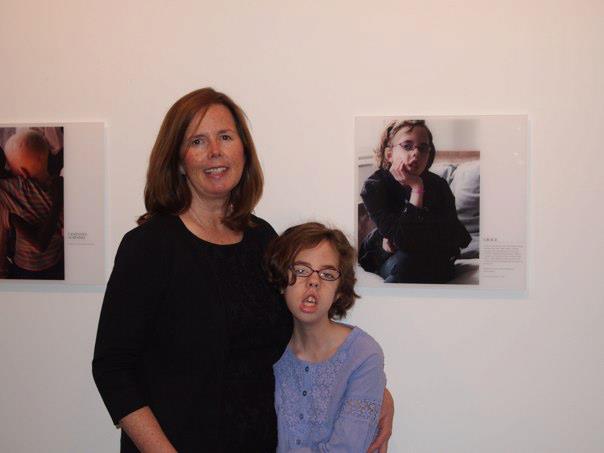
In case you missed it, Friday was the National Day of Listening. StoryCorps put together a Listening Wall, and Starfire contributed our two cents worth.
Here are three stories to start your week!
You can find these and other stories here:

In case you missed it, Friday was the National Day of Listening. StoryCorps put together a Listening Wall, and Starfire contributed our two cents worth.
Here are three stories to start your week!
You can find these and other stories here:
This afternoon, my 16-year-old son Ben, left the house with his younger sister Grace to go see Mariemont High School’s production of “The Odd Couple, ” starring their friend Ellyse Winget. When they left the house, leaving me with a few hours of time to spend with my mom, who is visiting, I felt this huge sense of relief. It was the relief that we all feel, when responsibility is lifted from us, and it was the sense of relief that we feel when our children are doing things they want to do, with the people they like.
I could have gotten some respite by dropping Grace off somewhere, I suppose, at an event or an outing, with other similarly abled people. However, I wouldn’t have that same sense of relief, because I know that Grace would not necessarily be doing what she wants and with whom she wants. Furthermore, she wouldn’t really be growing and I’m not sure that she would really be developing meaningful relationships that way. Knowing Grace, she would develop a relationship with the volunteers, who would really just be temporary volunteers.
Today would not have happened, without a group of people who work across various agencies in Hamilton County, who spent time getting together to talk about what they have done well and what they want to do better in the future. Within that meeting, these leaders each wrote down one area they want to work on, and then where there was like-mindedness, they came together and started brainstorming. In this case, the area of interest is “youth inclusion.” Being wise leaders of their own organizations, they recognized that they are not the youth and that this needed to be youth driven. So they tapped a few young people they knew and got them together and got them meeting and talking. Like all good and important movements, it is starting small and slow, but each meeting has more meaningful discussion and brings one or two new faces. The results are already beginning—Grace is at Elysse’s play, with her brother today.
If you are an interested youth, or know an interested youth, the next meeting is Saturday, 12/15, at 11:30 a.m., at Awakenings, in Hyde Park Square
I have been thinking a lot about Joe’s social life. At his age (25) he should have more friends. Friends that call him up and say: ”What ya doing? You want to come over and hang out?” Or friends who call and say: “Hey, a bunch of us are going to Oktoberfest. You want to come?” Trouble is, he doesn’t get invitations like this. Joe does have a couple of really good friends who he spends time with now and then. But he needs more. Maybe new friends just don’t think about asking him. Maybe they think it would be too much trouble to come get him / bring him home – or ask me to drop him off and pick him up. Maybe they think, for some reason, it is ‘not appropriate’ and Joe doesn’t need other people in his life – “Joe’s family takes good care of him, he doesn’t need me.” Or maybe it is awkward to arrange things with me, Joe’s Mom – since Joe needs help scheduling things. Perhaps they just don’t know how much Joe would really enjoy spending time with regular friends doing ordinary things. So, taking a page from Tim’s book, I decided that it is us (Joe and I) who need to do the inviting. And little by little, I have begun helping Joe make invitations – mostly thru Facebook. We have been pretty successful. It is a little disappointing when someone is busy and can’t accept the invitation. But that is the way of life and Joe seems OK with that. Sometimes, Joe’s invitation goes ignored or is refused with no explanation at all – that is pretty tough. I make excuses for the person and tell Joe, ‘Maybe next time”. But I don’t have to tell him he is being disregarded – he knows. It hurts. It makes me want to pull back and stop inviting. I know, pretty thin skinned. But that’s not all . . .
Joe has participated in StarfireU for three years now; he is currently in his fourth and final year of this awesome journey. Key to the efforts at Starfire is the development of a solid network of friends for each of Starfire’s members. Understandably, Starfire has been working really hard to bring families into the social network building work they do. So they ask us families to help identify the people who already know and care about our sons/daughters. They have asked me to name these people in Joe’s life and then to reach out to those people and invite them to come into and be a part of Joe’s social network. Starfire asked me to invite these important people to come to Joe’s PATH (a futures planning process)and to his CAPSTONE Collaboration (a network building project) meeting. They want me to ask these people to become more involved in Joe’s life. It is really important that I contact these people and ASK them to come help Joe. However, this isn’t easy for me – in fact, it is extremely difficult. They are good people, really they are. They truly care about Joe, I know this. But it is SO VERY HARD to call or even email and ASK them for help. So I stall, I procrastinate, I make excuses.
I am totally excited about the work that Starfire is doing. And I am absolutely thrilled about the wonderful social network of true, lasting friends that is possible for Joe thru this work. This is life changing stuff! I am totally convinced that the more people Joe has in his life, the richer, more vibrant, and safe his life will be – especially when I am no longer here to support him.
So why can’t I do my part? Why is it that I am so afraid to ASK?!!
I have really struggled with that question: I am a shy person. That’s true. I was raised to be self-sufficient, and meeting my child’s needs is my job. To ask someone else to carry my burden isn’t right. That’s true too. To ask for help is a sign of weakness or incompetence. It’s like saying, “I can’t handle ‘things’ on my own.” Well, maybe there’s a little of that. And then, I come to a thought that hits a nerve: I am afraid of being rejected. There is a spark of pain and lingering sadness that comes with this thought. This is real and powerful and not quite rational. Why does this fear seem so out of balance? And, as I continue to search in my mind . . . when I am brutally honest with myself . . . I know that I hear it . . . from some place in the dark, dark, depths of my consciousness, comes that debilitating whisper: “Your son is not worthy. Why would anyone want to be friends with him? No one has the time or energy to spend on him! Why would they want to? How can you possibly think that anyone could really develop a true relationship with someone who has so few skills in holding up his end of developing and nurturing a friendship?” My heart sinks as I realize that THIS is what is holding me back.
Let’s be clear here: I don’t really believe any of that! But I cannot deny that I hear that whisper. Where does that demoralizing voice of doubt come from?!! How does my fear of rejection rise to the level that it becomes paralyzing?!
In reflecting on this and looking back over my experiences since Joe was born, I remember several times when I have sought help on his behalf – and met with rejection. I have heard words (spoken and unspoken) from others that have fed and kept that cruel whisper alive.
I would like to share these stories with you; not to gain sympathy, nor to prove how tough our life has been. Please believe me when I tell you that Joe has had a wonderful life! And I would measure my life no tougher than the average – actually easier than many. What I do want to gain is your understanding of the path we have traveled and how the experiences I have had along this path have influenced me. The words and actions of others do impact our lives – there is no getting around that. My life experiences have led me to be who I am today, and explain (at least to me) my challenges in facing ‘The ASK’. Here are my stories:
It goes way back to when Joe was just a baby . . . When Joe was born, we felt so fortunate to find a young mother who was interested in babysitting Joe during the day. At the time, I held a full time, career-oriented job at GE and was ecstatic to have such a perfect daycare solution. Joe’s babysitter started caring for him when he was two months old. We did not know that Joe had a disability until he was formally diagnosed at the age of 11 months. For some time, Joe’s delays were not readily apparent to the average person. But by the time Joe had reached 18 months, his delays were very obvious. He was unable to walk or crawl or stand. He could sit, but he sat with a lean and was not stable. He was not talking at all. Joe’s sitter was accustomed to taking Joe along with her and her own two children to the store or to the pool or the park – wherever they went during the day. Apparently as Joe grew older and his disability became noticeable, people – her friends in particular – had started asking questions about Joe and his delays. The sitter became uncomfortable having Joe with her. So, one afternoon, she told me that she could no longer babysit Joe. I was shocked and totally distraught. I began my search for another day care provider. We asked everyone we knew and could not find another private sitter. So I turned to regular daycare providers. One by one I approached each daycare in our area. One by one they turned me down. Joe was ‘too fragile’. He would get ‘stepped on’. “We don’t have a place to put him where he will be safe.” “We can’t possibly provide the special care that he needs.” Many times the excuses didn’t even make sense – the answer was basically, ‘No’ because he had a disability. With every rejection, my heartache intensified. No one wanted my baby – my beautiful, sweet, happy baby. He didn’t fit. He didn’t belong. He wasn’t normal. He wasn’t good enough. My heart was breaking!
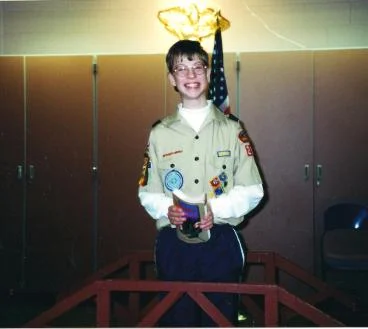
My next story takes place when Joe was about eleven. Joe had participated in Cub Scouts from the very first day when he came home from school dancing around and waving a flyer about signing up. He joined right away and attended every meeting / earned every badge / enjoyed every minute of being part of the troop. I joined too as an assistant leader and Joe’s Dad ran some of the outings. It was a great experience and Joe was quite proud of his earned badges and of belonging to the troop. He was especially proud on the night when the boys in his den “Crossed the Bridge” from Cub Scouts to Boy Scouts. At that point the boys moved up to another troop and location under new leadership and into the ranks of ‘REAL’ Boy Scouts. Joe was excited and ready. We went with his Cub Scout troop to the informational/orientation meeting with the new Boy Scout leadership – all men – all in uniform – the REAL DEAL! The Cub Scouts also attended several get acquainted / ‘these are some of the things we do as boy scouts’ meetings. At one of these meetings, the Boy Scout Head Master pulled me aside and told me that Joe couldn’t possibly participate in Boy Scouts. I was shocked! I explained that he had always participated in Cub Scouts and that I would happily provide him with the support he needed. The Master was persistent and said that I, as a woman, would not be permitted to attend. I insisted that there must be a way that they could find support for him. At the next meeting, I was surprised to learn that the Boy Scout Master had arranged for a representative from another Boy Scout Troop to evaluate Joe for inclusion to his troop. This troop was exclusively for scouts who had disabilities! So, while Joe’s fellow Cub Scouts were learning with and getting to know the Boy Scouts from their new troop, Joe and I were pulled into a private meeting with the Scout leader of the ‘Disability Troop’. The ‘Disability Troop’ leader talked with Joe and I and then reported that Joe definitely would NOT fit in with his group of scouts. His troop consisted of men who were anywhere from 20 to 40 years of age – Joe was just 11! He said that Joe belonged in the regular Boy Scout troop. Left with no other choice, the Head Scout Master told me that if I could find an adult male who would assist Joe, then Joe could join his Boy Scout Troop. Unfortunately, Joe’s Dad was unable to help out since he had a full time job and was also co-running a small business. There was only one person we knew that I could possibly ask to do this for us – the man who had lead Joe’s Cub Scout group for the past year. He is a kind, gentle, caring man but it was hard to ask. Sadly, he said no. He said he just didn’t have the time. Joe’s scouting career ended. The injustice was infuriating and the heartbreak intense.
Only a year later, I wanted to help Joe build friendships with his ‘typical’ classmates at school. There weren’t many children his age on our street and I expected that there were classmates at school who were already friends with Joe during the day who we could encourage to become closer friends with him. I could talk with their moms and invite the friends over and support Joe in developing these friendships. I had read about a ‘Circle of Friends’ concept where a group of friends was built around a person with a disability who needed support in developing friendships. But I needed help in learning how to go about this and in knowing which friends would be good candidates. I was also hoping that some of this interaction / friendship building could take place at school. I remember going to one of Joe’s IEP meetings full of enthusiasm and hope that I could pitch this idea to Joe’s IEP team and they would help me make it happen. Surely they would understand the importance of friends! I began by explaining to them that Joe didn’t have real honest-to-goodness friends. No one asked him home for sleep overs. He wasn’t invited to birthday parties. He didn’t get invited to go play at anyone’s house. He needed real friends! As I tried to build my case in earnest, my heart ached at the truth of my words and I was unable to keep my eyes from welling up and overflowing. I told them about the Circle of Friends concept and I asked them for their help. I was met with a very long period of silence as the people in the room looked from one to the other, each not knowing just what to say – how to go about saying no. I don’t remember who spoke or what exactly was said. I do know the answer was a definitive ‘NO’. The explanation was something along the lines of “That’s not our job.” The messages I heard were: ‘That’s your job.’ ‘Friendships aren’t important.’ ‘That would be too much work. And we don’t believe that what you are asking for is even possible!’ I felt alone and hopeless.
One more, quick story: Joe was in high school. He has always loved theater and has been involved in acting, on and off, since third grade. He took the theater classes at high school with support from the Special Ed team. But, in order to perform in the high school’s theatrical productions, students had to join the theater club and stay after school to rehearse. At that time I had a full time job and was unable to be at the high school to support Joe during the after-school time frame. I asked his Special Ed teacher if anyone could be found to support Joe after school for this. I was told that ‘No, it would probably be very difficult to find anyone who would want to stay after school to support Joe.’ No sense even asking around. End of story. I felt defeated.
As I relive these and other stories of Joe’s life, the memories of those struggles are so clear and the pain I felt then resurges as though it had never left. It is now quite easy for me to see why I am so ‘gun shy’ about asking others for help on Joe’s behalf. Having asked for help in the past and experiencing the pain of having my child rejected, I am now literally afraid of experiencing that pain of rejection again. I realize too, that the one thing that feeds that fear WAY beyond reason is my clear EXPECTATION of being rejected. For, even more than the past rejections themselves, it has been the messages that have come with these rejections that have had such aprofound, lingering impact. These messages were crystal clear: Joe isn’t good enough. He isn’t normal. He isn’t capable. He isn’t important. He isn’t worth the trouble. He doesn’t belong with us. We don’t want him. No one would want to be his friend. No one has time for Joe. He belongs with others ‘like him’.
If I listen to these cruel messages and let them guide my choices, I could easily be led towards places and programs that have been built exclusively for people with disabilities. After all, what I have heard is that Joe belongs with others who have disabilities, not in regular places and regular programs with everyone else. Asking for help from agencies who build these ‘special’ places and programs is easy – they welcome Joe. There would be no rejections there! It would be so much easier. I wouldn’t have to ask, all I’d have to do is sign him up. I wouldn’t have to fight to get him in. Joe or I wouldn’t have to prove that he is capable of anything – they don’t have expectations. I could avoid ‘the hard stuff’ of building Joe’s network and helping him find his place in the ‘real world’.
Thing is: I know that these messages are not true. I don’t believe in my heart of hearts that Joe belongs only in groups of people with disabilities. I don’t believe that anyone does. Every person deserves the same opportunities and experiences and daily life as anyone else. Joe belongs with ordinary people in his community doing the things he loves with the people he cares about. And there are people out there who do want to spend time with him and who will love him simply because he is Joe.
Candice talks in another post about the 3 Monsters that hold us back from worthy goals. As I reflect on past experiences, I realize that the messages I have heard throughout Joe’s life continue to feed my 3 Monsters and keep them alive and well. But, as Candice explains in her post, now that I recognize what is holding me back, I can set those monsters aside so that I can move forward.
I know in my heart that there are people out there who WANT to be in Joe’s life. And I have Starfire to help me find those people. As I witness more and more people coming into Joe’s network, I am learning that bringing people into Joe’s life really isn’t so much an ‘ASK for help’ as it is an invitation. It is an invitation to a wonderfully rewarding relationship. So I WILL do my part. I will INVITE. Because it is only by my inviting people into Joe’s life that I can help Joe build the rich network of friends that he WILL have in his life. And I firmly believe that the more people Joe has in his life, the richer, more vibrant, and safe his life will be. Some things you just know ~ if only because your heart tells you so.
“Why then the world’s mine oyster, Which I with sword will open.”
~ William Shakespeare
~~~~~~~~~~~~~~~~~~~~~~~~~~~~~
My husband wrote the following as a preface to a ‘Vision of the Future’ plan we developed for Joe seventeen years ago. The effort was initiated by Joe’s Special Education teacher at the time, Joy Nichols Garand (God bless her!):
Joey and Mrs. Garand
“This document is intended to be a living document which may change as Joey gets older or life situations change. At the time it was prepared Joey was eight years old. It represents a snapshot summary of how his parents would like to see his life and his surrounding environment develop. Therefore this represents a set of goals for which everyone associated with Joey, and even he himself, must strive to accomplish. By so doing, we will support a very deserving person in reaching his full potential and allow him to be happy in his life. . .”
In a portion of this document, we listed our dreams for Joe. Many of those dreams revolved around his living, as independently as possible, in a happy supportive environment. And we wanted him to be able to go places and do the things he enjoys. Additionally, there were five key ideas that cut to the heart of what we felt was of utmost importance to Joe’s future life:
We wanted him to “have true friends. Friends to just hang out with.”
We hoped that he would “find someone to marry. Maybe have a family”
We expected for him to “be employed in the community.” And that that employment would be “Meaningful. Enjoys it. Adds to his life.”
With true earnest we dreamed that he “Be fully accepted and appreciated in his community. Feel he is important, loved and that he belongs.”
Bottom line, we wanted him to live a “Normal life with as few supports as possible”.
That was long back, when we were young on this journey that includes disability. Along the way we have clung to these dreams, sometimes making compromises, sometimes experiencing triumphs, sometimes defiant, sometimes beaten down, many times hanging on by a thread. But all along, we have always refused to give up on the dream of building a life for Joe that is as close to normal as possible.
Skip forward about thirteen years: . . .To the period in our life when we started Joe’s ‘transition’ to adulthood. Joe graduated high school in 2007 with the same classmates that he had gone thru school with, all the way from Kindergarden. He officially left high school two years later at the age of 21 ½, when he had ‘aged out’ of the public school system. As with most high school graduates, there were some life decisions to be made. When he left high school we were told that there were basically two types of options for Joe. We could ‘place’ him in any number of ‘Work Programs’ and/or ‘Day Programs’.
The Work Programs that existed were either Workshops or ‘Enclave’ work group programs. The Workshops are a lot like regular factories except that all the workers have disabilities and the facility is a separate facility just for those who have disabilities. Enclave work groups are groups of people, all of whom have disabilities, who are closely supervised as a group – usually in some type of community setting. I have several concerns with both the workshops and the enclave work groups (which I won’t go into at the moment). The biggest concern I had at the time was that Joe HATES to clean, assemble, sort, package, etc. and would require constant redirection to ‘stay on task’ in either setting. He would not be productive. Most importantly, he would be miserable in this type of work.
When we investigated the Day Programs, we found programs that taught life skills, worked on social skills, spent time on crafts or maybe gardening, held exercise sessions, entertained, and had ‘outings’. These Day Programs were solely for people with disabilities with very few opportunities for real community involvement other than group outings where an occasional interaction with an ordinary citizen would occur. In other words not too different from the high school program he had been in for the last 4 years. He would be busy. He would be entertained. He may gain new skills. He would get exercise. He would have fun. He would probably even really like it.
But is that a life?
I remember being so distraught. What did that kind of life mean for Joe? I laid awake at night, tears flowing, mourning the normal life that Joe must give up. He loves people! He thrives in community! He has been raised all his life in the normal, everyday life that we, his family live! Now he must spend his days isolated along with other adults who also have disabilities. Was he to be forever locked into the same life experience day after day, year after year?! Is that all there is for him?! To be trained, behaviorally modified, and entertained in an endless loop? To be isolated from the rest of society so that building relationships with regular people in the community would be near to impossible? To be ‘PLACED’!! – as in – AWAY – on a shelf?!
Today, I look at my other two sons: one who has already graduated high school, and my youngest son who is a high school senior this year. How different their choices are. How wide open and exciting life is for them – endless possibilities! I remember being told as a graduating senior myself: “The world is your oyster!” Life is there for the taking. All seems possible! Busting into adulthood is liberating, exhilarating, intriguing, wondrous, albeit a little scary. This new-found ‘almost adulthood’ also carries with it expectations. Family and friends expect that you will find your niche, make something of yourself, learn to stand on your own two feet, become productive, and contribute in some way. You expect to take charge, make your own choices and begin to build your life your way, maybe even get married and have a family. You can expect to meet many new people and make new friends (and loved ones) to go and do and experience life with. Life is good and you are just getting started on an exciting adventurous journey that will take many twists and turns as you age and experience life.
One thing’s for sure, you do not expect to be on an endless loop of being trained, modified, and entertained!!! You have no intention of being . . . Placed – Away – On a shelf!
I heard a quote not long ago that stuck with me (unfortunately I do not remember the source in order to give proper credit – my apologies to the author!). It goes something like this: ‘There are some truths you know because you have learned them. But then there are other truths you know from deep within you that you didn’t learn – you just know.’ And I can tell you that I just know that this disparity between how Joe’s future looks and how his brothers’ futures look is just not right.
Fresh out of high school, Joe should be looking at a wide open and exciting life – with endless possibilities! He should be busting into adulthood – liberated, exhilarated, intrigued, and in wonder knowing that anything is possible. We should be expecting him to find his niche and make something of himself. We should expect him to be productive and contribute. He should be allowed to build his own life, maybe get married and have a family. He darn well should be able to expect to meet many new people and make new friends (and loved ones) with whom to share his life!!
Pardon me. Please allow me to step back off my podium – I admittedly do get carried away at times.
Back to those high school / adulthood ‘Transition Planning’ days: Unhappy with the options that had been presented so far, we kept looking. Against the advice of the Transition Team at the high school we looked at one last ‘Day Program’: StarfireU. The Transition Team had told me that StarfireU was for ‘higher functioning’ students and that Joe wouldn’t fit in. But, I thought, ‘How could it hurt to look?’ So we (Joe, his Dad, and I along with Joe’s Service Facilitator) went for a visit – just to see.
The minute we walked thru the door, we knew that this place was different than any of the other programs we had visited. The respect with which Joe was received blew me away. Instead of looking at me when they asked questions about Joe – they asked him. And they listened to what he had to say. They answered his questions – no matter how ‘left field’ they were. Joe was treated with the same respect that was shown to my husband and I. The description of the program was so intriguing. StarfireU members (attendees) spend some of their time in-house with various seminars taught by ‘Community Partners’. These are ordinary (and some not-so-ordinary) citizens who are drawn in from the community to share knowledge and passions. A lot of the members’ time is spent out in the community; meeting people, going places, doing things, volunteering, experiencing life! These aren’t ‘outings’, they are engagements. Interaction and engagement with any and all ordinary citizens is encouraged, supported and facilitated. The StarfireU program is definitely a program like no other. You can’t leave Starfire without being uplifted, inspired and challenged to think (dare I say, dream) in a new way. Of course we signed up!
Now, after experiencing StarfireU for three years, I can tell you that enrolling Joe in StarfireU was the best decision I have ever made. The experience we have had at Starfire has changed our lives and will continue to change Joe’s future. You see, Starfire is not about training Joe – or modifying him – or entertaining him. There is no endless loop at StarfireU. This is a four year, carefully planned and executed, person-centered / asset(gift)-based experience. StarfireU launches participating members into a life full of possibilities along with a supportive network of friends and family. Starfire is all about helping Joe build a full, rich ~ as close to normal as possible ~ life that is productive, adventurous, and experience filled. Central to Starfire’s efforts are helping Joe find those friends and loved ones who are thrilled to share in Joe’s life. These are the people who are critical to supporting and sustaining Joe as he embarks on his OWN exciting adventurous journey that will take many twists and turns as he lives the full rich life he deserves.
And so, with Starfire’s help, we are starting to discover that the world is Joe’s oyster too!
Written by guest contributor Jack Pealer
You’ve got to be taught to be afraid
Of people whose eyes are oddly made,
And people whose skin is a diff’rent shade,
You’ve got to be carefully taught.
And, the teaching and learning happen, mostly, outside the awareness of the teachers and the learners. I remember one bit of that teaching and learning in my own life.
About 60 years ago I learned something about deaf people, and I’ll bet that not many now know what I learned then. I learned that people who can’t hear could run faster than anyone else. How did I learn that?
The house where my family lived from 1949 until nearly 1960 was just two blocks from the Ohio State School for the Deaf. Of course, we called it the “deaf school.” The school in Columbus was–and still is–on land that had been a golf course before the state acquired it around 1950. A major cross-town street runs past the entrance to the school; the campus was—and still is—a cluster of one-story buildings sitting several hundred yards back from the street. Now, today, as an adult, I know it is only several hundred yards. When I was ten, it looked like the buildings were a mile or two away across a vast plain of the former golf course. That vast plain was our playground. There was no other in the neighborhood. We played football and baseball there. We were pirates, cowboys, adventurers in the heavy shrubbery that lined the school’s entrance driveway. I remember one attempt at civil engineering—building a “dam” across a tiny stream after a heavy spring rain.
But games ended when we saw people—students–walking out of the school toward us. On many afternoons, young people from the school would go in groups toward the street—to catch the bus or walk to the nearby shopping center. We knew we had to give them plenty of distance. That was because we knew there was something funny about them. They made odd movements with their hands. Some of them made unusual sounds to one another. And, we knew, they could run. We saw them and either hid in the shrubs or headed for home because we knew that, if we got too close and they spotted us, they would run after us, catch us, and do unspeakable things to us. We abandoned the field; we knew better than to hang around.
We just knew. We learned, seemingly, from the air. I can’t today recall any specific event that tells me how we learned. I do understand now the effects on us of that distance across the field and the messages about difference that distance and separation transmit. I can report that no one I knew was ever harmed, chased, or even approached by any student from the School for the Deaf. I suspect they were as apprehensive about us as we were about them, and I wonder sometimes what stories they might have held or told about my friends and me. What unspeakable acts were we believed ready to commit?
Separation (I never went to school with other kids who could not hear) and distance(that several hundred yards that looked like miles) turned out to be effective teachers. It took me a long time to get clear about what I “knew.” It took a long time not to be afraid.
Written by guest contributor Diana Lynn Mairose, Starfire Board Member
I have been involved with Starfire for 12 years. Since I first started in 2000 as a member, we have doubled the space and the staff, and the creativity behind what we do. I see Starfire as leaders in innovation.
As a Board Member at Starfire, my role is to represent everyone who contributes their time, efforts, energy, and creativity to such a great organization. I see how much energy and resources we need so we can further our mission and what we believe in. It is different to see other perspectives, and keep in mind our future and how it will benefit members. I represent every member. It can be challenging because sometimes it takes rewording things, sometimes unexpected things happen, but we all have to think it out. We all have a voice. Being on the Board for Starfire, I have become a better thinker, it has taught me to think more because it impacts so many people.
Starfire is on a path to building more inclusive communities, and it’s a great mission. It’s so much stronger than it ever has been. The biggest hurdle I think we have is to teach others our mission- at first how they see it might be different than how we see it. Different in how they take part, their lifestyles, their environment. Just like my definition of community may be different from someone else’s, everyone can take part, just in different ways. Logistics like transportation, where people live, people’s lifestyles- it’s just going to look different for each person. Some people might have to take more steps to understand.
It’s definitely possible. It’s all about the ability to find outlets that you can use creatively. People can begin by taking the time to listen, to find out what people’s dreams are. It might not happen on day one or day five, but you have to get to know people. We have to teach people to think outside the box, try new things. We have to emphasize people becoming connectors in their community.
Written by guest contributor, Kathleen Cail. You can read her earlier post here.
I recently attended a fabulous conference, hosted by Starfire, which was basically about community development. Part of the discussion was about “bending over backwards to enhance the image” of people who experience disability. We were focusing on “code words.” I worried that when we are too politically correct about words, we end up creating barriers for the very people we want to knock down barriers. We spend so much time talking about “code words” that I worry we make people feel as if they are walking on egg shells and rather than getting to know a person, people avoid that person because they are afraid they might say the wrong thing. Some people in the audience disagreed and said that words do matter because words often reflect what is meant and believed.
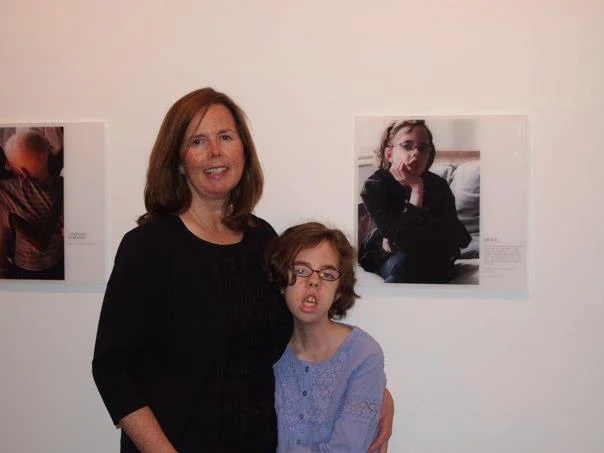
Today, I picked up my daughter at school and she was very excited to show me the biographic pamphlet she had completed. Apparently there is an aid or co-teacher in the classroom who helped Grace with this by scribing for her. The 2nd paragraph read, “Grace suffers from Muscular Dystrophy. She has many challenges in her life.”
So much for my soapbox about words earlier that morning. I was on fire. These are not the words of a 13 year old and these are certainly not the words of my 13 year old. I wish I could say that Grace would not likely have mentioned that she has Muscular Dystrophy, but that’s not true. This is a big part of who she is right now. We hope that we can lead her away from this, as time goes on. However, she would never say she suffers from it. I was furious. Whenever I have been asked to introduce myself, I never mention that I am overweight, have a tendency to be controlling, get migraines, got a C in high school chemistry and math is my weakest subject. It’s not that I avoid these things, but it’s not what people want to know about me and it is not what I am going to use as common ground in a potential relationship. Muscular Dystrophy is not going to be the common ground for a potential relationship at Grace’s new school, either. Muscular Dystrophy is going to be something that makes Grace different and last time I checked, what school-aged kid wants to be different, particularly a 13 year old middle school girl?
Words DO matter and there are “code words.” To me these code words sound a little different from the list we constructed at the meeting. To me they include words/phrases like, “we are all about inclusion” or the “Downs kids.” That one always makes me think ofa dystopian world where we have the “fatties,” the “gingers,” the “uglies,” the “short people,” the “Epis” (have to carry EpiPens), the “ADDs”, etc. We just don’t do that. But for some reason, we do feel the need to label people experiencing disability. It is horrifically “politically INCORRECT” to say, “the blacks” so why would we say “the Downs kids?” I’m truly baffled by this.
Words DO matter. Even today I received an email about trying out for the school play. I had asked for some information since Grace is interested in trying out. In fairness to the teacher, Grace has had a very difficult transition to her new school and for the first two days, she flat out refused to go to her classes because she was afraid of the bell ringing (this is considered non-compliant behavior—forget that it really is true anxiety exacerbated by the fact that Grace spent 10 years in a school that had no bells at all). In reading the email, I couldn’t help but wonder if all the parents whose children want to try out for the school play received this email and if it had similar (what I read as code) words,
“…With that being said, expectations about rehearsal time, behavior and keeping up her academics would remain the same if Grace chooses to do the play. I know that everyone is working hard to give her a positive, successful experience…She will need to be at rehearsals and positively contribute when she is there…If the acting part of the play seems like it is going to be too much, there are other ways to get involved besides being on stage!”
We have only been at this school for a few weeks, so I am trying to tread lightly. It is hard to stay calm in the face of this, but it is so important to remain calm in order to “keep my eyes on the prize”—developing a great school community for my daughter, filled with teachers, administrators, friends, and peers who know my daughter, value my daughter, like my daughter and invite my daughter to truly be a part of the community. A community that has opportunities my daughter can seize and enjoy. Part of achieving that goal will take education on my part and theirs. We all have a lot to learn and it is a journey for me, Grace, and for everybody else. I saw a car magnet the other day that read,“People are good.” I think that is true. People are good. We just all sometimes make mistakes or have more to learn. That goes for Grace, me, and the people we meet.
I took a big risk at approaching “Grace suffers from Muscular Dystrophy” as a teaching moment. At the end of “Meet the Teacher” night I approached the social studies teacher and introduced myself. I told her that it was very hard for me to bring up this subject, given that is was “MTT” Night and we were a new family, but that it was very important to me and something I felt couldn’t wait. I told her what came home and how that made me feel and what my concerns were with it. I picked the right person with whom to take the risk. She thanked me for sharing this. She said that she learned a lot about Grace and who we are as a family and what we want for Grace. She also told me she learned a lot about perceptions of people. She wanted me to know that the aid who wrote this is a very nice person and would never have wanted to offend Grace or us and would not have seen what she wrote in this way. This is always the hard part. I know people are fundamentally good and kind and nice. However, that isn’t an excuse or a justification. I know that is a default response. I make that same default response—“I didn’t mean it.”
Truly the teacher was great, but my struggle is always how do I move the conversation beyond the default response. What I want to say but don’t is, “Since she is nice, she will understand then that what was written suggests pity, neediness and less value and that is not an image we want for Grace and that is not what we want people to see or feel when they interact with Grace. We want people to see Grace for who she is. Grace is a typical adolescent who has hopes and dreams. She has crushes on boys and favorite musicgroups. She likes to dance and sing and hang out with friends. She hates homework. She has been known to throw her medicine down the sink, take off her nighttime braces, when she should be wearing them, and refuses to play on any team that is special needs only. She bugs her brother and her brother bugs her. She thinks her mom pushes her too much to do homework and study and doesn’t like when her mom tells her what to do. She thinks her father is way more fun. She is a democrat and Obama is her hero. If she could watch TV all day, she would. She loves to hug and hold hands. She loves to talk and is very observant. She asks good questions. She’s gorgeous and she’ll tell you she has beautiful blue eyes. She loves the Reds, the Bengals, the Red Sox and the Patriots. She hates the Yankees. Grace has been to many foreign countriesand many states in the US. She loves her dog Hank, but not the cat. She loves horses and does horseback riding. She swam on her old school’s swim team and hopes to swim on her new school’s swim team.
Does this sound like someone who is “suffering from Muscular Dystrophy?” Do you feel sympathy for the child described above or do you want her on your team? Do you want to cross her? Make her do something she doesn’t want to do? Or be a Yankees fan or any fan but a Reds, Bengals, etc. fan? Words do matter in helping Grace’s image. I think you know the image I want for Grace, so I think you know the words I would choose. Words DO matter after all.
Written by Jim Price, CEO/President of Empower MediaMarketing and Starfire’s current Board President
I always seem to find correlations between what I do for fun, for good and at work. If you aren’t living the way you work or working the way you live I don’t believe you can fully experience the treasures of life in a seamless and transparent way. Back in 2005, when I began to get more heavily involved with Starfire, I was also leading a mission at work to create a new word of mouth marketing (WOMM) team and capability at our marketing agency.
Word of mouth is the original form of marketing that has since come back into prominence. WOMM was born out of a need; passing information from one person to another was the only way to advertise pre-mass media and was instrumental in spreading religion, underground movements and even urban-legends. Today WOMM has been fueled by technology (people connecting with people more often online) bringing the oldest form of marketing back to sometimes the tent pole marketing strategy of campaigns.
It was paramount we get in this business and have the capability. As we got started we all agreed that our point of view on WOMM for clients would be to turn one-time engagements into long-term relationships and loyalty. At the end of the day, it’s all about relationships and we wanted to help clients build those with their consumers over time online and offline. We also believed the way to do it was for us to provide the reasons and means to get influential people to talk and refer our clients products. Six years later, we’ve been successful.
What I did in my professional life has now come full-circle in my personal life. Through my work with Starfire and participating in evolving their mission and vision, there’s no question there’s a correlation. It’s time for the world of disabilities to transition to a world of inclusion where we turn the one-time engagements (outings, volunteer events, the occasional hello etc.) into long-term relationships and loyalty. We need to create a world with people who care about them to come together to build their personal social networks. Through conversations, connections and collaborations at the same places we hang out at every single day, we can provide the reasons and means to get all of us who can be influential people in their lives to talk with them to build their networks one genuine conversation at a time.
Do you agree? If so, let’s do this together and tell me how you can help.
The story below was shared by well over 18 thousand people in just the 2 hours I noticed it posted on Facebook. It’s been circulating around the web as far as I can tell since May this year. Whether it is true, or just beautifully written, there is something about it that has people all over passing it along, keeping it alive. You have to wonder, what is it about this story that makes people want to share it again and again?
It’s entitled: “A sweet lesson on patience.”
A NYC Cab Driver writes…
I arrived at the address and honked the horn. After waiting a few minutes I honked again. Since this was going to be my last ride of my shift I thought about just driving away, but instead I put the car in park and walked up to the door and knocked.. ‘Just a minute’, answered a frail, elderly voice. I could hear something being dragged across the floor.
After a long pause, the door opened. A small woman in her 90′s stood before me. She was wearing a print dress and a pillbox hat with a veil pinned on it, like somebody out of a 1940′s movie.
By her side was a small nylon suitcase. The apartment looked as if no one had lived in it for years. All the furniture was covered with sheets.
There were no clocks on the walls, no knickknacks or utensils on the counters. In the corner was a cardboard
box filled with photos and glassware.‘Would you carry my bag out to the car?’ she said. I took the suitcase to the cab, then returned to assist the woman.
She took my arm and we walked slowly toward the curb.
She kept thanking me for my kindness. ‘It’s nothing’, I told her.. ‘I just try to treat my passengers the way I would want my mother to be treated.’
‘Oh, you’re such a good boy, she said. When we got in the cab, she gave me an address and then asked, ‘Could you drive
through downtown?’‘It’s not the shortest way,’ I answered quickly..
‘Oh, I don’t mind,’ she said. ‘I’m in no hurry. I’m on my way to a hospice.
I looked in the rear-view mirror. Her eyes were glistening. ‘I don’t have any family left,’ she continued in a soft voice..’The doctor says I don’t have very long.’ I quietly reached over and shut off the meter.
‘What route would you like me to take?’ I asked.
For the next two hours, we drove through the city. She showed me the building where she had once worked as an elevator operator.
We drove through the neighborhood where she and her husband had lived when they were newlyweds She had me pull up in front of a furniture warehouse that had once been a ballroom where she had gone dancing as a girl.
Sometimes she’d ask me to slow in front of a particular building or corner and would sit staring into the darkness, saying nothing.
As the first hint of sun was creasing the horizon, she suddenly said, ‘I’m tired.Let’s go now’.
We drove in silence to the address she had given me. It was a low building, like a small convalescent home, with a driveway that passed under a portico.Two orderlies came out to the cab as soon as we pulled up. They were solicitous and intent, watching her every move.
They must have been expecting her.I opened the trunk and took the small suitcase to the door. The woman was already seated in a wheelchair.
‘How much do I owe you?’ She asked, reaching into her purse.
‘Nothing,’ I said
‘You have to make a living,’ she answered.
‘There are other passengers,’ I responded.
Almost without thinking, I bent and gave her a hug.She held onto me tightly.
‘You gave an old woman a little moment of joy,’ she said. ‘Thank you.’
I squeezed her hand, and then walked into the dim morning light.. Behind me, a door shut.It was the sound of the closing of a life..
I didn’t pick up any more passengers that shift. I drove aimlessly lost in thought. For the rest of that day,I could hardly talk.What if that woman had gotten an angry driver,or one who was impatient to end his shift? What if I had refused to take the run, or had honked once, then driven away?
On a quick review, I don’t think that I have done anything more important in my life.
We’re conditioned to think that our lives revolve around great moments.
But great moments often catch us unaware-beautifully wrapped in what others may consider a small one.
How does a story like this get circulated again and again, by thousands upon thousands of people across the globe?
Taxi drivers, let’s think, typically have a list of job duties that looks like this (borrowed from eHow.com)
Pick up or meet customers according to requests, appointments, or schedules
Collect fares or vouchers from passengers
Determine fares based on trip distances and times, using taximeters and fee schedules
Vacuum and clean interiors, and wash and polish exteriors of automobiles
Operate vans with special equipment, such as lifts
Perform minor vehicle repairs such as cleaning spark plugs, or take vehicles to mechanics for servicing.
Nowhere does it say, “make the most out of the many encounters with strangers you will meet.”
And that’s just it. The “job duties” assigned to a cab driver, only speak to a fraction of the what it actually means to be a cab driver. This story breathes life into every bullet point on paper that has ever attempted to define us. It says that if we make it, just driving a stranger from point A to point B could be the start of a great adventure. That each day could be ripe with the potential of a new bond, a compelling story, a big hug at the end of a long drive. It says when we turn off the meter, when we respond to one another, when we don’t take each other for granted, we are simply able to acknowledge the fact that we are all in this messy life together, and able to do a little something more for the people around us. Maybe we keep on sharing the story as a reminder to be good, to be patient, and to be open to people.
Conan O’Brien in 2010 hosted his last “Tonight Show” on NBC. In his remarks to the audience he said, “All I ask is one thing, particularly of young people. Please do not be cynical. I hate cynicism; for the record it’s my least favorite quality. It doesn’t lead anywhere. Nobody in life gets exactly what they thought they were going to get. But if you work really hard and you’re kind, amazing things will happen. I’m telling you, amazing things will happen.”
Those words have stuck with me, particularly because I agree with him about it being an unflattering quality, and partly because I’ve worked so hard to keep that quality in check with in myself.
What is the opposite of cynicism? Surely, it’s not blind optimism. I listened to President Obama speak last night and he touched on his 2008 campaign slogan “hope” and what it meant in the context of 2012. I tried to recall his exact words from then, and needed to Google as a refresher. I think it fits in this conversation: “Hope is not blind optimism. It’s not ignoring the enormity of the task ahead or the roadblocks that stand in our path. It’s not sitting on the sidelines or shirking from a fight. Hope is that thing inside us that insists, despite all evidence to the contrary, that something better awaits us if we have the courage to reach for it, and to work for it, and to fight for it. Hope is the belief that destiny will not be written for us, but by us, by the men and women who are not content to settle for the world as it is, who have the courage to remake the world as it should be.”
We hope plenty. We hope at night, sleeplessly. We hope on drives home, tearfully. We hope on the way to coffee meet-ups with strangers we think could be the future best friend of someone we know, or at least come in and teach a class about something they enjoy. We hope via text message, in person, and through staff meetings. We hope people aren’t alone. We hope people are happy. We hope what we’ve worked on is something, enough, knowing it’s never enough. We hope all the damn time.
And what is this hoping? Do we sit back and cross our fingers behind our backs while we think good thoughts? Do we superstitiously avoid cracks in sidewalks together, holding hands and skipping? Do we cross the street when we see black cats, avoid walking under ladders, curse ourselves for breaking mirrors? For us, hope is the uncomfortable teetering between what we know could be, what we know to be right, what we know to be possible and what we know Others expect will happen.
Tim and I exchanged an email stream back and forth in 2011 about this very thing, the role of the Others. “There’s another kind of cynicism…those people who say ‘welcome back to reality.’ It’s a hopeless sentiment and is a momentum-killer. The only way to overcome that is to A) ignore it and B) build up enough allies that them saying it doesn’t matter anyway.” The Others, I can surmise, speak ill of what we’re doing. Cynics, of course, are often spineless. The ‘Welcome Back to Reality’ phrase is an effort to save face, a last ditch ‘I told you so’, salt poured into a wound we tear open daily. Often, the cynics aren’t actively working to change the situation, but have opinions and criticism and suggestions plenty.
We know that we do, what we’ve worked on, what has and hasn’t sustained is not perfect. While imperfect as what we do may be, as flawed as connections and capstones can turn out, it is a step in the right direction, a direction that isn’t the same as everything else that is out there that keeps people exactly where they’ve always been. I suppose a cynic can layered, as one-dimensional as they often seem. They can be both in complete disbelief that anything hopeful, good, wonderful will happen and they can have a complete distrust of others’ motives, outcomes, or ambition. If they aren’t careful, they’ll become misanthropes.
The opposite of cynicism isn’t blind optimism. Cynicism is pessimism in its nastiest, most spiteful form. It is useless, purposeless and dangerous. It sits and stews in its own filth; it grows and feasts on others for fuel. It infects others, casts doubts in otherwise strong minds. In my domestic life, I’ve been known for leaving pots and pans of food sitting on the stove overnight. Worse, I’ve left bowls of food in the microwave for say a few days at a time (a conservative estimate). On one such occasion in one of our apartments, I went to microwave something, opened the door, and encountered a bowl of food covered with flies and maggots. I had left a bowl of something cheese-based in the microwave, in the un-air-conditioned house for over a week. Cynics moan and don’t do anything about it. They writhe in their own nastiness. Cynicism is the same as the maggot infested bowl of food: toxic and wasteful.
I have been tempted with that dark whisper in my ear, too. Nothing you do will ever be enough. It’s not perfect enough. People are still lonely, aren’t they? Did that change someone’s life, really? Did that even matter? Was it enough? Could more have been done? Could something have been done differently? It directly plays into judgment of ourselves and of other people.
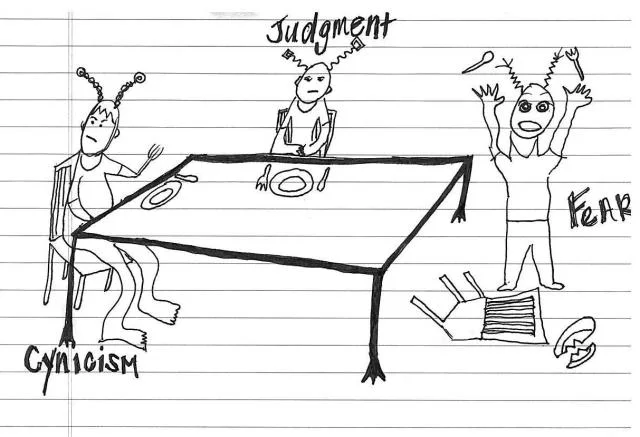
Judgment, another of the three monsters depicted in the picture, is probably the one most present in us. Speaking for myself, it’s definitely the one that affects me the most. Having majored in theology as an undergrad, I’ve always been curious of how Biblical quotes get misconstrued. (See eye for an eye for example) but judgment is another one that we often misinterpret. Judge lest ye not be judged doesn’t mean NEVER JUDGE ANYONE EVER!, it’s more about being held accountable to the same standards. It’s a sort of moral checks and balances.
“Why do you look at the speck that is in your brother’s eye, but do not notice the log that is in your own? How can you say to your brother, ‘Let me take the speck out of your eye’ and behold, the log is in your own eye? You hypocrite, first take the log out of your own eye, and then you will see clearly to take the speck out of your brothers eye.” Luke 6:42
Essentially, take a good hard look at your dirt first before trying to tell someone how they should clean up theirs, and how you could do it better. Further, it’s helping the person remove the debris from their eye, help remedy the situation. Not just letting them squirm with it. (We’ve all had to have someone help locate an eyelash, contact lens, stray bug that was bothersome but we just couldn’t put our finger on it, literally, metaphorically. It often required help, but only after we’ve done our own work first.) Judgment is easy to do. We do it all the time, consciously and unconsciously, and it’s constantly reinforced. If you don’t believe me, the next time you’re in a grocery checkout line, please prove me wrong that the magazines won’t have someone featured in a bathing suit with cellulite!, stretch marks!, divorce!, love-child!, cheating scandal!, financial woes!
While judgment upon others is rude, pointless, and catty, judgment upon oneself is often debilitating. It’s a silent loathing of all the questions I asked above. Was it/I good enough? Will it/I ever be? Self-judgment leads into fear. Digging heels into the ground, immobilization. If cynics criticize and kill momentum, and judgment questions the quality and mode of momentum, fear prevents momentum to begin with. Roosevelt described fear as that “nameless, unreasoning, unjustified terror.”
When I traveled to Rome in 2003, we climbed 323 steps to the top of St. Peter’s Basilica from on the insider. When I reached the top, there was a thin mesh wire structure separating me from the winding tunnel of marbled staircase (safety) and falling to my death on the basilica’s alter below. I begged to turn back and just go back to the ground floor. Someone I was with at the time dragged me to the outside roof, to view St. Peter’s Square from the cupola. I was terrified, shuffling my feet with little movement, forcing smiles in photos, grasping on to people and railings in every photo. Was it worth it? Of course. Was fear the nameless terror? Of course. It’s the same as fear of spiders, clowns, the dark, flying, tight spaces, needles, dentists, or fear of heights in my case. It’s a nameless terror, unreasoning, unjustified.
What do we fear most in this work? What is the nameless unreasoning, unjustified terror that we back ourselves in a corner for, shuffling our feet, clinging to railings? That we’ll be proven wrong? That our work will be deemed silly, pointless, and not worthy? Do we fear it won’t work? Do we fear that people will think we’re hopeless romantics? Incurable optimists? Wishful thinkers? Do we fear that people will condemn us and ostracize us from the cool kids’ lunch table? The fears are irrational, misguided.
What we should fear isn’t our insecurities and questions about what if’s, but the effects of what happens when we let cynics, judges, and fear-mongering take hold. It only serves to cloud our vision and makes the road much more onerous, and intolerably longer.
The 3 Monsters become hungry. Cynicism, judgment and fear prevent us from in the very worst of days, being with present to people and working to chip away, however slowly and heavy the work may be, a systemic approach that people are problems that need to be fixed, and it’s our job to control, supervise, and fix them.
That is not blind optimism, the chipping away. It is hope that the chipping away is working towards something, something a little bit better, never perfect, not complete, but better than what was thought possible before.
And that, we have to be okay with, that it the chipping away might be good enough– cynicism, judgment, and fear aside.
We are not ignoring the enormity of the task ahead. We are not settling for the world as it is, but as we know it should be. Cynics, judgers, and fear-mongers, we have a table reserved for you together just beyond that exit sign. Misery loves company.
Here is a guest post from a three seniors who talked about people they’ve met so far while working towards building a capstone committee. Thanks Kyle, Joe, and Ashley for sharing your thoughts about the people you’ve gotten to know.
Kyle writes:
Justin is a cool person because he likes magazines and comics, trading cards. He is a great person and I make eye contact with him. I want to teach him some moves. I want him to follow his dreams and have a great life. He likes Black Panther, Giant Man, Captain America, Thor and Batman, Black Widow. We talked about super heroes and super hero movies.
Cal is all heart. He likes superheroes, too. The comic expo is a large event with lots of comics, Marvel and DC. He is a fun guy, we talked about a new comic book that was about Jackie Chan Adventures. We both like fighting ninjas.
I was doing all these moves and met Robert. Robert taught me more blocks, punches and kicks and special moves. I like taking his classes to learn moves and stunts. I would love to be a stunt man in the movies. Robert likes Batman and Superman.
Dan is a great guy. He knows everything about himself and makes friends with the spirit in his heart. Spirit and soul, he knows a lot about me. We drank some coffee and pop.
Joe Wenning narrated:
Chris Miller helped me practice and perform my Steamboat Joe, historical character. We met at the Freedom Center to practice. Chris knows a lot of history and gave me facts to learn more about my character. We met at a restaurant. Chris’ character is roustabout Henry. He walks around the steamboat entrance at the Freedom Center. Performing with Roustabout Henry was exciting and wonderful. I look forward to performing with him again.
Joe shows off his catalogue of connections!
Ashley wrote:
I met Joan at the Blue Ash Recreation center. She is a coordinator and works in an office she does manager things. We have things in common and like to do paper work, projects and researching for activities. She also does some creative stuff.
I do photography with Jess and take some photos at Ault park and looked at the flowers and took pictures of them.
As you can tell, these are small seeds towards building something bigger. People meeting each other and starting to get to know one another because they have some things in common. I can’t wait to see what grows from these connections.
Bad Habits: We all have them. Some we readily admit to having; others, we may not even know we have. One thing’s for sure, it is somehow quite easy to recognize someone else’s bad habits. And it is REALLY easy to come up with ways to ‘fix’ those bad habits that belong to someone else.
Problem is: the only person who can actually change a habit is the person him/herself. No matter how much you love someone – or how bad you know the habit is for that person, you cannot MAKE that person stop the habit unless he/she wants to stop. You can push, prod, penalize and bribe; but you cannot make someone stop smoking, stop drinking, lose weight, stop leaving shoes in the middle of the floor, stop biting fingernails, stop leaving the toilet seat up, etc., etc. – unless he/she decides to do it. I ought to know. As a wife and mother of three sons, I have done my share of the pushing, prodding, penalizing and bribing. Time and again I have learned that if a person does change, it is ONLY because he/she saw a need to change, had the desire to change, decided to change and then put the effort into making the change. So really, truly, it is a fact of the human condition: only the person him/herself can change a habit – not me, not someone else, not some program, not some professional, not some drug. It really comes down to a personal desire and choice on the part of the person who has the habit.
All this might seem obvious. And you would think that I have already learned this lesson enough times to understand it by now. But, alas! Not so! See, not so long ago, I was really, REALLY, intent on changing what I considered to be one of my son Joe’s worst habits. But in his case (I am thinking it was because he has a disability and in the world of disability, things are supposed to be different), it was called a bad ‘behavior’. And the ‘experts’ had convinced me that this ‘behavior’ had to be ‘modified’ to become a more ‘socially appropriate behavior’. So I guess I sorta lost track of just who was in charge of changing said behavior.
The behavior that was to be ‘modified’ is hugging. If you have read this post, you know that Joe has a long history of ‘inappropriate’ hugging. And you know that I have spent many years trying to get him to stop this behavior. Yep, I pushed, prodded, penalized and bribed with all my might – to no avail! It was frustrating for our whole family, including Joe. I pretty much resigned myself to the fact that Joe enjoyed hugging too much and he had NO desire to change the habit. This was a bit of an ‘AH-HA! moment’ for me: If Joe didn’t see the habit as a bad habit and if he did not choose to change the habit, it would NOT be changed! His Opinion / His Desire / his Choice.
You see, it doesn’t matter that Joe has been labeled with a disability. He is a human being, privy to the same human condition that we all share. No one else can MAKE him change his habits – even if they are labeled ‘behaviors’. Only he can choose his actions. Disability can’t take that power away from him. His mother can’t take that power away from him. No one else can ‘fix’ Joe’s ’behaviors’. That right, that responsibility belongs to Joe.
I feel the need for a disclaimer here: I realize that sometimes the things we do (habits / behaviors) are reactions and are not intentional actions. Sometimes the reason for a “behavior’ can be very complex. And sometimes a person has much less control over their own behaviors. My thoughts here, in this writing, are in regard to behaviors that we are aware of and that we can consciously control.
Furthermore, as explained in my previous post, I realized (with Starfire’s help) that Joe’s hugging is directly linked to his amazing gift for making real heart-felt connections to other people. And as I have come to appreciate Joe’s love for people and his ways of engaging and uplifting others, I have become more accepting of his hugging habit. I have vowed not to stand in Joe’s way. I have tried hard not to interfere or overreact when he hugs people. Well, it hasn’t been as easy as all that and I still had some learning / growing to do . . .
Although I knew that Joe was giving hugs as a means to connect to people, This habit was bothersome to me. He still hugged even when it made the other person uncomfortable. He would hug the same person seven or eight times in the space of an hour. And his hugs were still ill-placed with strangers. But by now I had learned my lesson well. I cannot ‘fix’ Joe’s habit. He is the one who must choose to make a change. So I held back . . . Until I just couldn’t stand it anymore!
Joe and I were running errands. It was one of those days that was crammed with lots of stops around town to take care of minor obligations. I took Joe along because it was his day off from StarfireU and he enjoys this sort of thing (there are lots of people with whom to interact!). It had occurred to me that in recent outings with Joe, he had really been hugging strangers a lot. There was a bunch to accomplish that day and I have to admit, I was a little short on patience. I just didn’t think I could deal with Joe hugging everyone we came in contact with. So, I decided to talk to him about it ahead of time. I told Joe that people who didn’t know him probably didn’t want a hug from him. I explained that most people are more interested in a conversation than a hug. I told him that if he wanted to make new friends, this was best done thru conversations. He listened but didn’t say much.
We first went to Meijer’s to shop. As we were standing in the check-out line, Joe (predictably) started talking to the person behind us. Joe pulled a topic out of the air that had no relevance to the moment and he pretty much started in the middle of the story. SO of course, the person was confused and looked to me to fill in the blanks, which I did. Then the three of us had a pleasant conversation. I can’t remember where we stopped next, but pretty much the same scenario played out two or three more times. I was thankful that Joe wasn’t hugging and was trying to have conversations instead. But, his attempts at starting a conversation left me filling in the blanks for him; and it was becoming annoying (did I mention that I was already ill-tempered this day?). By the time we were at the cashier window picking up our order at Wendy’s, I had pretty much lost what little patience I had started with. As I was paying, Joe leaned forward in the front passenger’s seat and said to the lady in the window, “Lauren Amos is having a baby!” And the Wendy’s lady said something like “Oh, well good for her.”
OK, I said to myself as we drove away, Thant’s it! I can’t take any more of this! So I took a deep breath to gain composure and calmly began explaining, as gently as possible, to Joe how best to start a conversation. I told him that he needed to talk to the person about something they would be interested in. We know and love Lauren Amos, but the Wendy’s lady didn’t know Lauren and couldn’t care less about whether Lauren was having a baby. I talked about how to start at the beginning of a story. We had about half an hour drive to our next stop so we talked about things he could talk about with people that they would be interested in. I told him if he couldn’t think of anything better, he could always talk about the weather – lots of people do that and we are all a little interested in the weather. We practiced a few opening lines and our conversation drifted into other topics.
We arrived at the cell phone repair shop and walked in together with our cell phones. As I showed my phone to the man behind the counter, another customer walked in. He stood near us as he waited his turn. I noticed Joe watching thid new person. And, as the repair guy walked away with my phone, I braced myself for whatever mid-story, nonsensical line Joe was about to deliver to this poor unsuspecting sole. “How you like the weather we’re having?” Joe confidently asks. I’m pretty sure my chin hit the counter as I watched an extraordinarily normal conversation take place. By the time we left, the customer, the repair guy, the repair guy’s helper, Joe and I, all had a wonderfully fun conversation as we all took turns with the banter around the weather, cell phone cases, and dogs that chew cell phones. When my husband picked up my repaired phone the next day, the repair guy told him what a great guy Joe was.
Here is what Joe taught me that day: Joe likes to hug, but that ‘behavior’ is just a means to connect with people. What he really wants is the connection and engagement. He can learn new ways to get what he wants. He wants the person to like him and if a conversation is the best way to accomplish that – well then, by gosh, he will use a conversation. If he can improve his conversation starter skills with some new ideas from me, he’ll even give that a try. He can understand explanations and weigh them in his mind. He can take suggestions, practice new techniques, and use them. OMG!! All the tactics I have tried over the years to MAKE Joe stop the hugging were fruitless. I was so focused on getting the behavior to stop that I spent little time trying to understand why the behavior was happening. I didn’t ask, “What does Joe want?” I was too busy pushing, prodding, penalizing and bribing to consider offering explanations, suggestions, techniques or tools. One respectful conversation with him helped Joe decide for himself that, sometimes, he wants to talk instead of hug. His Opinion / His Desire / His Choice / His Effort!!
And one afternoon helped me understand that Joe does not need me to decide what his bad habits are or to try to ‘modify his behaviors’. He needs me to pay attention to what he wants or is trying to get and then to support his efforts in getting that by giving him information and some ideas to try. Isn’t that what any successful intervention program gives? Not force – Not bribes – Not punishment – Not Belittlement . . . SUPPORT to do what the person has chosen to do for him/herself!
Since this time, I have noticed that the less I interfere with Joe’s encounters with people and, the more I support him in starting conversations; the better his conversations are. The less I try to control Joe, the more he controls himself. He is more confident and HE HUGS LESS! But don’t worry; Joe hasn’t stopped all hugging – just most of the I-want-to-connect-with-you-but-I’m-nervous-and-don’t-know-what-else-to-do hugs. There are plenty of hugs for those occasions when a hug is definitely called for!
I will admit that this is a journey and I am still learning – I have some pretty tough, deeply ingrained, BAD behaviors to Fix – of my OWN, of course!
Welcome, Kathleen Sheil, for a second time to Cincibility! Read her earlier post here.
By Kathleen Sheil and Rachel Mecklenborg
On the night of Starfire U’s commencement, I was scared but at the same time I was proud of myself for accomplishing so many of my goals. I did many things I never thought I could do. I planned happy hours, a baby shower, and finished senior year with Starfire’s Annual Meeting, which was a night to remember.
Looking forward, I would like to keep my focus on event planning. I hope to find a volunteer or job opportunity in this area.
One of my friends, Rachel, has been helping me connect to others also interested in event planning. She’s a former event planner herself and loves meeting and talking with new people like I do.
Kathleen and Rachel, downtown Fountain Square
We’ve met with event coordinators from a few different non-profits like Make-A-Wish Foundation, Mayerson Foundation, and American Cancer Society.
After meeting wonderful people and learning about some great organizations, I’ve decided to focus on planning parties for Make-A-Wish Foundation. I chose Make-A-Wish because I can plan parties and help children, which I’m also very passionate about.
I heard about Make-A-Wish Foundation from a young woman named Becky who was on my Capstone committee, and helped Starfire’s Annual Meeting be the huge success that it was. Becky now works at Make-A-Wish, and she thought volunteering would be perfect for me. I’ve filled out my volunteer form, and I can’t wait to get started. I’d like to help plan a Young Professionals Happy Hour for Make-A-Wish to spread the word about the organization and its mission. Eventually, I also look forward to planning Wish Parties for the children involved with Make-A-Wish.
This connecting process after my time at Starfire U has been very unique in so many ways. I am getting to know new people, and I’m beginning to feel like I’m living my event planning dream. The biggest challenge I struggle with is making sacrifices in my social life to accomplish my goals. I now realize my future comes first.
I can’t wait to reach for the stars in the event planning universe.
I write often about my personal journey in this work and life, and all the forks in the road along the way. The last few years have been full of mentors, leaders, and teachers that have given me a new perspective on what it means to live and work in the world. I’m thankful for each of them.
One of my earliest teachers in this work/effort/life is Leslie Whitt Williams.
About 10 years ago, I was the “Volunteer Coordinator” for Starfire. My job was to recruit people to help “chaperone” the “outings.” I was really good at it. I was proud of the way I was able to bring them in, get them to fill out paperwork, sign them up for outings….the processes of the job. I knew it was also important because volunteers made the “outings” more fun. But I never really thought deeply about why that was, or about how there might be something more to do than “outings.”
For each volunteer, I would ask them to come to Starfire’s office on Victory Parkway and do an “intake” meeting (I put some of this language in quotes now because that kind of language doesn’t actually help anyone live a good life. It just serves as either meaningless jargon, or a weak attempt at giving myself professional credibility. It’s not a natural way to talk to or about people.)
At the “intake,” I would present them with a bunch of information: How to Interact with People with Disabilities (as if there were ever any one tried and true way to interact with any plurality of people at all), History of Starfire, and How to Sign Up For Outings were all the kinds of topics I would cover. I would also ask them about what they liked to do, where they lived, etc. Again, I was really good at all of that.
I began each of these volunteer “intakes” with a question: “Do you have any experience with people with disabilities?” (Again, this seems silly to me now. It was based on my faulty thinking that anyone could actually have a translatable experience between two separate people because both shared a label of “disability.”)
Most people would say they had a brother or cousin or neighbor, or that they had volunteered or worked at some agency/camp, or they would just say “no.”
One day about ten years ago, two sisters called me and said they wanted to volunteer at Starfire. Both were in high school at the time. I think Megan was a senior and Leslie was a sophomore. I can clearly picture them sitting in my office as we chatted.
When I asked them if they had any experience with disabilities, Leslie said “Sure! One of my best friends at high school has Down syndrome.”
I can still remember how shocked I was to hear that. It was the first time anyone had said anything like that, and the fact that it is seared into my memory ten years later tells you what a deep impression it left on me.
We continued on with our “intake,” but things were never the same after that. Leslie’s words were a wake-up call, the first of many that have followed over the years. If she was able to state simply that she had a best friend with a disability, then that meant it was possible for others as well.
I got to know both Megan and Leslie well over the coming years.
Leslie continued to teach me as a volunteer: She has the most natural way of talking to people with disabilities. I’ve literally never seen it from anyone else. There’s no hint of condescension or patronizing tone, no playful humor, no overly positive “awwww” lilt in her voice. There’s no pity or impatience or dismissive trivialities. She simply talks to people as she talks to everyone. I know this sounds strange, but it’s true. It’s like she’s immune to our society’s way of subconsciously creating the “with-their-own-kind” mentality around people with disabilities.
And Megan has also led the way in showing what helps in the lives of people with disabilities. She went on to graduate from college, and then did a year of service as an AmeriCorps volunteer at Starfire, helping us launch Starfire U. Since then, she’s gotten a job at the Cincinnati Public Library and is married to a really great young man, and they still volunteer with Starfire. But Megan has also formed a deep friendship with a young man who was in danger of getting lost in the “disability system.” She has stood by him over the past four years as he grew into a caring and valued citizen. She invited him to her wedding and she and her husband include him in various parts of their lives. She has pledged to be a part of his life forever. So she is now one of the people in the bottom quadrant of the 51 People chart for him.
I once told Allisa (Megan and Leslie’s mom) that whatever she did to raise two such amazing, smart and mindful young women needed to be bottled and sold.
After high school, Leslie went to study law at Case Western. She asked me to be a reference for her for as she looked for summer jobs and other places to build her resume. I was not happy to see Cincinnati lose such an amazing young person (to Cleveland, of all places!), but I knew she was heading for big things.
But before she could really get started, Leslie had to leave school and come home to battle for her life against Mitochondrial Disease.
She and I are friends on Facebook, so I’ve gotten to see the pictures of her wedding, and Megan brought her over to visit Starfire a couple of years ago. When she walked in, everyone was, as always, drawn to her. And, as always, she spoke in that distinctively indistinct and natural way with each person she met. It was like listening in on conversations from the inclusive future we all dream of.
This week, Megan invited me to this Facebook “event” with these words:
My beautiful, intelligent, funny, incredible little sister is dying from a genetic disorder called Mitochondrial Disease. (More details here: http://www.umdf.org/site/c.8qKOJ0MvF7LUG/b.7929671/k.BDF0/Home.htm) She is rapidly running out of time…
One of the items on Leslie’s Bucket list is to fold 1000 paper cranes. According to Japanese legend this will grant one wish. I propose we help Leslie along and all fold a crane (or two, or three, or four!) in her honor. Maybe she’ll even get her wish!
If you would like to participate, grab a square sheet of paper, fold a paper crane, and write/stick/draw/glue some inspirational words, encouragement, positive thoughts, wishes of your own, etc., onto the crane!
Get them to me by 09/01/12 and I will string them together for her. Pictures/video of yourself in the process or with the finished product will also be appreciated.
Let’s show Leslie just how much we value our fellow man! Even if you don’t know Leslie, that’s OK! The more people that participate, the better! I’m leaving this open, so please invite anyone you wish.
http://en.wikipedia.org/wiki/Thousand_origami_cranes
Instructions: http://www.origami-fun.com/origami-crane.html
Edit: This has gotten huge! (Which is amazing!) Thanks to Crystal of Little Free Radical (http://littlefreeradical.com/) we now have a PO box where you can send your cranes.
Little Free Radical ATTN: Cranes for Leslie PO Box 850673 Braintree, MA 02184
My personal address is 15 Meadow Ln, STE 12, Highland Heights, KY 41076 Either address is acceptable.
Thank you, everyone!!!
So here’s your call to action: Will you make a paper crane for Leslie? We need to get them in by September 1st (next week!)
I would love it if we could make ours yellow, because yellow is the color of friendship. And maybe we could pledge to follow Leslie’s (and Megan’s) example and look for personal ways to build natural friendships with our neighbors with disabilities, partly in honor of Leslie’s way of living in the world.
It seems like the perfect way to pass on the lessons Leslie’s taught us.
It’s funny to me that when I met them, I thought I was going to teach them “how to interact with people with disabilities.” They taught me how to do that on that day. And I will do my best to live out that lesson for the rest of my life.
And it’s funny to me that Leslie asked me to be a reference for her, because if she vouched for me, I’d consider it a treasure.
The Whitt Women – Allisa, Leslie & Megan
In 2008, when I was at UC, I took a class on education as it fits into cultural phenoms and cultural groups. We had to write a long, detailed ethnography, exploring our own families traditions, familial patterns, and the like, as a distinct cultural group with a lens towards historical events which would have shaped behavior.
We were to interview the oldest person we knew to begin to collect “data” and understand our families through genealogy, culture, spirituality, material possessions and artifacts, educational patterns, etc. At the time, choosing the oldest person in my family was slim pickin’s. Uncle Ron, my grandmother’s last remaining brother, was the oldest living relative I knew, at the ripe old age of 66.
While I had heard family names of people I’d never met frequently while growing up, and visited annually each Easter their graves at the Gate of Heaven Cemetery, I hadn’t given much thought to who these people were. Two particularly great aunts were told in stories together and their names sounded like one: AuntieAggieandAuntieBernie. The sounds kind of bumbling in your mouth like a car hitting speedbumps and potholes. Fused in pronunciation and every story, they became one entity, a duo of women that existed together in every recollection, every tale.
In my ethnography I wrote in 2008 (I’ve probably saved every paper I’ve ever written) I write of Mary Agnes, “Aggie”:
Interviews with Ronald Lee Meyer, Sr. (grandchild of Edward and Margaret Bahr Suermann) indicate that the youngest Suermann, Mary Agnes was born with cerebral palsy. The Suermann family followed advice from the town physician [In Indiana] to institutionalize Mary Agnes, “Aggie” around the age of four, since public or private schooling did not exist for children living with disabilities. Margaret was not comfortable with this decision, but followed the physicians advice regardless. The institution was located in a nearby town in Indiana, though the exact city could not be recalled and public records on rural Indiana could not be found. Ronald Meyer, Sr. continued that family visited Mary Agnes in the institution. Each visit they found Mary Agnes weeping and incredibly unhappy. The staff insisted that Mary Agnes was unable to talk. The Suermann’s however, were aware that Mary Agnes could talk and that she told them stories of the treatment in the institution. The Suermann’s followed the traditional advice at the time that children with disabilities should reside in institutions. However, the breaking point in the Suermann family was on a final visit to the institution when Mary Agnes recalled to them that all children were stripped naked, laid out on a gymnasium floor on mats, and sprayed with a hose to be bathed.
I want to be upfront and honest that this is neither a criticism of the Suermann family or praise for how they lived and what was decided. I wasn’t there and we all know that families make the best decisions they can with the resources and answers they are given. Aggie, being institutionalized at age 4 was what was expected. It was, the “norm” for a child that was deemed not “normal.” The Suermann’s removing her from an Indiana state institutional was not the norm, but it would change how Aggie’s life would unfold.
Bernadine “Bernie”, Mary Agnes “Aggie” & Margaret -sisters-
:ate 1930s. It is likely that Bernie is around 20 in this photo, Aggie, about 12, and Margaret probably 24
The history of how the Suermann’s got from Indiana to Cincinnati is a little unclear. We know that Edward Suermann (Bernadine, Margaret’s and Aggie’s father) died in 1924, two years after Aggie’s birth, falling off of a ladder. We also know that Margaret Bahr Suermann (their mother) died in 1932 when Aggie was only 10. Nevertheless, Bernie, Aggie, and Margaret Suermann (my great-grandmother) all came to live in Cincinnati at some point, likely in the late 1930s.
It seemed strange then to analyze my family through such a clinical lens, it seems more strange now that I’m in the thick of thinking about who is in someone’s life and how people can either hinder or help depending on how they see a person and what they hope for them.
Families aren’t immune to this either. Families aren’t sterile. They’re messy, chaotic, and randomly assembled. You don’t choose the contents of a family. It is, figuratively of course, a mixed bag of nuts. Families are unique and strange. Stories are sensitive, dates and years are important. The list of people and events are sometimes hard to follow for outsiders. History gets jumbled, mixed up, and feelings get hurt over heirlooms like knickknacks and jewelry, and photographs, houses. Sentimentality takes over practicality, sometimes.
But stories persist in families, and they are often a sense of pride. For AuntieAggieand AuntieBernie, their story has been told through my grandmother, and my aunts, who though teenagers when they passed, still remember their apartment, purchasing Bernie’s cigarettes for her at the pony keg, the Suermann sense of humor.
There weren’t, it should be noted, programs to keep Aggie involved in her community, likely no means to transportation save for a family car likely owned by a brother. There wasn’t “respite for the family” or “respite” for Aggie away from her family. They seemed to make it work then, and photographs show that Aggie was included, seamlessly, into most avenues of family life.
Suermann Cocktail Party mid-1950s
(from left clockwise: A “nameless” cousin or neighbor, older brother Leslie Suermann, Margaret Suermann Meyer, Bernie holding Aggie’s cup, Aggie
I wasn’t there, obviously. I can’t say that it was easy, or difficult or blessed or burdensome or anything else that “official studies” report about families whose family includes a person with a disability. I just know that Aggie’s story hasn’t been lost in my family. It could have been had she stayed institutionalized in Indiana. But in the picture above, she’s a part of the cocktail party, dressed fashionably for the 1950s, her hair nicely done, a brooch on her sweater. I love that if you look closely behind the water stains and crinkles, Bernie holds Aggie’s cup, casually. It’s subtle, but speaks of how the family included her, even in drinking, (in true German fashion). My mom pointed out once in these old family photos, that Aggie’s siblings were also sure to fold her hands nicely for the photo-op since she often had arm spasms, bending over backward to make sure she looked her best, even for a photo that likely only family and friends would ever see.
The Suermann-Meyer Family circa 1957, as best as I can guess.
Aggie is included in the large family photo far right, dressed in the on-trend, capris and black and white saddle shoes; My grandmother, age 12, sits behind Bernie shoulder right center
As it’s been told to me, Bernie felt both an family obligation, and some resentment in living her life “taking care of Aggie.” Never married, and the second youngest of the Suermann children, she cared for Aggie until her own death in March of 1985, one month before Aggie’s in April.
Margaret died in February 1985, Bernie March 1985, and Aggie April 1985. I missed meeting all of these women by a few months: I was born in November 1985, so have delegated myself as a storyteller, honoring the family legacy.
It becomes more personal now that my work is framed in the context of disability and services. Aggie’s life was lived 1922-1985. Of course, it’s an understatement to say that things have changed both for my family but also in the history of disabilities, how people were treated and choices families make. It’s interesting to think that families have tried to do it alone. Services have tried to do it alone and now we find ourselves at Starfire working on how to bridge these two.
Let me be clear here that the proverbial “it” here is not:
-fixing people
-doing things for people
-controlling people
-merely keeping people entertained
-transporting people
-babysitting people
-warehousing people
The “it” here is the sought after “right thing,” that often is grey and confusing and not clear. It’s ultimately though, in most cases, a good life that both families and services must work towards together with someone.
Bernie, I’m sure, would have respected a service that could help as both she and Aggie aged, take care of some of the physical demands of caring for someone who uses a wheelchair while you get older, too. A respectful staff member that might have helped navigate insurance and social security would have been welcomed. An advocate or service facilitator that went over real options with Aggie and her family would have been good, too. (And I’ll admit my ignorance, they might have had these things, but being 1922-1985, I’m sure they were limited. There weren’t that many laws or options in place to protect Aggie, support Aggie, or assist Aggie her journey to discovering her gifts, or the Suermann family in understanding how their roles could be more than caretakers.)
Margaret, Aggie, Bernie, 1970s
Of course, Aggie was loved and cared for and included in her family at every event and photo-op… She was well-fed, happy, lived with her family, and in all the photos I’ve seen dressed quite on-trend with ladies of that day and age. Who was she outside of being Margaret and Bernie’s sister? Who was she outside of being “cared for?” I don’t know. So much of her story is tangled in Bernie’s story of “taking care” of her, as necessary and important and needed as it was, so I don’t know much about Aggie as her own person, and that’s important to the story, too.
I don’t think AuntieAggieandAuntieBernie’s story is particularly remarkable, inspirational, or anything of the sort. In fact, I think it cheapens it when it’s read as some sort of heroic, or worse, ‘special’, tale of sisterhood. I’m sure there were squabbles and disagreements, resentment from both sisters, annoyances, unspoken battles. It’s just one story of one family making it work; they just happen to be related to me, and I happen to have beautiful pictures of their lives. Every family has their own story that could be shared, or would prefer that it not be as they figured “it” out or as they continue to do so. And the figuring “it” out, how to be a family, how to grow together, how to bend, how to make room for disagreement, how to celebrate, how to age, how to care for someone with respect, how to die, how to make “it” work, is let’s remind ourselves, not a disability issue.
As we at Starfire continue to change and grow and invent as an organization, we continually remind ourselves that working towards community is a together thing. Myles Horton begins “The Long Haul” before telling his life story:
To my forebears and loving family, and to the unsung and sung women and men, the world over, from whom I have learned
I guess this post is just that. Forebears, loving families, unsung and sung men and women from whom I have learned, keep learning with us.
Suermann Cocktail Party mid-1950s
(from left clockwise: A “nameless” cousin or neighbor, older brother Leslie Suermann, Margaret Suermann Meyer, Bernie holding Aggie’s cup, Aggie
I wasn’t there, obviously. I can’t say that it was easy, or difficult or blessed or burdensome or anything else that “official studies” report about families whose family includes a person with a disability. I just know that Aggie’s story hasn’t been lost in my family. It could have been had she stayed institutionalized in Indiana. But in the picture above, she’s a part of the cocktail party, dressed fashionably for the 1950s, her hair nicely done, a brooch on her sweater. I love that if you look closely behind the water stains and crinkles, Bernie holds Aggie’s cup, casually. It’s subtle, but speaks of how the family included her, even in drinking, (in true German fashion). My mom pointed out once in these old family photos, that Aggie’s siblings were also sure to fold her hands nicely for the photo-op since she often had arm spasms, bending over backward to make sure she looked her best, even for a photo that likely only family and friends would ever see.
The Suermann-Meyer Family circa 1957, as best as I can guess.
Aggie is included in the large family photo far right, dressed in the on-trend, capris and black and white saddle shoes; My grandmother, age 12, sits behind Bernie shoulder right center
As it’s been told to me, Bernie felt both an family obligation, and some resentment in living her life “taking care of Aggie.” Never married, and the second youngest of the Suermann children, she cared for Aggie until her own death in March of 1985, one month before Aggie’s in April.
Margaret died in February 1985, Bernie March 1985, and Aggie April 1985. I missed meeting all of these women by a few months: I was born in November 1985, so have delegated myself as a storyteller, honoring the family legacy.
It becomes more personal now that my work is framed in the context of disability and services. Aggie’s life was lived 1922-1985. Of course, it’s an understatement to say that things have changed both for my family but also in the history of disabilities, how people were treated and choices families make. It’s interesting to think that families have tried to do it alone. Services have tried to do it alone and now we find ourselves at Starfire working on how to bridge these two.
Let me be clear here that the proverbial “it” here is not:
-fixing people
-doing things for people
-controlling people
-merely keeping people entertained
-transporting people
-babysitting people
-warehousing people
The “it” here is the sought after “right thing,” that often is grey and confusing and not clear. It’s ultimately though, in most cases, a good life that both families and services must work towards together with someone.
Bernie, I’m sure, would have respected a service that could help as both she and Aggie aged, take care of some of the physical demands of caring for someone who uses a wheelchair while you get older, too. A respectful staff member that might have helped navigate insurance and social security would have been welcomed. An advocate or service facilitator that went over real options with Aggie and her family would have been good, too. (And I’ll admit my ignorance, they might have had these things, but being 1922-1985, I’m sure they were limited. There weren’t that many laws or options in place to protect Aggie, support Aggie, or assist Aggie her journey to discovering her gifts, or the Suermann family in understanding how their roles could be more than caretakers.)
Margaret, Aggie, Bernie, 1970s
Of course, Aggie was loved and cared for and included in her family at every event and photo-op… She was well-fed, happy, lived with her family, and in all the photos I’ve seen dressed quite on-trend with ladies of that day and age. Who was she outside of being Margaret and Bernie’s sister? Who was she outside of being “cared for?” I don’t know. So much of her story is tangled in Bernie’s story of “taking care” of her, as necessary and important and needed as it was, so I don’t know much about Aggie as her own person, and that’s important to the story, too.
I don’t think AuntieAggieandAuntieBernie’s story is particularly remarkable, inspirational, or anything of the sort. In fact, I think it cheapens it when it’s read as some sort of heroic, or worse, ‘special’, tale of sisterhood. I’m sure there were squabbles and disagreements, resentment from both sisters, annoyances, unspoken battles. It’s just one story of one family making it work; they just happen to be related to me, and I happen to have beautiful pictures of their lives. Every family has their own story that could be shared, or would prefer that it not be as they figured “it” out or as they continue to do so. And the figuring “it” out, how to be a family, how to grow together, how to bend, how to make room for disagreement, how to celebrate, how to age, how to care for someone with respect, how to die, how to make “it” work, is let’s remind ourselves, not a disability issue.
As we at Starfire continue to change and grow and invent as an organization, we continually remind ourselves that working towards community is a together thing. Myles Horton begins “The Long Haul” before telling his life story:
To my forebears and loving family, and to the unsung and sung women and men, the world over, from whom I have learned
I guess this post is just that. Forebears, loving families, unsung and sung men and women from whom I have learned, keep learning with us.
A recent webinar series by TASH, called Dancing with Community, talks about the basic steps toward building inclusive communities with people with disabilities. It focuses on the research and ways to support a person who is stepping out of the role of service client, and into the role of community citizen. This blog is in response to the first two sessions of that webinar series.
“The world needs what we know and who we know more than ever.”
– Aaron Johannes, Spectrum Society for Community Living.
The WE in that quote is referring to people with disabilities, and person-centered thinkers, who are finding ways to build relationships and strengthen community in an otherwise lonely social climate.
“…roughly 20 percent of Americans—about 60 million people—are unhappy with their lives because of loneliness…”
—The Atlantic, “Is Facebook Making Us Lonely?”
So… why is community alluding so many of us?
One reason might be the amount of service/outsourced care that we rely on…
“As of 2010, the country had 77,000 clinical psychologists, 192,000 clinical social workers, 400,000 nonclinical social workers, 50,000 marriage and family therapists, 105,000 mental-health counselors, 220,000 substance-abuse counselors, 17,000 nurse psychotherapists, and 30,000 life coaches. The majority of patients in therapy do not warrant a psychiatric diagnosis. This raft of psychic servants is helping us through what used to be called regular problems.
We have outsourced the work of everyday caring.”
This got me thinking about my own stories of outsourced care, and how one story in particular turned into community.
For years, I had back problems. My mom has the same issues, so does my sister, my cousin, and the list of relatives who feel my pain (literally) goes on. I would go to a masseuse, and the problem would be solved, until a few months later when I’d need another massage. At the time this was the only solution I saw, and it seemed an all-encompassing, cure-all solution to the problem, and better than any pill. Fine by me.
But later down the road, those sporadic masseuse appointments weren’t enough. Eventually the pain was enough that I needed one every month, and I couldn’t afford this type of care. Maybe I needed a better mattress, different shoes, I don’t know what, but I was a college student on a shoe string budget, so I needed something that was proven to work.
I picked up a yoga mat and DVD, one of those starter kits that come all plastic wrapped together with lots of promises on the cover from Half Priced Books. To my surprise, I started doing yoga at home in my living room, and something changed. I could go weeks and not feel any pain whatsoever. I also felt more energy, happier, and less stressed. But I was still doing it alone, in my living room, and though there were benefits it began to feel like one of the most isolating parts of my day, and I was doing it to myself.
One of the lessons in this TASH webinar is:
When we’re doing this:
Think this…
I left my dvd home practice for the studios. Going to a studio for the first time was intimidating, I felt like everyone knew something I didn’t. Eventually that feeling went away. I began to hear about potlucks at the studio, charity classes, wine and yogaflow nights, and classes in the park with live music… I started joining in on stuff outside of the regular yoga class schedule. Watching the sunset over Ault Park definitely beats yoga in front of a living room couch!
Yoga at Ault Park. (that’s me in the yellow).
Then I started doing trade work, going in and cleaning once a week, which got me free, unlimited classes. With the stress of having to pay gone, my practice got better, I became more committed. The more I went, the more I began to connect with one teacher in particular. If I would miss a few classes in a row, she would text, “I miss you!” and I would be sure I made it to the next one. Before leaving for Macedonia, this teacher came to my house and gave me a private yoga session to help me mentally prepare. When I got back, she came to my wedding.
Now I belong to a community of yogis, one that I can tap into for resources if ever necessary. All of these benefits came to me as soon as I stepped out of my living room and began to do yoga with other yogis, at the same time and the same place as they.
So… Finding a community and belonging to it was rather simple, once I got off the couch.
1) Find something I like to do/feel like I am good at
2) Go where other people are doing that and do it with them
3) Get to know those people
4) Make a commitment to keep going back
Do these steps look the same for everyone? What about if circumstances are different?
What happens when I’m elderly? Or if I were a single mother on low income? What about if I had a developmental disability? Do the steps toward gaining access to community change? Certainly, my life would look different, as Tim explains in his post here. But I think the steps remain the same.
The Friendship Algorithm: Big Bang Theory
So what are the barriers that often stand in the way from a person taking those steps toward community? One issue that comes up in the TASH webinar is that with so many staff in place to help serve people’s needs, the greater community doesn’t feel needed. The community sees a service worker, or a nurse, or a program, and don’t see where they fit into that equation or how important they are to it.
While a nurse, or a program, or a service worker is often vital to a person’s life, this staff might only “provide care” for the person, and not a life filled with friends or community. It is entirely possible that relying on outsourced care workers for the end-all of our human needs might unintentionally work toward isolating people from their community. And anyone who has felt lonely or isolated would agree that friendships lead to better health, safety, and greater confidence to work toward our goals and dreams.
Now, my masseuse would not have seen it in his job description to find me a yoga community to belong to, nor would I have seen it coming if he had! But, what if he had? What if “care” meant holistic, complete, life-supporting, instead of specialized, segmented, and myopic?
Readers and community members, can you help us get to an answer?
How can we (Starfire/Cincinnati/Services) move to a more “community welcoming” mindset? If we want to get more people in the community involved in the lives of people with disabilities, how do we do that? Can it be as simple as an invitation?
who: all of us. yep, we mean you too!
what: building an inclusive community focused on strengths, passions, and love
when: the time is now… it’s already overdue!
where: a family barbeque, a favorite park, the holiday dinner table, a Saturday morning on the front porch, a monthly gathering of friends, a project that needs some extra hands…wherever people are getting together
how: here’s the easy part, and the most crucial: just make or accept the invite to a community event.
Next time you’re going somewhere fun, invite someone new to join you. Instead of staying at home, say “Yes” to an invitation. Any invitation. Find ways to get to know a person with a disability as a friend. Then introduce your friend/son/cousin/sister to your friends, and their friends. We’ll do our best to keep the invitations flowing, and the conversation open.
why: because we are all in this together, services and programs cannot be the final answer for people gaining access to relationships or a good life. And because leaving people with disabilities out of ordinary life obstructs society from access to a wealth of relationships….
I recently blogged about Madisonville for Queen City Discovery last week while the blog host was on vacation. There was a simple invitation posted on Facebook that said “Would anyone like to write/contribute an article to QC/D to be published next week when I’m out of town on a trip? You can write about anything you want… mostly.”
The Bramble Patch
I replied and then got a response, leaving me with roughly 24 hours to photograph, feature, and write about my neighborhood, what we’re up to, what we’re about. I took photographs of places I knew about, and places I didn’t know much about. The Bramble Patch, featured above, is one of those places I do know that I photographed. On any given evening, we could go there together, and I could probably point out 2 -5 people I know, some of whom I went to grade school/high school with. I could introduce you to them, if you’d like me to.
The QC/D blog usually features abandoned buildings or long forgotten factories, apartment complexes, schools. Luckily, being curious, snooping, taking pictures, and digging around are all things I enjoy doing. It surprises me how much people don’t do that. And frequently we hear over and over again “we just don’t know anyone/anything/anywhere.”
Honestly, I grow tired of this rhetoric, that one can live somewhere for decades, months even, and not “know anything.” It weighs heavily on some of us here, that the work of community has been delegated to a “service” instead of something we could all do together. It is work, but it’s not something that can be delegated out and paid for like plumbing or dental work.
Weathered and forgotten building
Whetsel Avenue
QC/D features places often abandoned by people and society, beautifully deconstructed walls, chipping paint, old doors, left behind furniture. I think there are places fully inhabited by people, families, pristine and up-kept, marvelously painted, and delicately manicured that have forgotten their purpose and place, too. They’re almost as sad as as the abandoned places, full of potential, and completely unable to recognize their worth, or immobilized by the inability to see connections among neighbors, to talk, to leave the house, turn off the tv. We’ve lost our way, I’m sure. It’s really no surprise that some of the oldest cities centuries old have town squares, plazas, piazzas. People were not meant to isolate themselves.
Corner of Madison and Whetsel (center of Madisonville)
I was recently at a coffee meeting with a parent, explained the role of capstones in the senior year, and started talking about people that the family knows, people who would know the person. The parent replied that they didn’t know their neighbors. Didn’t belong to community groups, church, no civic organizations. They’ve always been “pretty independent.” I reassured, that it was okay, there was no “perfect number of people” in someone’s life, and we didn’t have to know how a person fit into the project,either. The parent thoughtfully remarked, “I guess that doesn’t help us out now. Us being independent not knowing anyone.” We wrapped up the conversation with invitation. The parent was willing to learn, willing as they put it to “move out of my comfort zone.” The parent realized, that independence, was really just leading to isolation.
While it weighs heavily, the resistance of some to know others, the fight back against building this with someone, of trying something other than what’s always been served, I also had another experience, of parents and people who are abundant with invitations, forthcoming with names. Tim wrote about 51 people… In one such coffee meeting, a family listed with their son, 41 different non-paid people that the person knew in one hour. 41 potential connections. 41 already budding friendships. 41 people who already know the value of that person in their life. 41 people that could potentially support, invite, and love the person (and some of that 41 who surely, already did.)
Inside of the former Madisonville Arts Center, currently under works to bring back to life as new community arts space!
I think of the buildings in my own neighborhood, historic and forgotten and think of what could be. Wouldn’t that storefront make a wonderful local store? That blue abandoned warehouse would be a beautiful music or events venue. There’s the old house I still dream of being a coffeehouse even though it never got off the ground. I think the same about people. Does that person even realize that their love of comic books could make a difference in someone’s life? Does she realized that their shared love of music could change the way a person is valued? Wouldn’t he make a great friend?
For every birthday growing up, I received a card from my grandparents with a check in the amount of my age. Scrawled out in Grandpa’s characteristic lefty-handwriting, with a smiley face in place of an “o” or two, it was just one of the small ways my grandparents of 40 grandkids (and parents of 11), made each one of us feel loved each year.
This was just the beginning of what was to be 40 grandkids… Grandpa is in the back with the hat and Grandma is wearing the shades over on the far right
Once I hit double digits, the excitement for those birthday checks of course grew.
But the best part of those birthday cards was not really the check. It was the message inside. Even after going through the trouble of remembering each one of us grandkids, they then went through the extra effort of writing us a special note inside.
Years after they passed (both within 6 months of each other), Grandma Mary and Grandpa Bill live on in each one of us. My cousin Meredith has kept one of the cards she got for her birthday close to her still, and tells the story of how this quote has come to be advice she carries with her:
I feel it was a rare gift to see this wisdom put into real-life context, exemplified by our Grandma and Grandpa’s lives as role models to us kids… Thinking back on their lives and this wisdom, brought me to an unlikely connection with the theory of SRV (Social Role Valorization) I thought worth sharing…
SRV is referred to quite a bit on Cincibility, and at first sight is such an incredibly weighty term that most people probably feel their head spin around before being able to approach its meaning. This is unfortunate because many of us here at Starfire have discussed how SRV is really the answer to so many of our modern woes, and to so many problems with the “system.”
So, Grandma, Grandpa, if you’re out there and can just be patient with me on this… Here is a most introductory, “SRV-extra-lite” way of sharing this theory, using your simple wisdom as a springboard:
“Watch your thoughts, for they become words. The way we think about a person might be subtle or subconscious, but the words we use to describe him or her can be revealing. When our thoughts devalue, our words show devaluation… and thus begins a vicious cycle…
“This consumer has explosive mood disorder, can’t be in crowds, and has pushed away several support providers because of hitting…”
vs.
Mindfully thinking about a person’s challenges and vulnerabilities, and planning for these challenges by focusing on a person’s natural strengths, passions, and interests.
“Abigail is very proud of her Jewish heritage and knows a ton about musicals. She likes to try new places to eat around town and is a great conversationalist. She may get uncomfortable in crowds, although she has every capability of expressingwhen she would like to leave a situation or go somewhere new, and needs someone who is willing to listen to these cues from her.”
Watch your words, for they become actions. Words can create distance. They can give off the air that one must first be “qualified/authorized/specialized” to be around a person unless they are “Staff/Special Educator/Family member.” This poses a barrierbetween a person and the community and lessens the likelihood that a person with a disability will end up being invited to “belong” to community.
“I have been working with this consumer for 5 years as her staff person. I have read and know her files.”
vs.
Describing a person’s roles in a way that invites and encourages a community person to share in the richness his or her life as fellow citizens. Check out Tim’s ad for Starfire
“You should meet Abigail, she is a friend, sister of 7, lover of musicals, and loves eating out. She has been looking for someone to try this new restaurant with…”
Community member: “I have been looking for someone to help me write my restaurant review blog. Maybe we could review that restaurant together…”
Watch your actions, for they become habits. When community doesn’t feel the need, or feel comfortable to step in to be someone’s friend, or advocate, or supporter it becomes a matter of habit, or an unconscious reality. It becomes the unspoken norm to exclude, keep separate, or seek “programs” for people with disabilities.
A recent report came out revealing that people with disabilities often “do nothing all day.”
vs.
Finding ways to make inclusion a way of life: means working hard to break the old habits of “us” and “them,” “client” and “staff,” “the served” and “volunteer.”
The more we act to invite people into community life who are marginalized and excluded, the more we are choosing to make inclusion a part of our lives. When we get in the habit of including others in our lives, everyone involved has greater access to what is known as the “good life”!
Watch your habits, for they become character. Any person routinely involved in activities with others on the sheer basis of “separate-ness,” “different-ness,” and negatively perceived labels, will lose a sense of character or selfhood.
When people who don’t share similar interests or passions are grouped, often that sense of self will atrophie, as study show a person in this situation often reports feeling “anonymous” and unmotivated.
vs.
Sharing what makes you distinctly unique such as a sense of humor, a passion for cars, or your love for swimming, with others who share the same passions on a regular basis, work to build a person’s character on the basis of their strengths and contributions to others.
“Abigail’s passion for song and dance really makes going to any musical production with her all the more enjoyable. She brings out the best in me!”
Watch your character, for it becomes your destiny. The destiny of a person with a character based on “clienthood” has historically looked pretty dismal:
“In its everyday reality, denial of membership decreases severely disable people’spower to pursue their own goals and increases their vulnerability to dehumanizing, or neglectful, or abusive treatment. Sometimes predators victimize people with disabilities, but people who mean well can also diminish excluded people’s humanity.” –John O’Brien and Connie Lyle O’Brien, from their book “Members of Each Other.”
vs.
Fellow citizens who make the constant effort to include, invite, and invest in one another’s personal success, create a destiny that looks much more welcoming to all people….
“To reduce the chance of unpleasant and dispiriting policy outcomes, learn more of the nature, extend and bases of social relationships….To learn, one need only to get involved: listen, look, try to understand situations in terms of shared humanity, and respond actively to invitations for personal engagement and civic action.” –John O’Brien and Connie Lyle O’Brien, from their book “Members of Each Other.”
So, what are you thinking, saying, acting, and being?
part two. find part one here: riding the white horse – part one of a two-sides to every story tale.
To be honest, eventually even I, the self-righteous, the critical, the outraged, started getting the feeling as a caregiver that it was hard enough work fitting into the “system” of policies and procedures, and supporting a person beyond that just ruffled too many feathers. I started watching the clock more and more… even caught some reality TV during my shifts for god’s sakes.
Wait, wait, wait. Before I get going on this, perhaps I should backtrack, starting from square one…
well maybe not that far back…
It was freshman year of college, and I was going to be a documentary filmmaker, thank-you-very-much. If not that, then National Geographic would certainly be knocking down my door eventually anyway. Naturally, I took a course called Non-Fiction Film to head me in this direction. I didn’t know it at the time, but this course became more or less a game changer in my straight and narrow path toward The Oscars.
One of the directors we focused on was Frederick Wiseman (who, by the way, is a very impressive name to drop when you’re applying for film school, FYI). He directed in true Cinéma vérité style, and had me mesmerized with his fly-on-the-wall approach to documenting a mental institution. The film is called Titicut Follies, and it repulsed me, angered me, and turned the tables on me.
near minute 18 on the youtube video linked below, you’ll find this shot
Wikipedia Synopsis: “Titicut Follies portrays the existence of occupants of Bridgewater, some of them catatonic, holed up in unlit cells, and only periodically washed. It also depicts inmates/patients required to strip naked publicly, force feeding, and indifference and bullying on the part of many of the institution’s staff.”
How could human beings be disregarded so blatantly in our country’s not so distant past, without someone holding up a yellow flag, calling a major foul? I knew what I had to do. I went to my closet of yellow flags and started packing for the journey to come.
“She has explosive mood disorder. She may bite, or hit, pull hair, or act out in fits of rage. We haven’t been able to keep a staff person on board with her for long, usually people ask to leave. We’re looking for someone like you because you’re so calm, we think your demeanor will be able to handle when she gets upset.”
This was my supervisor, telling me about a new “consumer” I would start working with. I started work as a caregiver after a position as a camp counselor for people with disabilities led me to the field, and one year after I graduated from college I was practically begging the young woman who interviewed me to give me the position. Not because I had been unemployed for long, I had just moved back to Cincinnati and was only out a couple of weeks. I guess it was part extreme desire to help people, and part underground investigation into the world of a person with a disability. My bag of yellow flags in tote.
I would be the best at calling foul.
“We really need someone to start immediately. We trust that you know enough and can work with difficult cases, so you don’t have anything to worry about. In any other situation I would be there to help, to train you for a day with her, but one of the staff who has worked with her a while can show you the ropes. She takes medication three times a day, always eats out every Wednesday and Sunday, she goes to the grocery store….”
Her voice droned on, I felt swallowed by the details. She had just described a monster to me, with claws, sharp teeth and all, and then told me I can handle it. Well, after just 2 months of working in this position, I felt that might be a compliment. They want Me to take on one of the worst consumers they’ve got, because I am special.
The hallway to her apartment stunk, the dimly lit stairwell nearly hid the stained carpet leading up the steps. Knock knock.
“Hello?!,” the voice elevated at the “o”.
It was quicker than I expected, I couldn’t get a third knock out before the door swung open. I had stood close to the door as I knocked, so by the time I realized she was standing there in front of me we were nearly in each other’s faces. At first, her appearance came to me in pieces, like data building out randomly to form a picture. Wild hair. Balmy skin. Untamed eyes. Frumpy clothes. A thick build. I wanted to grimace.
In the expectation that right then and there, her rage would rear its ugly head before me and send me in to panic mode, I sucked in some extra air and took a step forward into her apartment.
Abigail.
“Hiiiii,” she said invitingly.
“Hello, I’m Katie.” My senses were coming back to me, and I smiled at her softness as she greeted me. Maybe everything they told me was wrong.
Behind her, her caregiver on duty shuffled around so she could show me in the door.
“Move out of the way so she can get in Abby!” she said.
The tone of this caregiver was less inviting, but I figured she must have to be tough to work with someone so aggressive as Abigail.
“Abby and I went to the grocery store yesterday and bought stuff for dinner,” she immediately began. “The only thing she’ll eat is hot dogs, or there are some microwave dinners in the freezer you can heat up. She takes a bath every night at 8pm, and has to get up early for work so she goes to bed after that. Usually her meds make her too tired to stay up real late anyway. Did Terry tell you how to fill out her daily logs?”
“Yes…” I nodded. We had walked around the small apartment and stopped by the couch covered in plastic. I fumbled looking through the binder she thrust at me, searching for the required documentation, but all the while distracted by my fellow caregiver’s body language which told me she was in a hurry to leave. She wasn’t going to stay and “train” me at all… I was going to be left alone with her.
“Uff,” I thought. “No problem.” I wasn’t going to let it bother me. I have traveled on sketchy midnight trains through Transylvania, coached hours of labor, and ate coagulated cow blood (at first unknowingly, then knowingly). I could be brave.
I heard the story about Abigail and believed the picture that was painted of her to be true. What I found was something opposite, someone who was not a monster at all, but a young woman close to my age who had passions, interests, and gifts to be shared.
Inherently, human beings are of community, we take social cues from our culture, and we adapt to our environment. Immediately, I was curious about stories like Abigail’s, and how they fit into our cultural dialogue.
So, like any anthropologist would, I began taking notes. Literally. Not case notes about Abigail, but rather as her life as a “consumer.” I noted patterns. Transient “staff people” in and out who take over the remote until the shift ends. And cook hotdogs. One day they love you and bring you a potted plant, the next they find another job and someone new is getting frustrated, trying to figure out why you’d like to continue this “watering” business so badly.
Most of all, I noted how Abigail’s main access to community was no longer family. It was staff. But it seemed that the system she was a part of was adding to her isolation. It started with the story I was told about her before I even met her, the girl with explosive behavior disorder who had a “history” of violence… and ended with the lack of motivation in staff to do anything more than required to support her life.
Truthfully, in the world of “caregiving” I was in, there was rarely any continuity from one “shift” to the next, so very little team work, and very little spirit. And, somewhere in all that blandness, Abigail was lost, invisible… quietly watching it all so mundanely happen around her. We end up disabling the person, as Judith Snow put it.
In rides the white horse.
During SRV training in West Virginia, we met a man who drives buses part time, and cares for horses part time. He has one horse, a white horse, that he trains specially for therapy purposes for people with disabilities. In all his good intentions, I think of how little Abigail could use a ride on a white horse right now, something that would “fix” her explosive tendencies. Instead, I think about how very much in need of a few more friends she is. I am interested, instead, of telling a new story about Abigail, one that I know that doesn’t involve any violent past, or explosive behavior. One that speaks to her humor, her compassion, her sweetness. But her old story follows her, and doesn’t lend itself to new friends very easily.
Some weeks caregiving, seeing people like Abigail open the door for me and ask how my nieces and nephews were doing was the reason I had to keep doing the work. She remembered what I did last week with my family, and wanted to know what my favorite restaurants were. We talked about musicals, and I was able to convince the supervisors to let me go with her to her very first live performance (even though they insisted she hates crowds and will throw a fit in public). We smiled the whole time.
But most weeks, caregiving felt like being part of a disjointed body of weakened limbs. For many of the women I was working with, single mothers working their way through night classes, money was a big issue. I had student loans to worry about, but compared to my coworkers this was nothing. The wages for a caregiver are that of a hostess at a restaurant. You greet, you seat, and you wait for the next person to walk through the door. At 9 dollars an hour (9 being the high-end of the payroll), it seemed too much to ask to give more gusto to the work, to go above and beyond. Here’s where I throw a yellow flag. Or maybe all the yellow flags I have left in my bag. It’s at the system, however cliche it may sound.
I suppose that’s why I had to leave my job as a caregiver. It wasn’t because of Abigail, but the system that kept me from feeling I could truly make a difference in her life. Today I can call Abigail and pick her up to go out, with some resistance from staff who worry they might get in trouble for letting her hang out with me (not because we shoot up heroine together, but because we’re friends.. and there’s no paperwork for that). No one can fire me from being her friend. So perhaps, ultimately, I left the job in return for her friendship.
(read more about the danger of a single story here)
This post is a copy of a letter originally sent to Cincinnati Enquirer journalist, Krista Ramsey, in response to her “Best view of Cincinnati – it’s heart” article. In this article, Ramsey describes her work as a journalist the chance to see into the hearts and minds of Cincinnatians. In gratitude to all her readers, and the kindness of Cincinnatians, Ramsey ends the article with this call to action:
Are you a registered non-profit that could use 10 hours of work from a willing but not widely skilled journalist? Could I come and spend a day with you, and be of some service?
Send me your thoughts at kramsey@enquirer.com. In early August, I’ll choose a place to “pay it forward.”
I am writing in response to your column on July 19, about the great view you have as a reporter from the 19th floor of the Cincinnati Enquirer, into the hearts and minds of Cincinnatians.
We at Starfire would like to cordially invite you to spend your 10 hours of service with us, and see the great view of Cincinnati we have here, from our own “19th floor panorama.”
Although Starfire is a smaller non-profit, residing in a one-story building, we see a large part of the city from where we work every day.
Take a look:
Vonceil and Tonya are both nearby Walnut Hills residents. Every Friday they meet up at the Julie Hanser garden to water the vegetables, turn the compost, and pull out the weeds.
Vonceil and Tonya planting potatoes
Chris and Tammy are Anderson Township natives who love animals, and together they organized a dog parade to benefit the SPCA at their local park.
Dog walk attendees – in total the parade raised nearly $150 for the SPCA cruelty to animals fund
Joseph and Dugan are passionate about alternative transportation, so they organized a Streetfilms Festival featuring local films about urban cycling to an audience of over 150 people, hosted downtown at the Emery Theater.
Cyclists and Supporters of Streetfilms Festival gathered in front of Fountain Square during the weekly Northside Slowride
Jamie, Ty, and Hollywood are fashionistas who organized a runway event, “Urban Glam,” and all the proceeds went to local charity, Kenzie’s Closet.
Model on the Runway for Urban Glam by Jamie – Fashion Show benefiting Kenzie’s Closet
You see, from this vantage point, every act of service is a potential for making a personal contribution. Gardeners, musicians, cyclists, animal rights advocates, laughter yoga instructors, fashionistas, journalists, and basketball coaches, no matter who you are and what you do, you can find a way to volunteer your time with Starfire in the most impactful way possible.
It can be itty-bitty-scale, small-scale, medium-scale, or grand-scale. Whatever service work might lead to deepening relationships in our community, we support it.
Surprising your neighbor with a bouquet of flowers at her doorstep, lasagna dinners cooked up for the local police department, inspirational note cards handed off to passersby downtown, all are random acts of kindness we encourage at Starfire. Just in the last year, we’ve given over 4,500 hours of service to our communities.
We are constantly thinking of ways to give back to our friends, our families, our neighbors, our local businesses, and hope to build better connections that way. Service is one of the ways we try to “dig deep.”
Lastly, you mentioned being a “willing but not widely skilled journalist.” We would definitely beg to differ. We’d love to hear all about your hobbies. What is one thing you did last month that you could not live without? What do your friends and family say about your strengths? We’d love to hear about that one thing people always call on you for, whether it’s a certain dish you’re asked to bring every Christmas, or a keen eye for the best place to bargain shop.
Whatever it is, it will certainly come in handy! Have coffee with us, and by the end I’m sure we could have a whole list of ways you could give back to Cincinnati, and would have a group of supporters cheering you on and helping you make it happen the whole way.
At Starfire we open doors for people to contribute and share in the most inclusive, person-centered way possible. We’d love it if you’d come and see for yourself!
Sincerely,
Katie
Katie Bachmeyer | Researcher Storyteller | Starfire: 513 281 2100 (ext. 112) https://www.facebook.com/starfirecincy