The numbers... part one: Fidelity

I’m not opposed to success. I just think we should accept it only if it is a byproduct of our fidelity. If our primary concern is results, we will choose to work only with those who give us good ones. -Fr. Greg Boyle


Stories are what most represent our fidelity to people. Without the stories, like the onesTim shared in this post, there is no truth to the numbers. Our work is not a success, without sincere, binding devotion to each person’s uniqueness. The percentages are not compelling, unless the probability of relationships growing in every person’s life are greater.

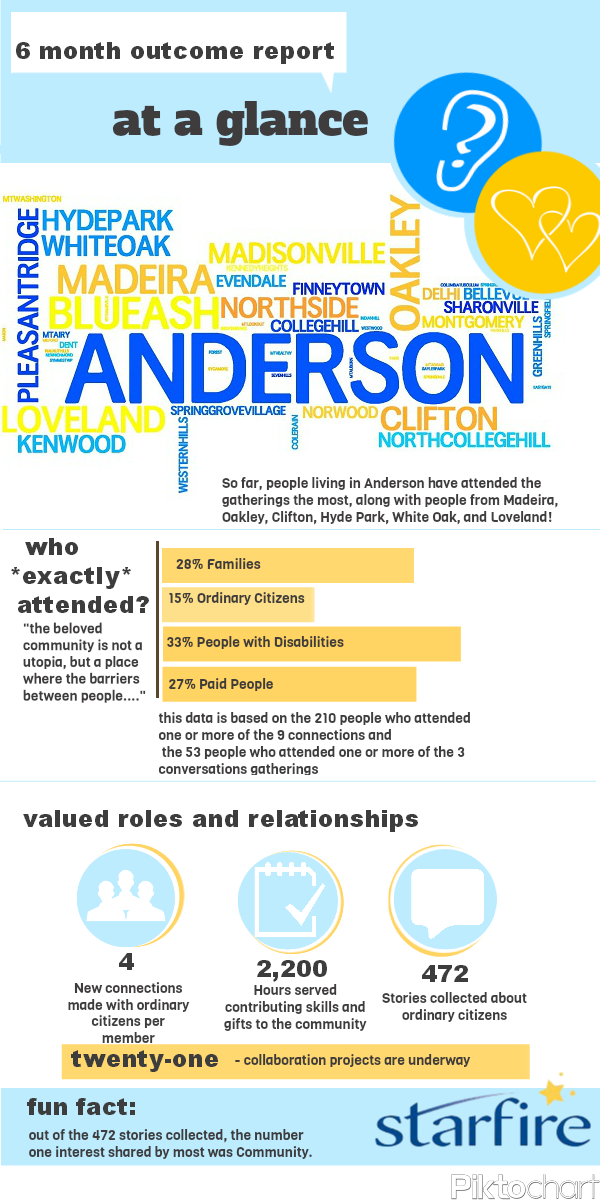
Below is a fancy infograph of our last 6 months of outcomes as an organization.

Try to imagine the numbers in a new way. Imagine that these numbers can breathe. Imagine they have a smile, a shoulder to lean on, a twinkle in their eye enticing you. Imagine they are as familiar to read as your best friend, as honest as your grandmother, as unique as the snowflake. Sit down with them, heat up a pot of tea, and wait for the numbers to speak to you. Then, listen. Listen as 92 times an infinite number of stories unfold. Stop counting, and see the relationships, the respect, the contributions binding communities together.

All dressed up in their Sunday’s best, they sure do look sharp – especially since they live in an amalgamation of Excel spreadsheets and the too many manila folders on my desk, but remember the true beauty lies behind our fidelity to the stories those graphs and pie charts hold.

Take a look:

timothyvogt
A Wiser Circle

by Annette J. Wick, from Women Writing For a Change (WWFC).  Read during one of WWFC’s readaround

Never, never rest contented with any circle of ideas, but always be certain that a wider one is still possible.” – Pearl Bailley

I sit with these words, alongside the joy of facilitating this circle of writers has brought. I reflect on those words, and say, yes, a wider one is possible.

Many months ago, I was asked to take over our (WWFC) relationship with Starfire, and facilitate writing circles for those young women (and sometimes men) who wanted to pursue the art of writing, and make it more integral to their lives.

Innocently, I told our director, “I’m not used to working with that demographic.” That was the term I naively called some in the audience today. “That demographic.” I had worked with cancer patients, grieving widows and those afflicted with Alzheimer’s. In my own circles, I had sat beside alcoholics and anorexics. And still, I said those words.

I took on that role, at first limiting our group to only Starfire students. We had a healthy circle, with many writing prompts, but still the circle felt empty. Words fell flat, they were not reaching their intended audience. Not because of those who arrived each week, their contribution was solid, but because I was missing a piece to complete this puzzle called a circle.

After that first session, I agreed to open the class to other partners within Women Writing for a Change and the greater writing community. We had two writers sign up. One , a young woman, home-schooled with grandparents in France, and another woman who worked in radio and publicity, immediately connected with our Starfire group. One winter day, I ran into circle members on the streets of OTR, at the Streetcar groundbreaking, and inside Findlay Market. Ironically, it was at that time, my husband and I signed a contract to purchase a home in OTR. Suddenly, we were traveling similar paths.

From there the class transitioned to another group of partners, one of which included my mother-in-law. She had never looked at herself as a writer. But as she attended each session, alongside Starfire members, she began to see herself in a new light, light that was emanating from the courage put forth by the Starfire members, who routinely put down on paper and shared aloud their family woes, lover’s quarrels, dreams of working in film, and desires to be accepted.

This most recent session, we cast an even wider net. Part of Starfire’s mission is to connect with people and places where everyone’s gifts are recognized and valued. More of this mission was being heralded via our partner, Courtney Calhoun, whose wondrous work connected each Starfire member, in some small way, to others in our circle.

To date, coffee has been shared, movies taken in, words have been written together, words have been spoken aloud at open mics. A connection in gardening is still in the works, as is working with children’s authors, and attending senior capstone projects. We have, in a sense, created our own community through hospitality and inclusion, cornerstone practices of both Starfire and Women Writing.

On Monday, I visited Starfire late afternoon, as members were preparing for their return to home. I was greeted with hugs, Tiffany and I discussed our shared discovery that the Great Gatsby film starred her favorite Bollywood actor. I ran into Vonceil, a student from a past circle, and she excitedly talked about her capstone involving Spoken Word poetry. That day, I happen to notice that a local coffeeshop was showing a film, based on a high school spoken word contest – The Loudest Bomb. I jotted down the information for Vonciel, and promised to see her perform soon. Lauren peeked her head out a meeting, to just say, “Hi.” Margot greeted me with a hug, and noted my sling from surgery was gone. And of course, Michelle waited patiently, as I greeted many of her peers, before we set out on our own quest for the West Side. She put up with plenty of my cussing that night….

I revisit my words, “that demographic,” one more time and realize I too am differently-abled, perhaps smaller minded that my partners at Starfire. For they take on each attempt at connection, each writing prompt with zeal and truthfulness. They find the connection, they include me. It is NOT the other way around.

I have learned much in our time together. The question of being intentionally inclusive rises up in me each time I am also with the Alzheimer’s population. I practice it within my writing circles with them. I practice it with my own mother and her companions at her care center. But the rewards don’t come first, understanding does.

In a recent writing session at the Alois Alzheimer Center, I was using a Christmas theme. Stockings lay on the tables, a few Santa figures loomed at each end. Christmas carols were sung, memories were written down. In the tradition of Women Writing for a Change soul cards, I close even that circle, where they can’t recall the words just written, and ask, “How did you feel being in the circle here today?” Some answer, “It was really nice.” Some repeat the theme shared in their writing. But Doris, one of our newer members, said it best, “It was good to be together today.”

In light of recent tragedies and stressful circumstances in each of our lives, it is possible to come together in comfort and joy, and connection and courage. But it is NOT possible to do so without the intentional creation of circles that support our work, our lives.

The quote at the top of page is incomplete. “Never rest contented…be certain there is a wider circle.…” I would also add, a wiser one.

timothyvogt
A Cheat Sheet

A Cheat Sheet

Posted on February 26, 2013 by Candice Jones Peelman

I thought it might be helpful to break down a few terms and words that get used a lot in our learning, our conversation and connection gatherings, and other places.   They sometimes seem hokey, or overused, or code words for something else.

But if you lean in real close, I’m going to whisper you a secret.

All these words, they’re pretty average, nothing too kooky, I promise.  Trust me, I don’t do hokey.

And these words don’t mean anything sneaky, or tricky, or strange and they don’t lead to burning incense or kumbaya sing-a-longs, unless you want them to.  (I’ve only twice attended something where incense was used… and both times were with Canadians in CANADA for Pete’s sake!)

And if you don’t get tied up in the sometimes “weirdness” of these words, and if you give up the fact that no one really cares if you’re cool or not, you’ll get a lot out of showing up and letting go of the “cheese” factor sometimes associated with them.

So let’s review some vocabulary, shall we?

Words

5VE or the Five Valued Experiences — Dr. John O’Brien’s work outlining a good life (see “good life” definition) the 5VE or Five Valued Experiences include: experiencing respect, making contributions, making choices, sharing ordinary places, and growing in relationships
“Starfire bases its work on the Five Valued Experiences.”

authentic  — don’t fake it.  Be honest.  Say what you know.
“When you answer, be authentic with your response.”

circle  — people who support you in your life; may include family members, friends, paid staff, and people you know you in various roles.  Circles may also advocate on behalf of the person’s best interest in times of difficulty.  Circles can be built intentionally [see intentional definition], and they can occur naturally.
“Andrew and his circle are going out to dinner this Thursday to celebrate his 25th birthday.”

community — 1. literally, a group of people; A group of people who care about a greater good of inclusion, where people are recognized by their gifts and talents as opposed to labels;  2. the city of Cincinnati, or your specific neighborhood.
1. “We want the collaboration projects to bring together a community around Kasey and work on the kindness project together.”
2. “We want to host the Brew Review close to or in Michael’s community.”

connect — 1. find time to talk about something another person knows about and see what happens after that 2. find others who have things in common with us or bring together other people who we’ve met that have things in common and see what happens after that
1. “I’d love to connect with you, Craig, about the best laptop I should look into buying.”
2. “Katie, I need to connect you to my friend, Cal.  He makes short films and would be interested in helping with editing some of these videos.”

good life — different for each person depending on interests, passions [see interests, passions definition] but includes a variety of ordinary citizens, family, and friends and one in which a person can live the Five Valued Experiences through meaningful ways
“We’re going to host a PATH to talk about what a good life looks like with Ari.”  [see PATH, circle definition]

harvest — bring it back to everyone else
“Alright, everybody!  Let’s go ahead and harvest what was said and heard.”

invitation — 1. an opportunity to get deeper, if you want.  2. Sometimes literally, an invitation to RSVP to attend an event.  We’d like you there, but it’s your choice.  We’ll probably keep inviting you, though, to lots of different things, based on your passions, skills and interests. [see passions, skills and interest definition]
“We’re making an invitation to Joe’s committee to spend time with him outside of the history project, too.” 
“I’m sending you an invitation to the Final Four Flyaway let me know if you want to go with me again this year!”

intentional — do it on purpose, have a reason for it, and mean it.
“Inviting Master Korchak to Kyle’s PATH was intentional.  We needed a martial arts expert in the room.” [see PATH definition]

interests

interests–stuff you like or like the idea of; things you find interesting 
“What kind of interests do you have?”
Ex: motorcycles, abstract art, antiques, couture fashion

ordinary places— places that are not separate, segregation-based, specific to disability, or exclusionary
Ex: a community recreation center fitness class instead of a disability fitness group
“We’re looking for ordinary places where Michelle could share the community journals.”

Ari & her PATH, January 2013

PATH — a visual, future-mapping conversation where people and their circles discuss what is most positive and possible with and for the person of focus
“In my PATH I talked about wanting to move out and learning how to build things with my hands like bookshelves and chairs.”

passions — things you feel strongly about or stuff you love
“So, what are some of your passions?” or “What are you passionate about?”
Ex: literacy, LGBTQ rights, inclusion, veteran affairs

people you know the least — people don’t know well or at all.  Having to introduce yourself is preferred
“Sit with people you know the least.”
Ex: not your significant other or best friend

skills — stuff you’re good at, things you can do.
“What unique skills do you have?”
Ex: web design, grant writing, cooking, hair braiding

small group — less than 5 people makes up a small group. 4 is preferable.
“Let’s break up into small groups.”

SRV or Social Role Valorization — big stuff here.  In a really oversimplified definition SRV is about how someone can be seen as different and that difference is seen in a negative way; It also talks about what not to do, how to bend over backwards to make sure labeled people aren’t seen as criminal, holy innocents, forever children, burdensome, objects of pity.  (For more info google “social role valorization.” There are a ton of scholarly articles written about it.  If you’d like to attend a Starfire discussion on SRV, drop a line in the comment section and we’ll keep you posted on the next one we host, usually every August.)
“I went to an SRV training a few weeks ago and it really has me thinking about how some people we know still talk to Sarah like she’s 8.  She turned 31 last January!  She not a little girl anymore.”

valued role — things that give us status; positive roles that we can be known by, roles that others hold in high regard 
Ex: Mom, uncle, coach, assistant teacher, musician, chef, event planner, writer,
“Margot has a valued role at Interfaith Hospitality Network where she works with the after-school program.”

Now that we’ve covered some of the words used, let’s work on mastering the vocabulary.  I know you can do this!

Mastering Vocabulary:

“This is your invitation to be authentic with a small group about the questions you have right now.”

Translation: If you want, get in a group with 4 or so people, talk about what you know, honestly about any questions you’re thinking.

“At Zak’s PATH we talked about finding ordinary places in his community where he might be able to connect to train enthusiasts.”

Translation: In the neighborhood of Mack, where Zak lives, we want to find where train enthusiasts meet that are not segregated places specifically designed for people with disabilities who like trains.

“DaMarr just hosted a community event where he connected to other people interested in Zumba.  It was a great to see all of the Five Valued Experiences working at once.”

Translation: DaMarr planned an event open to a bunch of people where he met people who also liked Zumba.  While there, he was respected by leading two Zumba dances, met some new people with those who attended, gave back to his neighborhood by opening it up to whomever wanted to attend and had it at a recreation center instead of Starfire.  He got to make choices as to what day it would take place on, who to send it to, and what songs he would like to lead.

Other “Oddities” You Should Know:

What’s with the name tags?
We want you to know people’s names.  And we want to remember yours.  There are a lot of people in Cincinnati.  Let’s give each other a break if we don’t always remember.  No one likes that uncomfortable “Hey…(elongated pause)…you!!” when you see someone you should know but draw a blank on their name.

name tag.

What’s with the markers?  Why is she drawing?
Listening is sometimes hard.  By giving visuals, people can see what was said.  Pictures  give life to the conversation, and not everyone can read.

markers.

Why do you care what neighborhood I live in?
Because place is important to all of us.  If you live in Harrison, you probably don’t care too much about what Loveland is up to.  Also, if you live in Mt. Healthy and sit in a small group with someone else from Mt. Healthy, you’ll be excited that you have that in common
and who knows where that conversation can go from there.

Sure this seems like a long list to learn.  But it’s not really.  We already know what these words mean.  You know what “authentic” means.  You know what small + group means.  This is just a cheat sheet to make showing up to Gatherings and hearing this stuff feel a little less weird.

And we’ll never burn incense, I promise.  Unless you intentionally ask me over to your community to do so as we connect over authentic conversations where we harvest ourinterests, skills, passions, and we sit in a small group and find out what a good life means for you.

I’ll wait for that invitation, though.  Until then, I’ll see you at the next Gathering.  I’ll be the one wearing a name tag.

: )

timothyvogt
Case Files & Memories

“I hope, wherever you come from,
there is someone who holds your story.
Someone who remembers you when you
were knee-high to a grasshopper.” –david pitonyak

Who Holds Your Story is probably one of my most favorite articles to share with people who have asked to volunteer, or asked for a guest speaker from Starfire, or asked for a facilitator for an upcoming “service week.”  In small groups, people read the first few pages aloud and then we’ll talk about case files vs. memories, stories vs. data, and how people’s identities often get lost in service systems.  I always ask for the names of some of the locations they’ll be volunteering and I’ll get the same responses Drop-Inn Center, Tender Mercies, Starfire, YWCA, nursing homes, soup kitchens, Boys and Girl’s Club.

All are great organizations here in Cincinnati.  And then I just say it– the labels associated with those places, the so-called “types of people” they’ll “encounter” instead of meet:

The Poor.                The Homeless.              The Disabled.              The Elderly.
Felons.              Addicts.            At-Risk.             Illiterate.             Low-income.

Most recently, I talked with a group of high school girls at Mercy High School on the Westside of Cincinnati.  “These are words we’d never use to describe ourselves, our families, or our best friends” I told them.  And some nodded, understanding how the story we’d just read together applied to their week of service coming up.  I talked about how they likely had a case file on them in their school, and that it probably didn’t say much beyond vaccinations, test scores, emergency contact info, and disciplinary actions.

I explained that at each of the service sites they’d visit, it’s likely that people will have a case file there, too.  A place where official notes and documentation are kept. I explained that case files are helpful, especially to staff people like myself who need information about how to contact family in an emergency, or if someone is allergic to peanuts, but it doesn’t tell someone’s real story, and it doesn’t honor where they came from.

Case files keep track of clients and data.  But they don’t tell people’s stories.  There’s a difference between being known by what’s in your file, and being known as a person.

This is a story about being known as a person.  About someone being remembered from when they were “knee-high to a grasshopper,” a story about two people who continue to hold each others’ story, and hold the story of the person who bonded them together.

Margot and Kathy met up a few weeks ago at a local coffee show to talk deeper about the 3Cs, Margot’s PATH goals, and Margot’s life.  I was there to help Kathy, an old friend of Margot’s family, learn a little more about what Margot is working towards (aquatic instructor certification, life-guarding, childcare, taking the Metro bus around town, looking for another job besides Kroger, and in explaining 51 People and the importance of other unpaid citizens and friends in Margot’s life.)

As I understand it, Kathy has known Margot since she was a little girl.  She was one of her mom’s best friend, and has stayed in Margot’s (and her siblings’) lives since her mother passed away in 2010.  She attended Margot’s PATH and has a love for her that is obvious, even in a brief coffee meeting.

Margot’s PATH, 2012

The two shared stories of inside jokes from different functions they’d attended over the years, how Margot’s siblings we’re doing, and then conversation trailed to cats and kittens, and Margot’s childhood home where she lived with her mom and brother and sister before she passed away.

“11 cats” Margot corrected.

“You never had 11 cats!  When?” Kathy laughed.

“Yeah huh!  Bella. She had kittens, Kathy! So we did for a little bit.”

“Always kids and animals” Kathy smiled, and told of Margot’s house with her sister and brother, and her mom.  For a moment the two shared a laugh about the cats, and reminisced about “old times.”

I explained the importance of Margot not doing things alone, about needing good people, people who like the same things, too.  I explained that paid staff were often good people, but often transient, and whose jobs were to keep people safe, fed, healthy, housed, but not often did their role include to help people to have friends, find friends who were ordinary citizens, make connections in their neighborhood, or know what was most important to a person.  We talked more about paid staff, answering questions, talking about home staff vs. day program staff, and shedding light on how systems work with and for someone’s life.

It wasn’t a paid staff’s job to keep memories, to remember kids and a house full of cats, or even stories about Margot’s mother.

It took a few honest conversations that day (and previously in conversations with Courtney, a co-worker of mine) with Kathy to help her get to this point.  Kathy assumed that because Margot has paid staff that she will be safe, fed, healthy, housed.  And she was partially right.  That is what paid staff do, and most do it very well.  Margot will likely never be hungry, without medical attention, or homeless.  However, it wasn’t until we continued to talk about stories, memories, and unpaid friends and citizens, that Kathy understood a little bit more, that while systems will keep her safe, fed, supervised, and housed, they won’t necessarily keep her happy, remember stories, make plans about what’s most positive and possible in life.

“Keep, keeping on… Now I understand.  It’s not just filling up days, but making sure she’s happy, and known.”  We talked more about Margot and Kathy working on a resume together, different volunteer opportunities, about Kathy sending some emails to contacts she has a recreation center and how Courtney and I could help find connections, support the work needed to make good things happen.

“I won’t be around forever, either.”  Kathy said, “We’ve got to meet new people.”  The two talked about plans to volunteer together at spaghetti dinners in order to meet more people and make more connections.

“We could even get a cheap lunch and save our money for pet food. Buy it and volunteer at the pet food pantry– save your coupons, Margot! (laughter).  This could be ‘our thing.'”

“A sad and all too common truth for people who experience developmental disabilities is that little, if anything, is known of their stories. Reams and reams of paperwork are generated each year, but only a fraction of what is generated describes the person’s connection to the world. The file is instead a collection of things that the service system wants — a chronicling of interventions, evaluations, signatures, data points. There is no unfolding of things in these files, no character development, no plot.  It all reads like the fine print on a cough medicine bottle.”  (David Pitonyak)

It felt good to hear Margot and Kathy dream of what could be their “thing” together and making plans, that Margot’s childhood is remembered by Kathy, that her mother, her home, the cats are all memories that someone else knows, and cares about too.  That stories Margot carries about her life are not lost, but in fact cause laughter by others who remember that too, even the details (and number of cats) are remembered a little bit differently.

It felt good that this “meeting” generated no paperwork, no signatures, no interventions or evaluations, that this meeting has nothing to do with her case file, but everything to do with her story, and who she is, and who holds her story.

timothyvogt
GOOD Things Going On Around Cincinnati

Learn how making friends can help you get to work without a car…. How stories coming out of Cincinnati’s 52 neighborhoods about the ordinary people can be more interesting than People magazine… How trying a day filled with random acts of kindness can be a philosophical leap into a life where we realize how interdependent we all are on one another…

Shane Hines recently applied for a contest with GOOD, “a global community of people who give a damn,” in an effort to bring events like these to Cincinnati, where people can learn, play, and explore together. Check out Shane’s contest submission below:

GOOD asked that contestants submit a video, like the one above, then choose 3 themes out of a list they provided and propose an event.  Here’s what Shane and a team of leaders from Starfire came up with:

Transportation…
Our event on transportation would be guided by Joseph Scheets and representatives from Queen City Bikes. With an interactive lesson plan, people would be challenged to learn the bus/bike routes while linking with other people based on shared passions. In the end, participants will be surprised to learn how connecting with people from their local community helps eliminate the need to rely on vehicles for transportation, not just because of carpooling, but because the closer we become to our communities, the less reason we have to drive away to find activities to get involved in. This event would be hosted in the lobby of Union Terminal, Cincinnati’s Amtrak station. People would be challenged to use an alternate form of transportation aside from their cars to arrive at the event. Joseph’s network through last year’s Cincinnati Street Films Festival would help spread the word about the event.

Exploration…
Our event on exploration would be guided by a local appreciative inquiry expert/asset-based development instructor, along with Krista Brinkmeyer (artist from the Cincy Story Mural). At this event, people would break into groups and take off to various areas throughout the 52 neighborhoods of Cincinnati. Every team will have a tour guide, or someone who has grown up in the neighborhood, and will be given the challenge of exploring the positive parts of what each neighborhood has to offer. They will also collect stories from the locals, and bring these back to the group. The group will then reconvene at the end of the event to share what they have learned and any surprises they discovered. This event would be held on Fountain Square right in the heart of downtown Cincinnati. There will be a live Twitter feed as well as a Flickr page set up to load photos from the exploration. Krista’s network from the Cincy Story Mural would help us spread the word.
Neighboring..
Our event on neighboring would be guided by Kasey McCarthy (kindness expert), Meghan Snyder (random acts of kindness guru) from the World Kindness Club, Cincinnati chapter. At this event, people would learn about the power of giving and interdependence through random acts of kindness assigned to teams in the same fashion as a Task Party. This event would be held at Washington Park, located in Over-the-Rhine. Through this event, people will reach out to “strangers” to discover the ties that bind us all as neighbors, citizens, and friends.

We should hear by next month if Shane and Starfire’s application won the contest. Wish us luck!

timothyvogt
The Five Valued Experiences

If you’re familiar with our journey, you know that we’ve had some pretty big learning moments.  One of the most important was when we started learning about Social Role Valorization.

But one of the things I struggled with when I learned about SRV was that it does an excellent job of laying out what not to do, but falls a little short on what to do.  Granted, it says “find valued roles,” and “enhance people’s image.”  But obviously there’s a need for some guidance on action, since people with disabilities are still living the same kinds of lives they lived 20 years ago.

So the question is:  “what should we be doing?”

When I asked her this question, Jo Krippenstapel gave me a copy of this article by John O’Brien:  “What’s Worth Working For?  Leadership For Better Quality Human Services”

In it, John details five valued experiences that help people with disabilities live good lives.  He also details five correlated “service accomplishments” that services/agencies/organizations could strive toward to help people have more of the valued experiences:

It’s a pretty simple place to start, which is why it’s such a brilliant and perfect answer to the question “What should we be doing?”

If we think about our own lives (and the lives of everyone we know) within the context of the Five Valued Experiences, the answer becomes apparent.  And it turns out that it’s not expensive, anyone can do it, and it’s not all that hard to get started:

Sharing Places

Is life better if you have a lot of places that you share with other people?  Of course!  If you only hang out at home and work, you are missing out on church, cafes, parks, town squares, sidewalks, museums, and lots of other places.  These places are vibrant community spaces that anyone can use.  We meet our best friends and future partners at these places.  We take our children to these places to meet up with other children.  These are the places we feel safe and come together as a community or neighborhood.   Jan Gehl, world-renowned architect, argues that shared public spaces are the basis for a thriving, vibrant democracy.  He has examples of totalitarian regimes who started by shutting down town squares to squelch dissent.  Our own constitution guarantees the right to “peaceably assemble.”

Ray Oldenburg talks about “third places” (first= home, second=work) as important places where we meet each other and network on equal footing.  They are essential to building a good life.

But what if you were only allowed to go to places that were designed for people with your same label?  For most people with disabilities, they only get to go to special schools/classrooms, live in special homes, go on special outings, and work in special workshops.  If that were your life, would life be more vibrant or less?  Do they have a better chance at meeting new people or worse?

Take a look at this video:

Joseph cannot drive, but he can ride the bus and he can ride a bike.  It just so happens that every single Thursday, rain or shine, there is a group of people who meet in Northside for the “Slow and Steady Bike Ride,” a bike ride hosted and coordinated by Mobo, the local bicycling co-op to promote cycling for everyone, not just the hardcore spandex wearing pro’s.

Think about the difference between Joseph showing up to ride every Thursday instead of going on a bowling outing with other people with disabilities.  Over time, he develops friendships with other people who love to ride, and that is exactly what has happened.  He gets invited to parties, he gets to hang out for burgers after the ride, and he can go to their bicycle maintenance courses, or ride in a charity ride with them.  The possibilities are endless, especially if he keeps going every week for the rest of his life.

The more that people with disabilities can share common typical space with others, the more they are known for the individual they are, instead of being seen as part of a group of disabled people.

joseph-bike-ride1.jpg
joseph-bike-ride3.jpg
joseph-bike-ride4.jpg

photo courtesy of michael providenti

photo courtesy of michael providenti

photo courtesy of michael providenti

Making Choices

We like to celebrate freedom and individuality in this country, so we know that choicesare important to us:  where to spend time, who to hang out with, what to eat, where to worship, how to spend our life’s work.  It gives us a sense of confidence and let’s us express ourselves.  Would your life be better or worse if other people made choices for you?  If we had a time machine, we could go back and ask our teenage-selves that very question, and I’m sure we’d give our adult-selves a pretty quick answer “I can’t wait to make my own decisions!”  And having a ton of choices doesn’t necessarily mean we’re all good.  Anyone with cable TV will tell you that.  It has to be the right choice.  The personal choice.  The choice with meaning.

For most people with disabilities, their choices are limited by someone else, a parent or guardian, or some paid staff involved in their lives – teachers, counselors, aides, program coordinators, caseworkers, executive directors, etc.  There are degrees of this, of course.  Some people have to do whatever their group home or day program plans for them.  Others get to choose from a variety of outings on a calendar, but even still, those outings have been planned for them.  The Slow and Steady Bike Ride wouldn’t be on that list of outings, for example.

Take a look at this video:

Ashley is in love with cats.  Any cat!  So she connected with Cheryl, who started a business around her own love of cats.  Together, Ashley and Cheryl recruited everyone they knew who shared their love for cats and held the “Party for a Purrr-pose” to fund a “trap, neuter and return” program.  Now, I’ve led somewhere in the neighborhood of 1,000 outings in the past 15 years.  Never once have I led an outing to trap, neuter and return cats.  But these ladies do essentially that like twice a week!

So for Ashley, our calendars and outings were woefully inadequate.  She has found her tribe, so to speak.  And they love her.  They are planning the 2nd Annual Party for a Purrr-pose this spring.  So even our best efforts to provide people with a diverse menu of options fall short of listening to a person’s heart.  When we discover the “pattern” we were made for, it gives us meaning.  It frees us to follow our personal calling, no matter how random or seemingly different it may seem.

ashley1.jpg
cats.jpg
ashley3.jpg

Ashley and fellow trappers

Ashley and Cheryl

Ashley and her commitee and the kids they hosted a “Cat Toy Crafting” series for

Making Contributions

What if you were only seen as a “taker?”  What if your whole life everyone just saw you as someone who they were supposed to help or pity?  We all get a degree of self-worth when we give of ourselves.  Whether it’s satisfaction in a job well-done, doing a favor for a friend or neighbor, or volunteering for some civic function, being a “giver” raises our self-esteem and status in the eyes of others.  It has something to do with reciprocation, fairness, and the give-and-take of connectedness we build our communities and relationships on.

Many people with disabilities are always a “client” or “consumer.”  Someone who is using up tax dollars or the lifeblood of their families.  This means employers don’t see their potential for work.  Neighbors don’t see their potential for friendship.

Watch this video:

And then read this post  and this post about Mike’s contributions to our city and my life.

Mike has a job and is a taxpayer.  He coaches a youth basketball team and has won an award for being such a great influence in the lives of those kids.  And he’s one of my best friends.  He is always there to joke about our rival basketball teams (Me Kentucky, him Indiana), and we hang out…fishing, having some drinks with the guys, wings, whatever.  I should also mention that Mike is an avid volunteer with the Hamilton County Republican Party, but we don’t discuss politics and I refuse to send traffic their way by linking them here.  He will not be happy when he reads this.  Sorry, Mike!

His story is one of connection and contribution in many ways.  People see him as an engaged citizen.  They know his name because he shows up and jumps right in.  We’ve offered outings for Mike and other people with disabilities to volunteer together at non-profits around the city, but as great as those chances are, they are still limited.  When he’s on an outing, Mike isn’t seen as giving his personal talents, he’s seen as part of a group….of people with disabilities.  So the status and appreciation he deserves/gets isn’t assigned to him.  It’s assigned to Starfire.  So we have help Mike be seen for his own unique contributions.  When people appreciate our individual contribution, we are valued.  The world opens up to us.

mike2.jpg
mike3.jpg
mike1.jpg

Mike with his fellow United Way honorees

Mike with his colleagues at GBBN Architects

Mike and Alyson with their team at the “Difference Maker” awards ceremony

Growing in Relationships

Do you have a better life if you have a lot of diverse relationships?  This is not about being an introvert or an extrovert.  We all need some basic relationships, and a few deep ones.  Relationships lead to love, safety, belonging and networks for jobs.

We all have some relationships of circumstance, like those we have with neighbors, co-workers and family, but the really really best ones are those we choose or happen into.  They are based on some sort of shared and freely chosen connection….some kind of affinity or affection for each other.  And we grow into these relationships over time, so they have to be stable and consistent to take root.  And knowing each other changes how we treat each other.  We’re more respectful and kind and patient with people we know than we are with strangers, so there’s something important and transformative about being known.

As we’ve seen for so long, most people with disabilities are limited to relationships of circumstance instead of relationships based on affection.  And often, those “circumstances” are narrowed down to one small aspect of their personhood:  disability.  They only go to school with other people with disabilities, they only hang out with other people with disabilities, they only date other people with disabilities, they only play sports with other people with disabilities, they only work with other people with disabilities and they only live with other people with disabilities.  I heard Tom Kohler once describe these as “relationship ghettoes.”  When we think about it, it brings clarity of purpose, doesn’t it?  We have to work to help people expand their relationships beyond “disability.”

Take a look at this video:

Krista last year was transformed into “KB.”  Notice Aaron, who makes his first appearance at 0:24 giving the rock n’ roll hand signal with Krista.  Krista and he connected through a love of creating organic and underground art.   When they met, they immediately hit it off.  Aaron, a punk rocker who owns his own screenprinting business, started calling her “KB,” and it stuck.  She became “KB” to everyone, and started to be known as an artist and cheerleader for Cincinnati.

At the launch of her project, she asked Aaron to speak.  He seemed shy, but stood up in front of a bar full of Krista’s friends and family and said “KB, you’re awesome.  I’m so excited about this project and no matter what, from now on, you’ve got my heart.” As he spoke that last part, he pounded his chest with his fist.

It was beautiful and showed the potential and power of friendship and reciprocation.   Their playfulness at 0:43 is beautiful….and their pose at the 1:12 mark literally takes my breath away.  It ranks as one of my favorite moments ever. These moments sing out to us “this is what is possible in life when we find each other!”

And this relationship has other benefits as well.  Aaron and Krista work together at his studio every other Monday.  You can imagine the possibilities.

krista2.jpg
krista6.jpg
krista3.jpg
krista1.jpg

the Cincy Story Mural project committee

Krista and her committee

KB and Aaron at DIY printing

Krista and Committee Member Randy with one of the completed murals

Experiencing Respect

Being respected and having dignity are a basic human need.  We often think that our self-worth comes from our possessions – our homes, our cars, our ginormous televisions…But in reality, our self-worth comes from our titles, labels and roles.  We are fathers, mothers, artists, writers, listeners, neighbors, employees, citizens, bread-winners, craftsmen, and a host of other things.

But we all also have our problems and struggles….what if those shortcomings defined our lives?  Would that be a dignified way to live?  Candice said it best in this post:

You could introduce anyone deficit first.  My chronically lazy daughter.  My useless and distant husband.  My clinically depressed sister.  My financially inept cousins. Oh look!  There’s my infertile best friend, and her husband, the one who was fired last week.  Over there is my brother, you know, the one who dropped out of college and impregnated his now ex-girlfriend. There’s my niece, the one who still owes me $200 and never visits family when she’s in town.  There’s the uncle that was addicted to painkillers… you get the point.  None of the absurd examples tell us anything.   Neither does “my mentally disabled daughter.”  I wonder what Betsy cares about, what she’s interested in?  What’s the funniest joke she’s heard in a while?  What was her 16th birthday like?  What’s her style?  I’m really less interested in the fact she has a disability.  It matters, of course, especially to her and her family, but it doesn’t have to be that which defines her–especially if her brother is “the lawyer” and she’s “mentally disabled.”  Brenda said it best once, and I’ll have to paraphrase,  when someone is 50, they’ll still have a disability, but they’ll also have their inner self, things they care about, things they’re proud of, valuable roles, self-esteem.

People who have Down syndrome, or autism, or cerebral palsy, or some other kind of label like that are only known by “disability.”  What’s perceived as being “wrong” about them becomes their identity.  It’s just degrading, plain and simple.  And it’s wrong.  It’s such a small part of who the person actually is.

Ronny decided he wanted to focus in on music, and in particular, drumming.  Through his connections, he met Baoku and the two of them developed an idea to create an original show.  They both had a belief that “hope” was a transformative part in their lives, so they made that the theme of their production.

So “Be Hopeful” was born.  It was contagious and pretty soon it included not only drummers, but horn-players, guitarists and singers.  It grew to include rappers, spoken-word artists and poets.  It drew in Columbian dancers and eventually attracted around 500 people to two showings.

One of the cast members told me a story about him inviting his former professor to come to the show.  The professor showed up and after the show said this:  “When you invited me, I knew it had something to do with someone with a disability.  I didn’t know what to expect.  But this….this is legit.”  This tells us that his expectations and imagination around what would be possible was lowered, simply because he knew a person with a disability was involved in some way.  Somehow, he expected it to be less than “legit.”  He soon learned, as did everyone who saw it, that not only was it legit, but it was one of the coolest things he’s ever experienced, all these different Cincinnatians from all walks of life, expressing hope for the future together.

And his mind wasn’t the only one that was expanded.  The show I saw opened with a poet.  After she read, she said that she had a six-year-old son with cerebral palsy, and that being a part of Ronny’s performance had given her new hope for her son’s future.  Her expectations for her own son’s life were raised.  She will be less likely to settle for the same old boring story around disability the world is perpetuating.

ronny1.jpg
ronny2.jpg

Ronny and Jai All Day, the emcee for Be Hopeful

Be Hopeful cast

OK, all of that is great, but here’s the secret:

While all of what I wrote above is important, the true beauty of the Five Valued Experiences lies in how they interplay with each other!

You can’t make good choices without a lot of trusted relationships to advise and support you.  You can’t be respected unless you can make a contribution others see as valuable.  You can’t build really deep personal relationships without meeting a lot of new people in new places and being respected by them.  And these five valued experiences go on and on like that, criss-crossing and strengthening each other.

Again, this has been written about in many places before, notably by John and his wife Connie Lyle O’Brien.  But I wanted to make sure and emphasize just how important I think this is.

They are the single best framework I’ve come across for how to begin to build a good life for anyone, but especially for people who get labeled “disabled.”

So now that you’ve got the basics, here’s how we used them to launch Starfire on a learning journey:

In the fall of 2010, we held two “Cafe Conversations” each month around one of the Five Valued Experiences.  September was “Sharing Places,” October was “Making Choices,” November was “Making Contributions,” December was “Growing in Relationships” and January of 2011 was “Experiencing Respect.”  Anyone was welcome to attend – staff, families, Board members, volunteers, funders and the community at large.  Jo and Scott Osterfeld alternated facilitating.

We designed each conversation to be about two hours.  We would gather in small groups, and start with a simple question:  “What are some shared places in your life and why are they important?  What would life be like if you didn’t have that shared place?”  People would listen to each other talk and then we would have the groups shout out the wisdom they heard from each other.  They would, of course, say how important all of those things were and give awesome and practical answers that we’d never considered.  It was a powerful demonstration of the common sense of this framework.  Then we’d ask them “How would you help someone share more places?” and they would come up with tons of ideas.

Finally, we would tell them to grab some markers and paper and “imagine it’s 2019.”  We picked 2019 because it was far enough in the future that our imaginations could stretch, but we wouldn’t be in flying cars or on megabuses to Mars by then.  (And we felt a “2020 vision” would eventually become too cliché.)

They’d struggle at first, but eventually came up with some pretty inspiring images of the future.

5ve-and-8sectors.jpg

one of the “visions of 2019”

We combined all of that wisdom into a Prezi, which you can check out here.

Those conversations changed our “organizational conversation.”  We stopped worrying so much about “independence” and “respite” and “peer interaction.”  We started to see that everyone needed these things in their lives, and we started to imagine ourselves in the role of helping foster that spark.  And it wasn’t something handed down from on high by the Board or Executive Director.  It was common sense stuff that everyone had lent their voice to.  It was a “shared vision of a desirable future” as John had written in one of his articles.

The last bit I need to tell you about the Five Valued Experiences is that they’ve become a “job description,” of sorts.  We can tell how good we’re doing by thinking about each of the valued experiences, in turn.

As anyone alive today knows, one of the self-inflicted evils we’ve created is a fetish with measurement.  (I say “evil” and “fetish” half-jokingly, but there’s a bit of truth to it:  will we ever be good enough to live up to the standards we set for ourselves?)

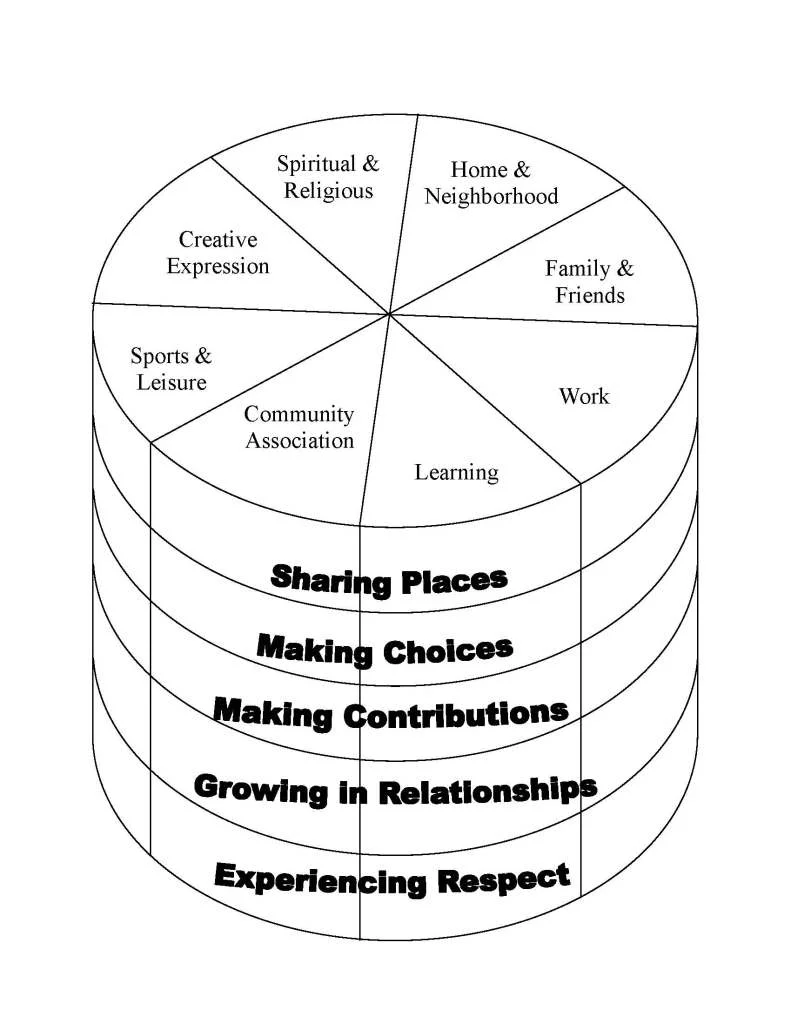
So I set about trying to find something that would measure social roles.  I either stumbled upon or was sent this tool, developed (of course) by John O’Brien.  We studied this and thought it would be beneficial to do a John O’Brien mash-up, so we combined the Five Valued Experiences with these Eight Sectors of Community Life, and came up with this:

xcdfindingmeaning.jpg

It’s not very pretty, but our logic is that if we help people share common places, make choices, make contributions, grow in relationships and experience respect in each of the sectors, we’d be making some significant progress.  It’s way more holistic than this diagram, but it seems to help new staff, in particular, think about small steps to start.

This post could have been called “A love letter to John and Connie and Jo,” but they’d not like that, so I’ll just leave it here, in the conclusion.

xcdfindingmeaning.jpg
timothyvogt
Friendships (BFFs) Exist For Everyone

today’s post is written by contributor Kathleen Cail

photo borrowed from kelle hampton’s blog

Recently I have been “parish shopping.” After living in one community for 17 years, we moved and are looking for a new parish to join. You’d think this would be easy. Aren’t all Catholic churches alike? Well, I’m here to tell you, they are not.

A few weekends ago, a priest at one of these parishes quoted Robert Louis Stevenson in his homily. Little did he know how much meaning that quote had for me.

So long as we love we serve; so long as we are loved by others, I would almost say that we are indispensable; and no man is useless while he has a friend.

In the midst of searching for the “right” parish, this quote reminded me that there are different parishes for people and their various spiritual needs AND that there are different friendships out there for all of us too. This is the more important message, actually.

Over the course of the last year or so, I have had the privilege of listening to parents talk about their hopes and worries for their sons’ and daughters’ social lives. I have been able to share my hopes and fears too. We have all said very similar things–we want our children to have friends but we wonder about their ability to engage in meaningful friendships. The funny thing is that I think if we step back and really look at our definition of ‘meaningful friendship’, it probably reflects that very special and unique “high-value” relationship we have with only one or two people in our lives, but doesn’t include all the looser-friendships we have collected over the course of our lives. Those friendships are no less important. They are just different and fill different roles and needs for us.

I have a couple of friends from high school and college who I rarely see, talk to occasionally, and keep up with through annual Christmas letters and Facebook. I have friends I’ve gotten to know through the years from various experiences we’ve shared at one time, and we run into each other over and over again and enjoy seeing each other and catching up. I have friends with whom I like to catch up, share a few laughs with over drinks or dinner, friends I play tennis with, and other friends—my “B.F.F.s” who I talk with about everything-the good, the bad and the ugly of life. I want to be with some people because they make me laugh, or they share an interest of mine, or I just care about them. That is enough for the friendship to exist. All of these people are important to me because they make my community. They each contribute in some way to make that community and my life vibrant and full, and they help me to feel appreciated, acknowledged, and valued. I do the same for them by being their friend.

All of our children can be appreciated for something that they bring to a relationship—humor, interest, knowledge, kindness, participating in an event or activity, etc. There will be people who they meet who assign a “high-value” to them and most importantly, they will meet one or two people to whom they assign a “high-value.” They will meet people they will call friends and who will call them friends too.

How do we get there though? There are hurdles. First we have to see in our own children those wonderful qualities that other people will enjoy and appreciate. I have to see that people will enjoy my daughter’s humor, and you have to see that people will enjoy your son’s interest & knowledge of basketball, your daughter’s interest in acting, or your son’s interest in movies. We have to appreciate those qualities, nurture them, sell them and BELIEVE that others can see and appreciate them too.

Then comes the big hurdle– taking the chance—taking the risk. Our sons and daughters are no different than anyone else in that they have to put themselves out there. Yes, the difference is that we may have to help facilitate this and we may have to help lead people on the journey with us. It won’t be easy, but someone much wiser than me said nothing worth doing is ever easy. So we start small, and honestly. We introduce our daughters/sons to the social world of our street, block, and neighborhood. We introduce our neighbors to our children and we let them know that our children need and want friendships and that we want and need our friends and neighbors to be in relationship with our children. We ask for friendship—maybe this is more overt than we have had to be, but that is OK too. There will be success and failure, acceptance and rejection. This is no different than any relationship we have all faced.

Just because our sons or daughters don’t really ask questions in conversation, or try to find out about the other person’s interest, doesn’t mean that a friendship can’t happen. Friendship is unique to the individuals involved. It doesn’t have to meet the standards of that rare, high-value friendship that you and I may have with one person. What is important is that through some form of friendship, we serve and are served by one another and “no man is useless while he has a friend.” –and is a friend.

timothyvogt
Sometimes Seeing Is Believing

It’s freezing outside. The wind has picked up the cold air and sent it blasting onto every exposed part of my skin as I make my way across the parking lot from my car into a breakfast spot along a strip of businesses. Diana is waiting inside, eating a cheesy breakfast sandwich and sucking down a pop. I was running late, having mixed up where we were planning to meet and driving across town before realizing I was at the wrong spot. She didn’t mind, she said and offered me a seat.

“People just piled in, it was great,” Diana started. Our plan this morning is to talk about last week’s Connections gathering in Oakley, and so we begin by gasping our breath at the number of people who had showed up that night. Some were expected, others not. Held at the library in one of the back rooms, we were sure that space had never seen so many people. 

I get up to grab a coffee and sandwich.

“Did you walk there that night?” I asked, sitting back down and warming my hands on the paper exterior of my coffee cup.

“I live about a mile away from the library, but it was just too cold and dark to walk,” she said. “So John swung by on his way and got me.”

John is one of Diana’s co-workers. We reminisced about all the stories that came out of the evening, all the gifts we heard that were shared. 

“When I first heard about these gatherings my thought was, ‘I have a boyfriend. I have family and friends. I have a full schedule, why do I need to meet more people?’” Then, speaking in a tone of both affirmation and realization, “I see it now.”

As we spoke, her eyes seemed to open more, filling with new ideas of what her neighborhood was and who was a part of her community.

“Some people who were there I knew, or I had seen before, but I didn’t know they lived around me,” she said. “I sat by Carlos – a person who was born in Guatemala, and I think he lived in Mexico before he moved – to Oakley!” she said, emphasizing “Oakley” as if it were the smallest, most plain-Jane place in the world for Carlos to wind up.

The impression she gave me was that after this Connections gathering in her neighborhood, Oakley is a more interesting place to live for Diana. It’s as if knowing the stories of the people who live nearby, and the gifts they have to offer motivates pride in a person, the kind of pride that gets people involved in maintaining the safety and goodness in another’s life beside our own family, boyfriends, or BFFs. 

“As it turns out, I sat right beside someone I’ve never met before who’s actually writing his thesis on transportation, which is right up my alley,” she said.

Diana is a transportation advocate working for Hamilton County Developmental Disability Services. She has worked to change things like the height of the windows on public transportation to be low enough for people in wheelchairs to see where they are headed, and has campaigned to replace the word “Handicapped Parking” with “Accessible.” 

“Cincinnati’s transportation is moving up slowly. People really need to be part of it,” she said. So who better to sit right next to at the Connections gathering than someone who wants to be a part of the transportation movement in Cincinnati. Last week, the two met up and spoke a time about her advocacy work and his research.

“I think it will widen his audience for his thesis,” she said, noting some concerns she is aware of regarding Access, the public transportation for people with disabilities in addition to her knowledge of the public bus routes. “My friend can drive, and she’ll ask, ‘What time will you be here?’ I have to say, ‘Well, I don’t know.’ Makes you think how easy it is to jump in the car. But for some people who cannot drive, whether it be disability, or they lost their job/insurance…I’ve seen a lot of people ride the bus because of the recent recession. It’s just so easy not to think – I can just go out and do what I want to do.”

I asked her what questions she left the Connections gathering with, what thoughts she was left pondering at the end of the night.

“What do we do with all these stories?” she asked. “It can’t just stop in that one room. Or that one place. I hope people keep coming back, just connecting.”

Notes from a recent Starfire Connections gathering

It helps when you can go somewhere, know a name….Being known=feeling safe. But you don’t go out if you don’t know anyone…

What comes out of the Connections gatherings will be a long, even lifelong effort from people in Cincinnati. It will be years of neighbors, who maybe never even knew they were neighbors, coming together to get to know one another’s gifts, stories, and connect over passions for anything. Trains, bees, bikes, photography, compost, NASCAR, globe trotting, vacuum cleaners, we’ve heard them all. We’ve seen how passion for trains can transform from a hobby you do alone in your basement, to a group of train enthusiasts creating an annual tour of homes who are host to elaborate train sets.

When you connect to others, the world becomes a safer place, and doors open to things that alone are not possible.

My coffee was near the bottom and getting cold, and the draft coming from the window wasn’t helping our cozy conversation last any longer. We stood up to put on our coats, and Diana began layering, first a sweater, then a jacket, scarf, gloves and hat. She lives a block away and walked to meet me. I, on the other hand, put on my too-thin winter coat and looked forward to the heat blasting in my car. 

“You want a ride?” I asked.

“No, I’ve got some errands to run,” she said. So we hugged and departed, she walking down the sidewalk toward the grocery store, and I weaving through the cars in the lot, keys in hand. Both of us silently making the promise to keep showing up to these gatherings, and continue reminding one another about all the gifts our little place in the world has to offer, doing our best to be sure that no one gets left behind.

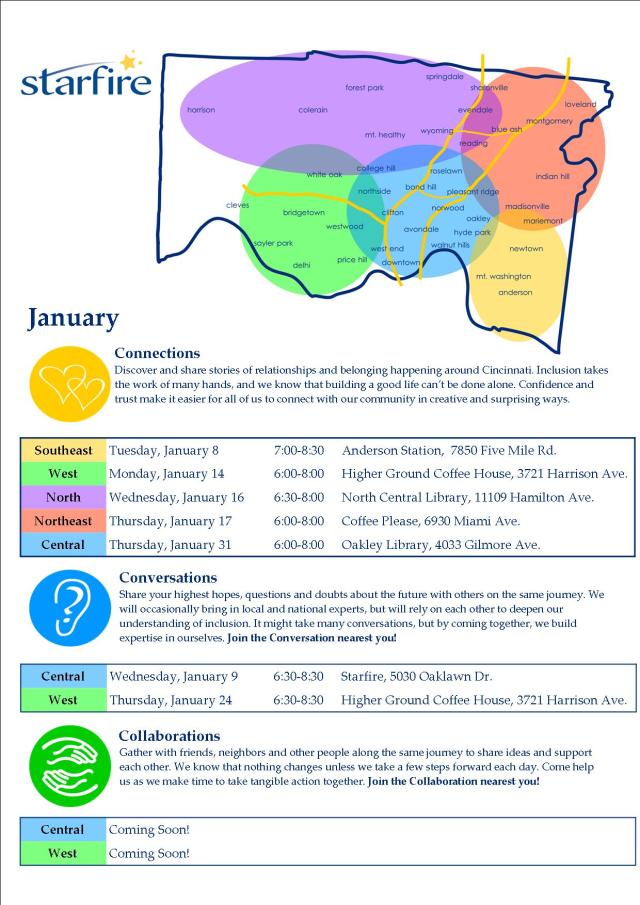
The next Central Connection gatherings will be tomorrow at the Oakley Library starting at 6p, open to anyone interested in being part of their community. Feel free to come with friends, family, and neighbors.

March Connections gatherings:

Tuesday, March 5    7-8:30p   Cherry Grove UMC, 1428 Eight Mile Rd.

Monday, March 11   6:30-8p   Higher Ground Coffee House, 3721 Harrison Ave

Wednesday, March 20  6:30-8p  Bread Basket & Pastry Co.  3218 W. Galbraith Rd.

Thursday, March 21   6:30-8p  European Cafe, 9450 Montgomery Rd.

Thursday, March 28  6:30-8p Oakley Library, 4033 Gilmore Ave.

timothyvogt
Honorees

Each year, Hamilton County Board of DD Services gives out awards at its annual  banquet.  This year, they are giving out nine awards.  Out of the nine awards, people connected to Starfire won five!  Here are their stories:

Kasey

Kasey McCarthy-   Self-Advocacy Award for her Senior Project of promoting grass-roots community kindness.  After a meeting of the minds of her neighbors, friends, and new people, a collaboration project was created centered around the themes of kindness, appreciation, and reaching out to others.  The goal was to do one kindness project per month that incorporates the people she wants to get to know, organizations she is involved in/wants to be involved in, her neighbors, and educating others on the value of kindness.

Kasey has also been written up on a couple local blog posts for her efforts, including the blog of her new friend, Ashley, A Year of Random Kindness.  You can read about their journey from first meeting, to World Kindness Day, to planning for a young girl’s program, to Christmas giving and other kindnesses the two have done together.

Kasey has also been involved in celebrating another recipient of an award: the Mount Notre Dame Youth Philanthropy Council.  MND’s Youth Philanthropy Council has been honored with the Volunteerism Award for their ongoing support of including our friends and neighbors with disabilities.  Since 2010, Mount Notre Dame Youth Philanthropy Council has been partnering with Starfire to include women with disabilities in the opportunity to participate in the philanthropic process.  MND YPC is a group of 70 students who have been given the opportunity to invest $5000 in the Cincinnati non-profit community.

Mount Notre Dame Youth Philanthropy Council

The first year of partnership during 2011-2012 school year, six women from Starfire U participated in the process.  From researching organizations, to presenting, to deciding which local nonprofit received grant money, and participating in the end of the year awards ceremony, six women from Starfire participated alongside the young women at MND.  For the 2012 – 2013 school year, the conversation of inclusion deepened, and the Executive Board of Mount Notre Dame decided to focus on funding organizations that provide a valued role or volunteer opportunity for a person with a disability that is a member of Starfire.   As the young women decide where to grant their monies, they will hear from 21 different Starfire members who are currently working at 21 different non-profit organizations throughout the city.  Kasey holds a valuable role during the process to help mentor the young women’s decisions, as well as provide encouragement and kindness during their process.

By focusing on nonprofits that already include a person with a disability in a valued role, they are helping to raise the status of people with disabilities in Cincinnati, as well as supporting the work of a nonprofit that values their contributions.

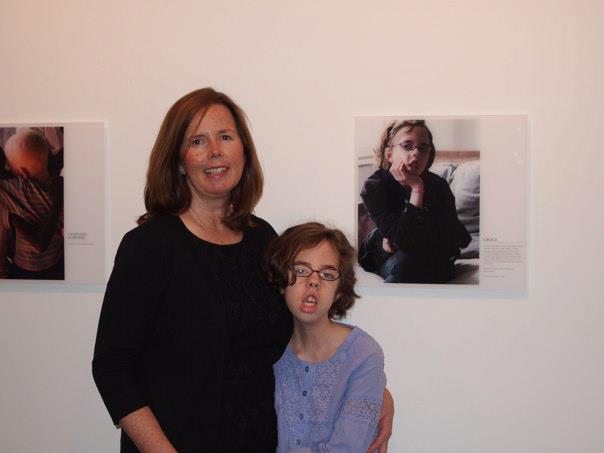
Kathleen Cail, pictured with daughter, Grace at Positive Exposure

Kathleen Cail (mom and new Starfire Board Member) has been honored with the Family Advocate Award for her efforts to promote inclusion and appreciation of beauty in everyone.  Kathleen collaborated with multiple people and organizations to bring Positive Exposure, an exhibit that shows the beauty in people with labels of disability, to Cincinnati in Fall 2011, and continues to help with strategic planning and getting the exhibition and programming into other communities and schools.  She has been a part of the Action Learning Groups that some families are leading, and has supported her daughter, Grace, and son, Ben, as they have launched an inclusive teen group, the Inclusion Seekers.  She has written some powerful blogs about inclusion here on Cincibility about the use of words and their importanceinclusive youth communities, and about chance meetings.

Will Latham (personal caregiver for a Starfire U member) has been honored with the Health Care Professional Award for his excellent work and attitude.  We have all met or seen paid staff that miss the mark, or miss the point completely.  (We’ve known aides that sat outside knitting while they were supposed to be supporting someone, others who play on their cell phone and sit in their car, and still another who sat at another table during lunch even after being invited…)  We know how much it means to see paid staff who really cares about their work.  Will is wonderful, respectful, and is always smiling.  He takes his role as a caregiver very seriously and we are continually impressed with the level of respect he has for those he cares for on a daily basis.

Vonceil

Vonceil Brown is a 4th year member of Starfire U and is being honored with the Speaking Up Award for her Capstone Project helping Cincinnati children and teens find their creative and expressive voice.

Vonceil’s story is one of courage and poetry.  Her confidence on stage when standing in front of a room, along with her lyrical, poetic words have helped changed the perceptions of community members for many years.  This year, Vonceil is taking her spoken word to a much broader scale, and is organizing a city-wide spoken word showcase with Public Allies of Cincinnati, local poet Jori Ann Cotton, and Elementz Hip-Hop.  “Voices of Cincinnati” showcase will tie together Vonceil’s love for kids with spoken word, partnering with 5 local urban high schools including her alma mater, Taft High School.  She will offer poetry and spoken word workshops to help these students express themselves, and empower them to make a difference.  As a poet, Vonceil’s voice is making a difference beyond her disability.

Tim sent out an email sharing these successes today.  Here are his thoughts, which I think speak well of small efforts.

“These are just a few efforts that we can all be proud of.  Vonceil is teaching kids of the next generation that everyone’s voice matters.  The Mt. Notre Dame girls are fully aware of the need for places that welcome people with disabilities.  They’ll carry those lessons with them for the rest of their lives.  The difference Kasey is making is small, but sends a powerful message of “what if we were just a little kinder to each other?”  Kathleen is helping us see the power of families embracing the role of advocates, and Will is highlighting the dignity and value in taking care of someone in a respectful, careful way…these are all people who have made an intentional effort to change the future in a personal way.  I know it’s a hard journey, but just take a moment to think about and appreciate all that we can accomplish together.”

Take a moment to think about and appreciate all that we can accomplish together.Andthese are just the few who are being honored in Hamilton County.  Imagine all the other small, meaningful efforts that are being made each day.

What small efforts have you noticed?  Who is someone you know deserving of being honored for their efforts?

timothyvogt
On Showing Up

My son, Joe and I have been showing up at Starfire’s new 3C’s gatherings lately. We have had some interesting experiences and I want to share them with you. . . .

I have to say, I have had mostly selfish reasons for attending the Connections Gatherings, really.  Sure I wanted to support Starfire’s mission which I thoroughly believe in!  But I also wanted to try and find new people who are interested in History like my son, Joe.  The thought is that these people who share an interest with him, would be good candidates for potential new friends for Joe.  And Joe went along with me because he enjoys social gatherings; and hey, this is all about him anyway – so I thought that he sure needed to be there.  So that is why we started going and that is what I expected to get – which I did, get.  But it strikes me now,  as I now look back over the last few months, how one-dimensional that thinking was.  For now, I realize the quantity and depth of all that I have learned, experienced, and gained from these gatherings – more than I could have ever imagined.  It was one of those You-don’t-know-what-you-are-missing-until-you-go kinda things.  So, let me tell you what you may be missing out on . . .

As a bit of background information:  The Connection Gatherings are monthly regional (5 regions across Cincinnati) gatherings – hosted by Starfire – which are open to anyone who would like to attend.  They are meant to provide a means to connect up with people in one’s own community.  So the idea is to come to the meeting that is closest to your neighborhood, and hear about the people close to you. Starfire’s four interviewers in each region go out into these communities and meet new people.  They learn about peoples’ interests, passions, talents, gifts, personalities, livelihoods, experiences, and dreams. They bring back the stories of four people each month to the Connections gatherings and share these stories.  Other people who attend these gatherings may share stories about people they know or have recently met as well.  Also, there is an opportunity to express one’s own needs such as: “I am looking for a baby sitter”; “I am looking for a good carpenter”; or, “We are looking for people to help out with Joe’s history project”.  That is the basics of what takes place each month.

I began showing up at the Connections gatherings back last year, early in the start-up of these gatherings when there were only 4 to 10 or so people, the majority of which were Starfire staff and Starfire’s newly acquired interviewers.  From these interviewers and the few family members who were there, I heard confusion, uncertainty, doubt.  There was worry about how other citizens might respond to being interviewed:  worries of rejection – and resistance – and distrust.  There was skepticism and confusion about how these efforts could possibly bring two strangers into being friends.  These voices were heard, acknowledged, and discussed – but, not necessarily answered.  Some answers are not easily found.


And yet . . . the troops persevered.  And each month new stories were told about people (average citizens) who were more than happy to share their stories.  There were several who even said, ”Please call me, I’d love  to be involved in this!”  Vibrant stories of fascinating people started rolling in:  Gardeners,  a Health / organic food fanatic, a Pit Bull rescuer, knitters, wrestling enthusiasts, people who love cooking, traveling, competitive knitting (who knew there even was such a thing!), Writers, outdoors men (and women), antique collectors, artists, people who love yoga and throwing backyard BBQ parties.  All these people!  All in my own neighborhood!  All of these gifts, all of this richness is all around us.  All of this fun stuff in life –  the things we all want to do – the stuff we live for / we can’t wait ‘til the weekend for.  It was becoming easy to start to think that maybe one of these people might want to take a fellow enthusiast along to a ballgame or a yoga session or a history event.  Joe was getting excited too.  At one of the gatherings, he heard about a friend of a friend who is a storyteller.  Now who doesn’t like storytellers. “Maybe he could tell stories at my History capstone!”, Joe blurted out.  We went home hopeful that night.

At a one of the larger Conversation gatherings, I was in a small group discussion.  We were sharing our own stories when one member of the group declared himself a sports fanatic.  The conversation was permanently derailed while the four men in my group launched into a rousing discussion of this sport and that / this player and the other.  One of the young men had a difficult time making himself understood.  That was easily overcome within the context of their topic and others were able to guess or decipher his words as he added his two cents toward who was the best ball player.  And on they went. It was as if I wasn’t even there!  But I really didn’t mind – I thoroughly enjoyed watching the shared enthusiasm and camaraderie as ‘those disabled’ and ‘those not’ simply became ‘those who love sports’!  It was not a stretch at all to imagine these men enjoying a game together at a ball field or at the neighborhood bar.

All along, in each of the meetings, I witnessed other sparks of potential connections as the names of people who shared particular interests were spoken together and intents to ‘hook them up’ were voiced.  People found leads for baby sitters, potential yoga partners, and invitations to view train displays.  Other people learned of quilting clubs, and crafting groups and men’s luncheons.    It became easier to believe that my Joe could find friends thru these Connections Gatherings.

And then . . . it happened! A Connection!!  Joe and I were at one of the more recent Connections Gatherings on our side of town.  As is the custom, those who were there were broken into small groups to share stories.  Joe was in a different group from me, so I am retelling his story as it was replayed to me afterwards.  Evidently one of the ladies (somewhere close in age to me – AKA ‘older’) in his group asked Joe if he was still in school.  Joe replied, “No, How about you?” She laughed and said that she finished school herself some time ago but that she had went on to become a school teacher.  She had recently retired.  When Joe asked her what kind of teacher she had been.  She replied that she was a history teacher.  “A History Teacher!”, Joe’s jaw dropped.  And from there the two of them began to talk about all the history she knew and all the history Joe knew and Joe’s capstone and (I am sure) lots about the Civil War and Pioneer Cemetery and this famous person and that one.  Reportedly, this exchange was very close to the one I witnessed between the Sports fanatics as the two  of them instantly became two ‘history buffs’.  Only Joe’s story has an even better ending:  The retired history teacher gave Joe her phone number and said, “Give me a call, let’s get together”.  Beautiful – right?

So . . .here are some of the treasures that I have REALLY gotten from these Connections Gatherings:

  • I have learned to leave options open and to leave room for hope.

  • I am reassured to know that, just like me, others struggle with this idea of Connections and yet they push on.  It is OK to feel doubts, uncertainties, and fear.

  • I have found good company to keep as I try to practice this work of helping Joe find friends and build relationships.  Company that offers not only moral support but real, tangible help.

  • I have a new sense of what community is really about and what the real priorities in life are.  I have learned of the beautiful / intriguing / interesting people and past times all around us.  In that, I have learned how valuable it is to take the time to get to know my neighbors and others in my own community. And I am learning how important it is for Joe to spend time in his own community.

  • I have learned the value of tapping into other people’s networks and that with each new person who comes to the table, the number of potential connections grows exponentially. I have come to the realization that this method of connecting to other people helps us reach far beyond our own personal networks of family and friends.

  • I have witnessed time and again, that when two people who are passionate about the same thing come together, disability disappears as common ground prevails.  This notion that passions, gifts, and interests are what bring people together and builds friendships seems more and more believable to me.

  • And, most importantly to me, I have learned that this really could work for my Joe.

I highly encourage you to show up at the Connections Gatherings nearest you – I am confident that you will be glad you did.   Information on dates and times can be found here on Starfire’s web page.

Jan Goings
Neighborhood Storytelling Increases Connections

this is a press release we put out recently about our Connections Gatherings…

What do an MMA fight club, evening sewing group, welder, and early dawn rail yard watcher have in common?  Stories like theirs are being shared at Cincinnati’s new Connections Gatherings throughout the city.  An initiative led by the non-profit Starfire, the Connections Gatherings are open to everyone.

“We’re doing some rebuilding of the old sense of what community is. And what being a neighbor is,” said Lynn Volz, a teacher in Finneytown. “I don’t know why we seem to be so busy.  By taking the time to talk to people face to face I think we’ll find we have so many more similarities than differences we perceived.”

Starfire began the Connections gatherings as a way to help lessen the isolation many people feel today.  People like Volz have been collecting stories from their neighbors and sharing them every month to others who live in the city.

“Traditionally, building community has meant seeking out services.  But this is about seeking out people, and building relationships,” said Sarah Buffie, a Starfire community connector from Northside.

“The more conversations, the more people who go out on their porch and get to know each other, it will open more doors for everyone,” said Volz, a College Hill resident.

Starfire has five regions mapped out across Hamilton County.  Each region holds a monthly Connections Gathering.  On the East side of town, Denny Burger is among the storytellers who is invested in sharing the gifts of his neighborhood.

“It can’t be bad to know more people in your community and to know what their interests are, to be able to reach out to them and have them reach out to you,” said Burger, a recent retiree. “It’s great to have community, we all need it.  It’s like oxygen.”

Burger said after he retired he wanted to get involved with a progressive effort, and thought working as a storyteller at Starfire’s Connections Gatherings was a good fit.

“In reality everyone has gifts and everybody brings something that is meaningful and valuable. So to help people explore and find out what those things are is a very joyful undertaking,” said Burger, Kenwood resident.

The Connections Gatherings are a way to hear stories, and learn new things about people who might be longtime neighbors or friends. Chris Smyth, who lives in Price Hill’s Enright EcoVillage, has invested the past four years to volunteering and working with nonprofits.

“I’ve never heard of an organization investing time and money into people like this. This is not the traditional approach. The harder work is in relationships, it’s harder to stop and chat than to just send an email,” Smyth said, who has a background in music ministry. “You have to really set an intention.”

Smyth said he has set his intention on being more visible in his neighborhood by sitting on his front porch and taking longer walks.

“I put myself out there.  If someone happens to be there to meet – great – if not I am still making room for enough time to have a long chat,” said Smyth, age 26.  “People who come to the Connections Gatherings notice a change, realize it’s worthwhile, and continue coming back.”

You can hear Smyth’s stories, among many others, each month at the Connections Gatherings near you.

Upcoming dates:
1/31/13   Oakley Library (4033 Gilmore Ave.) 6-8PM

2/5/13     Cherry Grove UMC (1428 Eight Mile Rd.) 7:00-8:30PM

2/11/13   Higher Ground Coffee House (3721 Harrison Ave.) 6-8PM

2/20/13   North Central Library (11109 Hamilton Ave.) 6:30-8:00PM

2/21/13   Madeira Municipal Building Community Room (7141 Miami Avenue) 6-8PM
2/28/13    Oakley Library (4033 Gilmore Ave.) 6-8PM

Contact info:  for questions or a full calendar of other regions dates, locations, and times, please contact Candice Jones Peelman at Candice@starfirecouncil.org 513.281.2100 ext. 124. Or go to our google calendar: https://www.google.com/calendar/embed?src=starfire.council%40gmail.com&ctz=America/New_York 

img_3431.jpg
timothyvogt
Being Loved

“The beginning of love is to let those we love be perfectly themselves, and not to twist them to fit our own image. Otherwise we love only the reflection of ourselves we find in them.” — Thomas Merton

We’ve received a few comments about 51 People, and Introversion is not Isolation on the blog and via Facebook about how many people without disabilities have a lonely life as well.  It got me to think about the people in my life and loneliness and how it affects all of us at some point, if we’re honest.  (I still think that the level of isolation is much more profound for people with disabilities, a much deeper divide than people without disabilities, but this isn’t a post to refute who is lonelier.)

I recently had the honor of witnessing a beautiful wedding for two of my best friends, Amy and Collin on Saturday and I’m feeling reflective, sentimental.  There are times when life and love is beautiful with love that is bountiful, evident, and publicly proclaimed in front of family and friends like on Saturday, and then there are times in those difficult and quiet moments where loneliness and darkness creep in, and being loved doesn’t seem so evident.

This dives deeper into the personal than the work we often talk about here, but it’s all relative.  I’ve not changed names here because the story is important, and I’ve tried my best to do so in a respectful way.  The only way I could do that in a respectful is in a letter format.

Our board member, Neal, wrote in his blog post, – “I’ve been very lucky in my life to have friends like you that make being alive a great experience.  Sure, I gripe and groan about the problems I experience but I’m human.  The reality is that with good friends and a supportive wife and family, things work out.  Life ends up pretty good.”

I guess this is a post about how people know you, carry your story, and how your presence, or lack of physical presence in this case, continues to make an impact.  How friends make “being alive a great experience.”  And what happens when you’re no longer alive to those who loved you.

Do you ever wonder how you’ll be known?  What will people think in their heads about you after you’ve gone?  What will they write, months later to public blogs like this?  What sense will others make of your life without your permission?
___________________________

Dear Phil,

It’s probably a weird, morbid thing that Katie’s voicemail is still on my phone.  And also weird that when my iphone was restored back to factory settings a few months ago due to a computer glitch, that I was not as worried about the camera phone pictures of the dogs or Jordan or of the house, the lost calendar for work, or the hundreds of lost contacts, but it was more the realization that perhaps the texts from you would be gone, too.

Gone as inexplicably as you.  There one minute and then just not the next.  A funny thing happened, though.  The pictures, and contacts and calendar and even the texts all came back after a day or so, miraculously.  The same cannot be said about you.  You have not returned.

That was your way, wasn’t it?  Taking off to Texas once, winding up in 20-20 another time, as gone and here as often as you’d like.  A phantom at the table one day and then just not the next.  You had the habit of disappearing for a couple of days, or months, years sometimes, and then resurface better than you’d left us, as if perhaps you were just specter caught out of the side of our eyes.

It’s taken me awhile to realize that this isn’t just another time that you’ve taken off.  And Jordan was right to tell me it was unhealthy to cope that way.  But it’s difficult not to when I know the last text you sent me was “I’ll hit you up when I get back in town again.”  I’ve had to stop myself from hoping you’ll be at a tavern somewhere again maybe 3 years down the road, and we’ll catch up like we did before, and perhaps I’ve just been looking in all the wrong places, looking in the wrong town for you.

Katie asked me to speak at your funeral.  And I did.  She also asked for photos and I couldn’t find any of the ones I was looking for, but I did find a book you gave me on my 18th birthday.  The Perks of Being a Wallflower.  They made a movie based on it recently, maybe you saw it before you died?, but I haven’t seen it yet.  I pretty much wrote your eulogy about what you wrote to me inside the book cover.  It was weird then, and is still now, to use past tense when talking about you.  But it went like this:

“Phil’s sense of humor was impeccable, dry, and ironic.  I apologize, but it was often inappropriate but perfectly timed.  Inside the book he wrote in bright green sharpie on the top of the page ‘You’re 18! You can now buy porn!’  In pen he wrote of our friendship—starting off rocky and developing into something he admired and was grateful for.  He wrote about not being good at these emotional and sentimental things, something we both had in common and struggled with, but wrote ‘Jones, these are the days I’ll look back on and smile.  Much peace and love always.’”  I changed my name since you died, but I kept the Jones.  You still owe us our wedding video.

I remember you stayed with me once when we were 17, maybe for a couple days; maybe it was just one night.  I don’t remember now.  Up in the attic bedroom on 31st you slept in Jenny’s bed, and I slept in mine, while Jenny slept on the couch as a child, making room for you, a much older child.  It was good to wake up and know you weren’t gone again.  We never talked about what that was about.  Why home wasn’t where you wanted to be.  Why fleeing to Texas in your red car, getting locked up in juvie, and sleeping in other people’s beds were better than your own.

For so long I’ve carried the story that it wasn’t my place to ask.  That our story was one of nondisclosure.  But not of nondisclosure to each other, but to ourselves.  It was none of my business; laughter, jokes, and ignoring whatever was going on what was exactly we needed from each other.  I guess in hindsight, we were probably wrong about that.

There are a lot of things we could have done differently.  I texted you twice since you died.  Once, about a week or two after, I had too much to drink and got emotional.  That message sent through to your number and I can only wonder who has your phone and read it.  The other, at Christmas to tell you happy birthday.  That one came back as “message undeliverable.”

The old crew went out for drinks after your funeral.  We hadn’t all been together since high school.   We joked about old stuff, I bought pizza, we drank bourbon and then we all went home.  We will never do it again, though.  I know that.  There was a sadness to the passage of time, knowing at one point, we all loved each other and that wasn’t true anymore.

There was more to the eulogy, Phil, and others spoke, too.  The point I tried to get across was that I was happy to have had the honor of loving someone as ridiculous, giving, creative, and beautiful as you, even for a short time.  You were loved.   I remember your mom whispering in mine and Jordan’s ear at the end of your ceremony “he loved you two so much.  So much.”

In a few months we’re coming up on a year.  I don’t know if you were lonely that night or bored.  I don’t know if it was sadness or fear, or isolation.  Maybe none of those things at all.  I don’t know because we never talked about such things.  I said I couldn’t hang out because of the ½ marathon.  I had to run 12 miles at 8 AM and had already slacked off on training.  We’d catch up another time.  I probably would have done that part differently, too.

Your words in that old book have helped.  Much peace and love always.  The Thomas Merton quote helps, too.  That I let you be perfectly yourself, and didn’t try to twist your image, and you did the honor of doing the same for me.  That loving someone just means, letting them be perfectly themselves. Much peace and love always.

Love,
Jones
_______________________________________________

It’s interesting that the five valued experiences don’t include “being loved.”  I’m sure love falls into the category of growing in relationships, but I’ve been in many where love isn’t present.  It could also be included in experiencing respect, but I tend to agree with Kathy Forte that you can respect someone and not love them.  Sharing ordinary places doesn’t seem to fit, and neither does making contributions or making choices.  I think there’s an absence of love even though I guess all of them could be ways to find love, make others love you, or the means by which you could grow in love.  But being loved is much different.  It’s the reason letters like this one get written, months after death, on a random Monday night that has no real significance.

I’m reminded of an obituary I read of a person who died the same night Phil.  It was about a person with a disability.  I know this, because there was a picture of her and because it said “for over 20 years she was a valued employee of Jackson and Kidd DDS Centers.”  I’m not upset by what was written about her.  It was respectful, and I didn’t know this woman and can’t say if there was more to her story or not.  Her life was defined by 20 years at an adult center.  But it doesn’t tell us anything that sets her apart from the hundreds of other adults with disabilities that have worked there too, and their stories likely read the same.

It said she was “beloved” and had many nieces and nephews.  I’d like to hear more of that story, the story of being beloved.  I hope that somewhere, a friend is writing her a letter, remembering her on this random Monday, too.

“Monday Night” overlooking Oaklawn 1/14/13

Being loved is probably the most valued experience.  It is one in which we all want.  We spend our lives looking for connections to others, planning for babies, and weddings, and funerals.  Gathering our people, collecting them like rare coins or trading cards, searching for deep connectedness.  Some people add value to our collection, a rare find!, one of a kind!, priceless!, while other people move on to the next collector, and the next, and the next.

Who are the people in our lives that hold our story?  Amy and Collin will hold and carry each others’, and part of mine, and part of Jordan’s, and parts of all our friends’s story.  What of the woman who died the same night as my friend?  Who holds her story?  Who holds yours?
Certainly for Phil, I carry his.  And being loved, I’ve learned, is the most valued experience.

timothyvogt
The Space Between Stories

John O’Brien tweeted out this link over the weekend, and I’ve read it multiple times since then.  (I’d encourage you to read his whole post for some of my references to make sense). The author’s words seem to be taken directly from my own skull:

“Sometimes I feel intense nostalgia for the cultural mythology of my youth, a world in which there was nothing wrong with soda pop, in which the Superbowl was important, in which the world’s greatest democracy was bringing democracy to the world, in which science was going to make life better and better. Life made sense.”

We write personally quite a bit here, and it seems in most all of my posts, I’m reflecting on some bygone memory.  You’ll recall my love letter to the Eastside from the past Spring.  Perhaps it’s because, as the author writes, that in the mythical Then of our lives, “life made sense.”  Perhaps that’s so.

What to make of this sense-making?  Did life really make more sense in Then-time, or did we float on in a bubble of the unknown?  I’d argue that it’s probably the latter, at least in my case.  He continues that we thought if we read the newspapers, went to college and stayed away from Bad Things, we’d be pretty much okay, set for life, even.  But soon, as the wisdom of time catches up with all of us, “that story has eroded at an accelerating rate.”

Let’s remember while the story gets eroded about soda pop and Superbowls, that the passage of hours, days, and years often paints our memory with a golden sepia tone.  Someone asked once, we’re the Good Ol’ Days really that Good?  And for whom?

I’ve stayed away from most Bad Things as much as I could, and it seems Bad Things still happen to good people.  And good people still do Bad Things.  And Good Things turn out to be pretty Bad Things, and Bad Things don’t seem so bad sometimes, too.  It’s pretty confusing, this life, even as the story of our mythology, our own revered nostalgia erodes daily, too.

It’s why, I think, change is so hard.  It’s hard here, too with the changes we’ve started to unfold in 2013, and what will continue in 2014, to 2015.   It’s much harder for some than others, likely because their memory, their collection of nostalgia reaches farther back than mine- to a time when we didn’t know what we did now.  Tim writes, “They are my mistakes and they are precious to me.”  But we’re not interested in making the same mistakes.  Connie Lyle O’Brien said in Toronto in one of her small groups that she was interested in “making new mistakes.”  I appreciated her confidence when she said this.

an old logo

So I guess, that’s where we are: the space between stories.  In between new pictures that are yet to be taken, new narratives of who we are and what we’re about, and folders filled with photos and calendars of events from 19 years of fun, our own cultural nostalgia.

We’ve read, we’ve studied, we’ve failed, we’ve remodeled ourselves, we’ve talked, we’ve asked, we’ve questioned, we’ve fought, we’ve cried, and we’ve learned that soda pop, even Diet soda pop, still isn’t really good for you at all, and in the grand scheme of things; that the Superbowl isn’t that important either, metaphorically speaking.  This is about more than fun and games.  It’s why we’ve started creating towards something else while working to dismantle previous visions of what was thought we should be doing.  It’s the space between that old logo, a shiny new one, a vision of white vans, and group outings, to a real vision of life, community, and citizenship.

An Inclusive Cincinnati

Creation and destruction, we’ve learned here, are not isolated incidents.  They don’t operate separate of each other.  So, we’ve created a space where people can show up, share stories, hear stories, talk, be known, laugh, have fun if they want to, get serious if they want to.  It’s an invitation.

This week you can join us tomorrow, Tuesday, January 8th for a Connection Gathering in Southeast Cincinnati (Anderson) and Wednesday, January 9th for a Conversation, here at Starfire in Madisonville and all through 2013 and beyond.

this-week.jpg

Join Us

Sarah recently sent an email about not letting “your worries trump your hopes” when it comes to showing up and trying the new.  That’s our invitation, too.  This isn’t about changing the world, (not yet at least), it’s about changing our own minds about the story we thought we had to buy; the story that told us separate was better, segregated was safer, and people can’t, won’t, shouldn’t, couldn’t…

We’re in between stories right now, and the sacred space of in between Now and Then can only be filled through each other, in simple ways, and “in such moments we discover our humanity. We come to each other’s aid, human to human. We take care of each other.  In such times, we learn who we really are.”

timothyvogt
Introversion is not Isolation

This post is less edited, less meticulously thought over than others I’ve written.  I often try to balance honesty with sensitivity to situations, but this seems too important to put off until the perfect words come to mind.

When I was a child, as many children do, I would hide behind adult legs in the grocery store in order to avoid saying hello to Mrs. So-and-So or Mr. What’shisface.  I’d blush, hide my face away, and eventually be allowed to not say hello, to not come from behind the legs, to shake hands and speak.  And because I never had to talk to Mrs. So-and-So, I never did.
I have never been an extrovert to the extent that I welcome the opportunity to give speeches or facilitate meetings.  It’s something I wrestle with, and I’m committed to working on this discomfort this year, a continuation of last year’s frustrations and anxiety with leading the Connection Gatherings, which I hope are on your calendar for January by now!  True- I’ve been known to sing karaoke or make my friends laugh with a ridiculous joke or story.

Karaoke in Savannah

But, it may come to a surprise to some, that I prefer, really, truly, to not be front and center considering I spend a fair amount of my day talking to people I don’t know, calling, emailing, meeting people I’ve never met before over coffee.  The reality is, whether I prefer to sit at home and read, walk alone and take photographs, or on the rare occasion, stand on stage and belt 4Non Blondes’ “What’s Up?” I still have to live in a world of full of people.

Our Public Ally this year, Andrew, remarked that he’s an introvert, too.  He spent his New Year’s Eve at home watching movies instead of going out.  I’m sure this is true of other introverts.  Choosing to stay in and snuggle up.  But I know that Andrew had the choice to go out if he wanted to.  He could have accepted the invitation and gone to a popular bar to a party a co-worker was hosting in Over-The-Rhine.  He could have called up any of his 1,363 Facebook friends (I checked) of which, I’m sure he has the numbers or emails of at least 25 of them, and made plans, if he wanted to.

Contrast this with “Brittany.”  Brittany is a member of Starfire, and the reason why this post is so important.  Brittany, (whose name has been changed) is quiet.  Like Andrew, she’s an introvert, too.  She enjoys spending her time reading, taking pictures, doing art.  All things that give energy to an introverted person.  All in all, she’s a pretty quiet lady.

Unlike Andrew, Brittany has only 37 Facebook friends (I checked).  Of those 37 friends, 21 are paid employees of Starfire, or former paid employees of Starfire that are no longer connected to Brittany.  13 of those people are other people with disabilities.  All of these 13 people are people she spends time with at Starfire between the hours of 9-3, as part of the Starfire U program.  Only 3 of her Facebook friends are unpaid citizens.  Of those 3, only one could be considered a “friend” or someone who has spent time with Brittany in the past doing things they both enjoy.  The other two are acquaintances she met in passing at an event.

We talk about 51 People so much around here that it almost becomes something that lessens its impact over time.  “51 People” almost becomes like a scene in an iconic horror movie.  You know exactly the part when Anthony Perkins, playing Norman Bates, is going to pull back the curtain on Janet Leigh’s character.  The first time, it’s horrific to see.  Over time, it’s not as scary since already know what’s going to happen.  Sure, it makes you uncomfortable, but you already knew it.

When I think of 51 People, as just a diagram, or just research Jack did in the 90s, it’s not as impactful.  When I attach names that I know and faces that I care about, it’s still horrific, just as scary as the first time that curtain was pulled back.  It never stops being shocking to think of Brittany’s life looking so isolating, lonely, and vastly different than Andrew’s, or mine, or yours.

True loneliness and isolation are vastly different than introversion, introspection, and solitude.  Part of my vows to Jordan when we got married were to respect his need for “space and silence on difficult days.”  Space and silence, of course, are healthy to a relationship, to ones equilibrium, necessary for sanity in a very loud world and often loud mind.  Sometimes, I’ve kept that vow, and sometimes, (recently if I’m being honest) I’ve not learned to stop talking, pressing, asking questions when I should be just be quiet.

My promise of space and silence didn’t mean isolation, though.  It meant, a moment of time to stop, no words when one doesn’t feel like talking, the ability to sit together and just not.  It didn’t mean being remote.  It meant coming back a few minutes, hours later, or even the next day and resuming.

This is very different than Brittany’s life.  I have to wonder:

What happens when space is distance from others, being physically separate, and when silence is the marker of a life alone?

Dorothy Day wrote, “We have all known the long loneliness and we have learned that the only solution is love and that love comes with community.”  As a child, at home, I would perform skits, dance in front of our VHS video camera, sing songs, write stories, make other people read them, play teacher with my sister Jenny and my cousin Courtney.  I loved attention, praise, and accolades.  I loved a crowd.  I was in the choir at Church in grade school not because I wanted to do solos, but because my voice was one of many harmonized and I wanted to be a part of the song, part of the community.  Even as an introvert, I didn’t want to be left out.


Being shy and quiet as child didn’t equate to isolation for me.  I felt comfortable with being a performer at home, because it was met with love from my community, my family.  It didn’t stop me from playing sports and being a part of a team.  I like singing karaoke because my friends already know how bad I am, and it’s entertaining to them, my community.  I can present about our work if asked, because I’m not standing up there alone.  I know that when we talked to TSI people in Toronto, that my community, my co-workers and co-thinkers were there with me, too.  No one has ever said that I shouldn’t be invited or included and used “introvert” as a reason I shouldn’t be around people.

We’ve talked about limited beliefs on here before, I think.  Tim’s written, “How we speak about people reflects on what we believe about them.  And what we believe about them reflects on how we treat them.”  If we think Brittany is shy and quiet and would prefer to be alone, then we believe it’s better to leave Brittany alone because she’s shy and quiet.  If we leave her alone, we never invite her out, or introduce her to others, or attend things she would enjoy.  When we don’t make invitations, introductions, attend things she would enjoy, she never meets people.  And because she never meets people it proves what we thought all along: she wants to be alone.  She should be alone.

Being shy and quiet are great things.  There is wisdom in a voice that speaks up rarely, but powerfully.  One of my favorite moments of the past 5 years here, was when Lauren, an also shy and quiet woman who never would speak up for herself, stood up at our commencement event in June 2012 and gave a speech thanking her mom and dad and friends.

I lean more towards the introversion in big social situations.  I much prefer one on one conversations than big speeches and sweeping presentations but for me, it doesn’t necessarily mean being alone or not invited or not included, or not having friends.  Andrew or I can choose to stay at home and watch a movie.  For Brittany, she’s at risk of not being known, and the sitting at home, alone, is not a choice—it is her reality, and one of which where there’s an opportunity to change.

timothyvogt
Dear Friends...

Every year Starfire sends letters to our friends and community to jump start our end of the year fundraising campaign. Our supporters draft personal letters to send out to their networks as well. Below is a letter written by Neal Schear, a board member who has been with Starfire for 8 years. Stripped of jargon, in plain words, Neal speaks to what so many of us in the day to day have difficulty describing…

Dear friends,

I’ve been very lucky in my life to have friends like you that make  being alive a great experience.  Sure, I gripe and groan about the problems I experience but I’m human.  The reality is that with good friends and a supportive wife and family, things work out.  Life ends up pretty good.

I’ve been on the Board of Trustees of Starfire for the past eight years as their Vice President of Finance.  It’s been an inspiring experience because I’ve learned about myself and the importance of the support of people around me.  I’ve come to realize that I’ve taken for granted that I have friends and that my family is healthy.

Starfire works with adults with disabilities young and old, and their families.  Our goal is to help change their lives by improving their social experience.  After all, we all want the same thing… Better friends.

This year we are starting a new project.  The goal is to create connections between people with disabilities and people without disabilities.  Instead of just entertaining people, we want to engage them, to find common interests among our members and the community.  The goal is to help create new friendships (connections).

We will need your help and your money.  So I’m reaching out.  Your past support has truly been appreciated.

I have no idea what the outcome of this project will be.  I just know it’s needed, and needed now.

 Thank you for your friendship (and support),

     Neal E. Schear, CPA

timothyvogt
My father's house and the Mayan Apocalypse

One of my favorite songs is by Arcade Fire, Windowsill:

“I don’t wanna live in my father’s house no more.” 

This is such a provocative suggestion.

What if we simply decide to move out of the “house” our “fathers” built?  We just have to notice that we want something new, then start to build our new “house” in some small, meaningful, intentional and purposeful way.

I don’t want to live in a house where my brother and his partner are shunned by their families or community because of who they are.  I cannot force everyone in America to believe that.  So I make sure to celebrate their marriage and imminent new arrival with them.  And my children were part of their wedding.  We’re building a new house of love and acceptance.

I don’t want to live in a house where I don’t know my neighbors, but I know the names of people who are on reality television.  Bitching about the state of TV won’t do much good.  So I never pass up a chance to hold a conversation, meet someone new or accept an invitation.  I’m helping build a new house of connectedness and tangible relationships.

I don’t want to live in a house where money and wealth drive elections and decisions, creating cynical spaces between people.  Becoming St. Francis or Siddhartha doesn’t sound like a solution (or much fun).  So I follow Wendell Berry’s advice and try to live in a more thoughtful, responsible way.  I’m building a sustainable house that doesn’t need annual 3% increases to survive and therefore, doesn’t have to sell its soul.

And I don’t want to live in a house where we separate each other into winners and losers, forcing people to live ostracized lives of various violence.  But railing against “the system” seems useless to me.  And acquiescing is boring.  So instead, I start by making my own life more inclusive in personal ways.  I use whatever influence I have to support innovation and help people plant the seeds of the future.  I am slowly constructing a new house built on a DIY-open-source and convivial foundation where anyone can join in at any point, and do anything that fits their fancy.

The beauty of this is that it gives me a great deal of power over the daunting circumstances that want to lock me into the present.  These obstacles disintegrate once I take those first doable steps.  And it places the responsibility for change squarely on my own shoulders, where it belongs and feels comfortable.

All of this relates to our work at Starfire.  We’ve gone through some pretty big changes in the last few years, and we’ll be going through more changes over the next few years.  We announced to the public two weeks ago that the outings we’ve offered for the past 20 years are ending in 2014.  You can imagine the emails and voicemails I’m getting.  But we also announced the creation of our new gatherings, which we’ve been piloting for six months and so far, are really something that I think will be more meaningful in people’s lives, and more effective in ushering in more inclusion in the world.  They give us new ways to step boldly into the future.

This is why I’m so jazzed about this Mayan Apocalypse thing.  First of all, it’s great for ridiculous jokes about putting off work, buying $18,000 works of art on credit cards and warning Bridget that she’d better appreciate me a little more in our precious last seconds together.

But more importantly, it’s just going to be great.

I should clarify…I don’t plan on any fiery deaths or cataclysmic judgment from on high.  But I do plan on this world ending…as it is…and that’s a not a bad thing.

You see, I take a more personal view of doomsday.  No one knows the hour.  That’s true.  In fact, the “end of the world” occurs for about 154,000 people around the world every single day.  Their world ended and none of them knew the hour.

So I get excited about how this world will end.  And I get most excited thinking about ways I can actively bring about the end of this world.  And I don’t mean this in a “nuclear bomb” or a “takemycountrybackshoveitdowntheirthroat” kinda way.  I mean in a personal “build the house you wanna live in” way.

While it’s tough on us all to go through this “end of the world” or leave those comfortable houses our fathers and mothers built for us, the call is there.  We must act.

The Mayans were right.  The world will end tomorrow, in millions of unnoticeable and unsung ways, and it will end the next day….and the day after that…and the day after that…And each day it will be built anew by our actions and decisions.  I love the sounds of all that construction.

timothyvogt
The Endless Immensity of the Sea

“If you want to build a ship, don’t drum up people to collect wood and don’t assign them tasks and work, but rather teach them to long for the endless immensity of the sea.”
– Antoine de Saint Exupéry

After the fourth or so night of collaboration planning, a Facebook friend posted the Saint Exupéry quote and it leaped out to me.

Capstone projects were dreamed up over coffee and conversation one afternoon while I met with Jo Krippenstapel and asked big questions.  What does the last year of Starfire U hold for people?  What honors people’s gifts, time, years spent learning and growing?  I’ve kept the notes, pinned above my desk from that day in January of 2011.  The notes shaped the basis of what capstones would become the first year and what could be possible for all people.

Blank canvas: do what’s most positive & possible

4th year is a blank canvas, build from 5 Valued Experiences

However, in the beauty of all the capstones that were worked on, completed, celebrated last year (all of which you can view here) the ideas/projects were decided before people were invited in.  One of the notes I took with my meeting with Jo was the snippet below:

img_0941.jpg

people intentionally invited

People intentionally invited.  So this year, Sarah came up with a beautiful format that intentionally invited people to dream, build projects with us before we decided what the projects were.

Over the course of six evenings, each of the 22 seniors invited in neighbors, friends, family, people we had met previously to come together and plan.  What we were planning for was to get connected to our neighborhood with keeping in mind each person’s interests and passions as our theme.  What were capstones, people asked?  What were they for?  We had that answer ready for them.

capstone-picture.jpg

What is a Capstone?

In Sheila’s room, Brandy, Melissa, her dad, mom, sister, two aunts, an uncle, three nieces, two cousins, Abby (Sheila’s connector supporting the project), Abby’s sister, Katie, and their mom all attended.  The group of people were all invited in because they care about Sheila or cared about kids and crafting and event planning.  Together, the group decided with Sheila that they will spend the year planning for “A Princess Ball” a little girl’s event for little girls who love dressing up, arts & crafts, and the finer things in life.

Princess Ball 2013

In Thomas’s room, his mom, Joseph, Dudley, Charlie, and Marvin all came together to discuss music, sound, recording, and events.  Together, they came up with the idea of Thomas bringing together musicians to collaborate on a new Cincinnati-based CD.  Thomas will also collaborate on the CD playing the piano.  The CD isn’t the only thing they planned.  There will also be a CD release party and other opportunities for the group and others who love music to get together and attend jazz nights at the Blue Wisp and other concerts around town.

Melissa’s night included inviting her 5 brothers and sisters, brother-in-law, sister-in-law, Carla, Stephanie, and Danielle, all college students who were interested in the project, Tim, her connector Erin, and neighbor and friend from Sayler Park, Andrea.  Together, with Melissa, they took her interests of kids, cooking, and Sayler Park, and came up with the idea of collaborating with an already existing neighborhood event, but adding something cool to it.  The Sayler Park 5k has been running (no pun intended) for 17 years.  Melissa and her invitees decided that an after-party would be just the thing to bring together neighbors, friends, and celebrate their town.  The 5k benefits the Cincinnati Recreation Center in Sayler Park, where Melissa volunteers with kids on Tuesdays.

img_0862.jpg

Melissa presents with neighbor, Andrea

Kyle’s night included comic enthusiasts and artists who are coming together to write, draw, and publish a brand new comic called “Soul Ninja” and celebrate with a comic release party in Anderson.  The group needed to be interrupted because the planning process was nonstop.  Those in attendance were so excited about the idea that they couldn’t stop the flow of ideas for drawing, story-lines, and characters. Kyle presented the ideas with Joseph and Justin.

Joseph, Kyle, and Justin present “Soul Ninja”

Ashley’s night included inviting in photographers, her family, staff, and others who were interested in supporting her photography gift.  All together, the group decided, that Ashley would take pictures, attend gallery openings, and have her own exhibit in May of 2013.  So far, Ashley has already exhibited her photos at the Emery Theater, and will be a featured artist selling her work at Starfire’s annual ArtAbility next week.

img_0769.jpg

Ashley’s Original Photography

Kasey’s night included volunteers from Crayons to Computers, where she has been a long-time volunteer, neighbors from her street, and Ashley, a woman she met who blogs about kindness regularly.  Together, the group decided that Kasey volunteering and giving love to people is important.  So far, she and others have shared mugs with kind notes and treats to her neighbors and friends who attended her planning night and are working on building a core group of people who love to do random acts of kindness and celebrate the gifts of others.

All told, this year’s capstones will be a bit different than last year.  Instead of “assigning tasks and work” as the quote says, we instead invited people to dream with us first, to long for the endless “immensity of the sea.”  To bring energy and ideas and then work together to narrow down a theme and project that could be done with people.

We aren’t building a ship, but we are building community.  Inviting people in to learn about why sharing places, building relationships, experiencing respect, making contributions, and making choices are so important is the long work.  The collaborative process is much different than delegating tasks.  We are inviting people to come along with us and contribute their gifts too, build community, because they also care about comics/photography/children/neighbors/music.
______
if you’re interested in getting involved in any of the projects written here or curious about the others that aren’t – please contact candice@starfirecouncil.org

timothyvogt
Being Known

Yesterday around 3:30 I was in the front of Starfire’s building and I ran into a woman,” Karen”, who was looking for help navigating the bus schedule. I tried to help her identify which bus to take and she went about her day. I left around 5:45 ready to head for home and as I passed the bus stop near our building I saw Karen standing there, confused. Had she been waiting for over two hours?? I immediately turned around and asked her if she needed a ride. She got in my car and I drove her to the nail salon about 3 miles down the road….

What does it mean to be known?

I’ve been looped into dialogues about this kind of question several times over the years but more so in an esoteric sense. Now I ask it to myself in an effort to find a way to communicate to others about the why around our work through Starfire.

I get equally impassioned and frustrated in the conversation about why we do what we do.
We connect people based on their passions and interests rather than their deficiencies or disabilities.

We know in the deepest sense of ourselves that knowing people, labeling people, based on what inherently sucks about them does not create community- no one introduces me as “oh you gotta meet my friend Sarah! She’s sabotaged every romantic relationship she’s been in based on her inability to overcome her destructive patterns!” ….That would be insane!! Who would want to get to know me deeper?? However, our society does this, everyday, with people who have the label of disability. “My brother has Down Syndrome- you should meet him because you work with people like him!” First of all, I work with people who like gardening, basketball, cooking, Indian Culture and Bollywood films, writing, researching, meeting new people, working with their hands, and on and on the list goes. Second, yes, I’d love to “meet your brother.” I’d love to meet him and find out what he loves and what he cares about and then I’m going to work my ass off to find the other people and places who love and care about the same things. It is at this intersection that a seed of connection can be planted. A seed that if watered by friends, family members and paid staff, can blossom into a friendship- a natural friendship based on a shared interest.

But, back to Karen. This little story tells me a few things: 1. If I don’t know Karen exists, then I drive past that bus stop and see her as any ole person waiting for the bus and I go on my way. She’s “independent” and she figures it out on her own. 2. If I only know Karen by what she needs or what she can’t do then I’m in a great position to “help” her out. But then the connection stops there. I drop her off at the nail salon and I head home.

Now imagine. Imagine if I know Karen exists, I know where she lives, and I know one or two things about her that she loves/is passionate about/is interested in. If I know her, I now know how to invite her in. Into community life that has actively excluded her for her entire life. Sometimes unintentionally, sometimes systematically- either way, not being given the opportunity to be known by anyone other than your disability and what services you attend is an injustice.

Let’s step outside of disability though. Imagine I know you, the reader. I know you exist, I know where you live, and I know one or two things you love/are passionate about/are interested in. Now I know how to connect you to a world in which you are already a part. I can invite you to a potluck, introduce you to my friends who started Cinciknitti, connect you with a friend who is doing a sweet neighborhood research project that you might want to get involved in!

For some reason this second anecdote seems familiar doesn’t it? It seems natural and normal and what one may simply call the beauty of networking! But the first anecdote- imagining knowing Karen is unnatural, weird, outside of the realm of possibility.

Or is it?

At Starfire we are constantly doing unnatural things to support people in having natural lives. Take a chance with us. Trust us. And next time you find yourself questioning why we’re focusing on making connections and building relationships, try asking my favorite question: Why not!?!?

Jan Goings
The difference between "Can" and "Cannot"

“Starfire tells you: ‘You can do this.’ There’s a big difference between cannot do and can.”

Katie at Eden Park

One of the privileges I have as a researcher storyteller is listening to others tell their story. The only thing to do is listen.  If the story is authentic, if it comes from the heart, it bubbles out like a spring and happily offers itself.

Starfire’s story plays out in different ways, and there are various sides of the story to be told.  But the humble truth is that when people speak about their story of Starfire, it is with a common, binding sincerity, albeit heated, elated or some combination of both.

Perhaps it’s because we’re talking about people’s lives.  That’s about as sincere as it gets. Maybe too because we’re talking about something that a lot of people don’t talk about: inclusion, in the real sense of the word.  It’s not a facade, used to lure funders and supporters.  It’s a constant and sincere effort, felt by many people for the first time.

One of my most recent conversations was with mother and sculptor, Leslie Daly, whose art will be featured at our annual fundraiser ArtAbility (coming up in next week, December 7th!)  She spoke to the experience her daughter, Katie, has had this year as a first year Starfire U member, and what she has always hoped for her daughter. What she said was beautiful.
First, a few things about Katie.  She loves music and acting.  This year she is trying a lot of other pursuits in the Arts, including glass making and sewing.  Said of her seamstress skills by Jessica, who teaches sewing at Starfire U:

“Katie’s so stylish.  She is a bit of a Victorian, I love her. She has a lot of courage in sewing.  She’s conquering a big mountain with the project she is working on now.”

Katie added….

“I came here (Starfire) during the summer.  My brother is in university, and I wanted to do the same, so that I can be an independent woman.  I just want to learn how to get a job in something I love to do, like music and acting… It’s my dream to prove myself to my parents… I love Starfire, I pick my goals, make friends.  It’s really fun here. Everyone loves when they come here, so it makes me want to be here too… I want to become a woman, take responsibility and care of myself, focus on my goals, get married, have kids.  It’s important to focus on goals, when you’re done you might have a job doing your hobbies.”

And her mother told me:

“This is what we have wanted for Katie from the very beginning.  We have tried to make it so that she was given the same things her brothers and sister were, as far as discipline and praise go. We want her to have that as an adult as well, so she can live independently, have a job, be social, be part of her community….It’s important to work with young people and have them become part of bigger community in which they’re going to live.  It’s that full inclusion and immersion into community and society that makes for happier individuals… I think it’s really important that she’s going to that world outside of herself, we all need to be looking at what else is out there, connecting with people outside of our comfort zone…  In the education system, there were so many years where people tell you all the things you cannot do. But Starfire tells you: ‘You can do this.’ There’s a big difference between cannot do and can.”

Have you heard a story told with conviction lately?  What was it?  Who told you?

timothyvogt